

Un paysage d'hiver avec des activités autour d'un village
Paysage hivernal avec activités autour d'un village c1857 par le célèbre peintre hollandais du XIXe siècle Frederik Marinus Kruseman (1816 – 1882), capture une scène par excellence de la vie rurale pendant les mois d'hiver. Le tableau illustre le style romantique, connu pour l'accent mis sur l'émotion, la nature, et le lien humain avec l'environnement. L’utilisation de la lumière par Kruseman, Couleur, et les éléments naturels transmettent un sentiment de tranquillité, tout en célébrant la vie humble des villageois alors qu'ils se livrent à des activités quotidiennes au milieu de la dure beauté de l'hiver.. La composition invite le spectateur dans un monde détaillé et atmosphérique, mettant en valeur l’harmonie entre l’humanité et le paysage environnant.
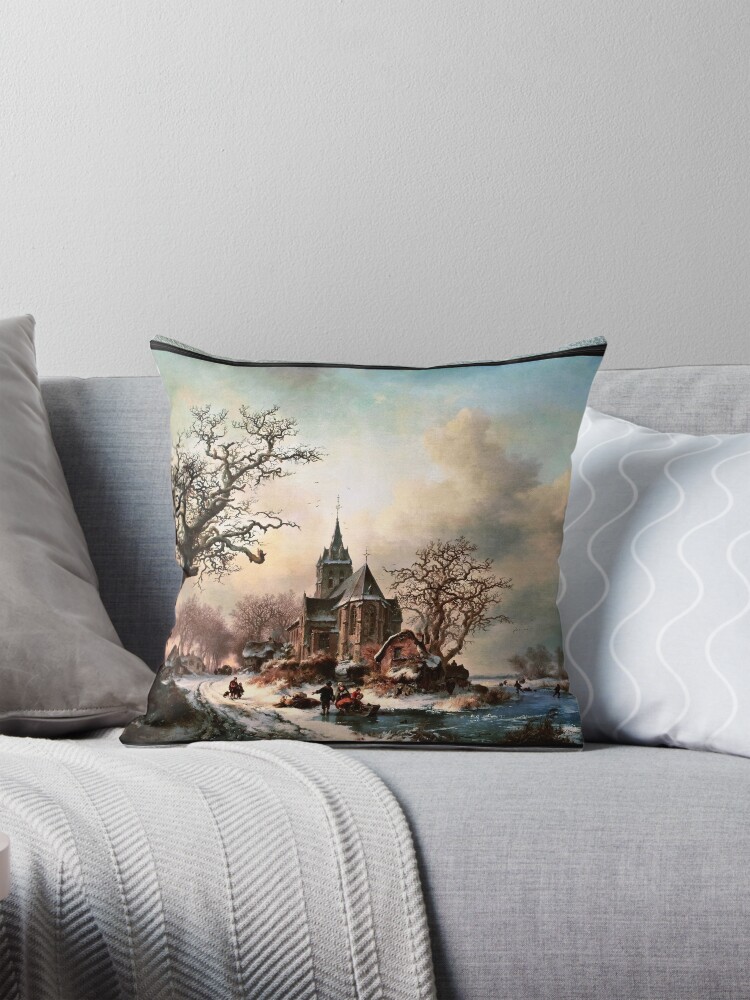
Table des matières
Aperçu et composition de la scène
Dans ce détail paysage d'hiver, le village est au cœur de la composition, entouré de collines légèrement vallonnées recouvertes d'une couche de neige. Le clocher de l'église au loin s'élève sur fond de lumière douce, nuages tourbillonnants, qui suggère l'atmosphère froide mais paisible d'une journée d'hiver. Le bâtiment, probablement l'église du village, est conçu avec une attention particulière aux détails architecturaux, révélateur de l’attachement de l’époque au réalisme. Les chiffres ci-dessous sont présentés en pleine action, capturer la vie quotidienne du village telle qu'elle se déroule au milieu de la neige.
Au premier plan figure une route enneigée qui serpente à travers le village. Un chariot, tiré par un cheval, est entraîné sur cette route, avec quelques personnages qui l'accompagnent. Un homme marche à côté du chariot, peut-être aider à le guider le long du chemin enneigé, tandis qu'une autre personne, peut-être une femme, est assis au sommet du chariot. Cette activité domestique, révélateur des enjeux de la saison, dépeint la nature laborieuse de la vie rurale. Au milieu, on voit un groupe de personnes marchant le long du chemin, emmitouflé dans des manteaux et des chapeaux chauds, ajoutant à la représentation réaliste de la routine hivernale du village.
Thème et humeur
Le thème principal du tableau tourne autour de l'expérience humaine dans la nature., surtout pendant la saison hivernale. La représentation par Kruseman des villageois travaillant et se déplaçant dans la neige évoque un sentiment de persévérance stoïque., caractéristique de la vie rurale au 19ème siècle. Le paysage enneigé, bien que froid et dur, n'est pas présenté comme un obstacle, mais plutôt comme un élément avec lequel les villageois cohabitent dans une harmonie pacifique. Cette image du travail quotidien dans un environnement hivernal à couper le souffle invite à la contemplation sur la résilience et le courage de la vie humaine face aux défis de la nature..
L'ambiance de l'œuvre d'art est à la fois paisible et dynamique, avec Kruseman équilibrant le calme du paysage avec le mouvement des personnages. Le cadre serein de l'hiver, rythmé par l'activité au premier plan, suggère à la fois le calme et le travail. La lumière dans le ciel crée une douce lueur, améliorant le calme de la scène tout en contribuant également à donner une impression de passage éphémère de la journée. Il y a un sentiment délicat de beauté tranquille, évoquant le calme et l'ambiance introspective typiques de l'hiver.
Détails du village et du terrain
Le village représenté est petit mais reconnaissable, avec un accent clair sur l'architecture rurale de l'époque. Les bâtiments, certaines avec des toits de chaume et d'autres avec des façades plus structurées, sont disposés de manière à suggérer la nature soudée de la communauté. L'église, comme le plus haut bâtiment de la composition, agit comme le point focal du village, renforçant son rôle central dans la vie quotidienne et la pratique spirituelle des habitants.
Le terrain entourant le village est dominé par des champs enneigés, arbres au feuillage clairsemé, et des collines lointaines. Les branches des arbres sans feuilles se tordent et se courbent au vent, ajouter une impression de mouvement à la scène autrement statique. La façon dont la neige recouvre le sol et les toits des maisons montre la profondeur de la saison et la lourdeur du froid hivernal.. L'attention particulière portée par Kruseman à la lumière et aux ombres projetées sur la neige donne une impression de profondeur et de texture., soulignant la froideur de la journée. Il y a une interaction entre la terre et le ciel, avec les couleurs du ciel passant d'une douce teinte rosée près de l'horizon à un bleu plus profond au-dessus.
Utilisation des matériaux et style artistique
Le choix de peintures à l'huile de Kruseman permet d'obtenir une texture riche qui donne vie à la scène. L'utilisation de la lumière et de l'ombre est magistrale, car il attire subtilement l'attention sur les surfaces réfléchissantes de la neige et la chaleur des personnages sur le fond frais. Les détails des vêtements des personnages sont finement rendus, mettant en valeur l’habileté de l’artiste à capturer à la fois les textures du tissu et les nuances de la forme humaine. Le coup de pinceau distinct utilisé dans les arbres, les nuages, et la neige, transmet la sensation de mouvement, tout en conservant le sentiment général d'immobilité et de calme qui définit la scène.
Le style romantique se reflète dans l’accent mis par la composition sur la beauté de la nature et le lien entre l’humanité et le paysage.. La représentation du village rural et de ses habitants est à la fois une célébration et un hommage au passé., évoquant un sentiment de nostalgie et de respect pour la simplicité, vie agraire. Il y a une célébration sous-jacente de la beauté tranquille de la nature et de la persistance de la vie au fil des saisons., surtout la rigueur de l'hiver.
Conclusion
Dans Un paysage d'hiver avec des activités autour d'un village, Frederik Marinus Kruseman crée un décor évocateur, représentation intemporelle d'une scène hivernale qui équilibre la sérénité du paysage avec le travail des gens qui l'habitent. Grâce à son rendu soigné des personnages et de l'environnement, il présente une vision de la vie qui, tout en étant ancré dans le contexte spécifique des Pays-Bas ruraux du XIXe siècle, transcende son époque et son lieu. L'artiste nous invite à considérer non seulement le froid et le calme de l'hiver, mais aussi la chaleur de la communauté, persévérance, et connexion avec le monde naturel. Le tableau est à la fois une réflexion tranquille sur les défis de la vie rurale et une célébration de la beauté durable du monde naturel en hiver..
Un paysage d'hiver avec des activités autour d'un village est une reproduction de maîtres anciens d'art numérique retouchée d'une image du domaine public.
Cette création d'art numérique, comme toutes les œuvres d'art disponibles sur le site Web Xzendor7, elles sont disponibles à l'achat en ligne dans une variété de formats de matériaux, y compris des impressions sur toile., impressions acryliques, impressions métalliques, gravures sur bois, impressions encadrées, affiches, et sous forme d'impressions sur toile roulées dans une variété de tailles de 12 pouces à 72 pouces en fonction de la taille de l'œuvre d'art réelle et de la boutique d'impression à la demande auprès de laquelle vous choisissez d'acheter l'art.
L’œuvre d’art est également disponible sur une large gamme de vêtements pour hommes et femmes., tasses, fourre-tout, écharpes, cahiers et journaux et de nombreux produits de décoration intérieure.
À propos de l'artiste
Informations ci-dessous dérivées de Wikipedia.org
Frederik a reçu ses premiers cours de dessin du peintre de natures mortes Jan Reekers (1790 – 1858), qui était à l'époque directeur de l'Académie royale des beaux-arts d'Amsterdam; et qui avait aussi instruit son cousin Jan Adam[ tout en fréquentant une école professionnelle à Haarlem de 1832 à 1833.
Dans 1833 il a ensuite commencé à étudier la peinture avec Dutch Painter, Graveur, Lithographe, Aquarelliste et illustrateur Nicolaas Johannes Roosenboom (1805 – 1880).
Puis dans 1835 il a déménagé à Het Gooi dans le centre des Pays-Bas, où il a suivi des études avancées avec le peintre paysagiste néerlandais Jan van Ravenswaay (1789 – 1869); ainsi que d'étudier pendant une brève période avec le peintre paysagiste et lithographe néerlandais Barend Cornelis Koekkoek (1803 – 1862).
Il est ensuite retourné à Haarlem et de là à Kleve dans le nord-ouest de l'Allemagne où il a peint des paysages, avant de rentrer chez 1839.
Dans 1841 il s'installe à Bruxelles et y reste jusqu'à 1852, sauf pendant une brève période de quelques mois où il se rend à Paris. Dans 1852 il est rentré chez lui à Haarlem et y est resté quatre ans, après quoi il est allé en Belgique, où il resta jusqu'à sa mort en 1882.