

Paysage d'hiver du château avec des patineurs sur une rivière gelée
Paysage d'hiver du château avec des patineurs sur une rivière gelée créé autour 1855 est un paysage hivernal évocateur par Frederik Marinus Kruseman, un peintre hollandais né en 1816 et passant 1882 Krusman, un maître habile à capturer l'essence de la campagne néerlandaise du 19e siècle, est surtout connu pour ses œuvres atmosphériques qui représentent souvent des paysages avec un réalisme saisissant et des représentations détaillées de la nature..
Ce tableau est un exemple typique de la capacité de Kruseman à marier le grandiose avec le quotidien., capturer une scène hivernale sereine qui transmet à la fois la majesté de la nature et la simplicité tranquille de la vie rurale. Son utilisation de la lumière, ombres, et point de vue, avec une palette de couleurs nuancées, offre un aperçu de la beauté sereine de l'hiver hollandais et du lien humain avec la terre au cours de cette saison.
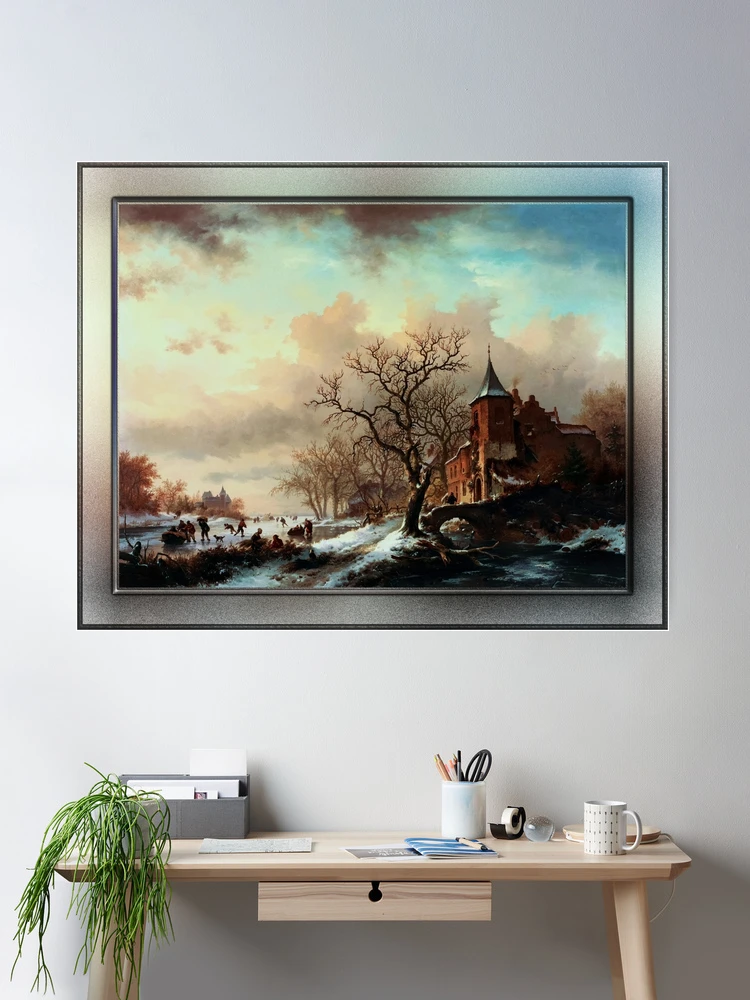
Table des matières
Le réglage et la composition
La composition du tableau se déroule devant nous dans un paysage large et panoramique, avec un accent sur un grand, château presque ancien niché en arrière-plan. L'artiste place habilement la forteresse légèrement décentrée, donnant au spectateur une impression de profondeur et permettant à l'environnement naturel d'interagir harmonieusement avec la structure construite. L'imposant château, sa maçonnerie brute patinée par le temps, se trouve au sommet d'une pente douce, entouré d'arbres stériles qui étendent leurs membres squelettiques vers le ciel, comme pris dans un moment de contemplation tranquille.
Une rivière gelée traverse la moitié inférieure de la toile, sa glace scintille sous un doux, soleil d'hiver diffus. La rivière, recouvert d'une couverture de neige, est le point central de la scène, avec des groupes de personnes patinant et jouant, leurs formes sombres contrastant avec le fond blanc et pâle. Ces patineurs, vêtu d'une tenue simple mais chaleureuse du XIXe siècle, ajouter un élément humain vivant au paysage par ailleurs paisible, créer une interaction dynamique entre les personnages et leur environnement.
Paysage hivernal et effets atmosphériques
Le paysage hivernal de Kruseman n’est pas seulement une représentation de la nature sous une forme statique, mais une ambiance soigneusement construite. La froideur de l'air hivernal est palpable, avec le pinceau délicat de l’artiste capturant la texture du sol enneigé, la netteté du ciel, et la légère brume qui accompagne souvent le froid hivernal. La neige est rendue avec un réalisme remarquable, chaque flocon semble briller d'une netteté glaciale, contrastant avec les tons sourds des arbres et du château environnants.
Le ciel, rempli de nuages doux dans des tons de rose, lavande, et bleu pâle, suggère un début d'après-midi ou une fin de matinée, où la lumière est faible mais suffisamment brillante pour être diffusée longtemps, ombres douces à travers le paysage. L'éclairage d'ambiance de cette pièce accentue non seulement les textures de la neige et de la glace, mais imprègne également la scène d'une ambiance sereine mais mélancolique.. L’interaction de la lumière et de l’ombre dans la peinture est un aspect magistral de la technique de Kruseman., renforçant le sentiment d’immersion du spectateur dans le décor hivernal.
L'élément humain: Les patineurs et la vie quotidienne
Un aspect central du tableau est la présence des patineurs, qui insufflent à la scène vie et vitalité. Plusieurs personnages glissent gracieusement sur la glace, leurs mouvements figés en pleine action, offrant une représentation intemporelle des loisirs d'hiver. Les patineurs apparaissent en petits groupes, certains se livraient à des activités animées telles que se pourchasser, pendant que d'autres font une pause pour se reposer, leur souffle visible dans l'air froid. Ces chiffres, bien que secondaire par rapport au paysage naturel, représentent un élément humain important dans la représentation de la vie rurale par Kruseman. Leurs vêtements sombres, composé principalement de manteaux, foulards, et des chapeaux, contraste fortement avec le blanc de la neige, souligner la résilience humaine face aux rigueurs de l’hiver.
Ces patineurs ajoutent au récit de la vie quotidienne pendant les mois d'hiver aux Pays-Bas du XIXe siècle. Le patinage sur glace était un passe-temps populaire pendant les hivers rigoureux, lorsque les rivières et les canaux gelaient.. Les personnages ne sont pas de simples ajouts à la scène mais contribuent au thème du tableau, l’harmonie entre l’homme et la nature., montrant l'interaction joyeuse avec les éléments.
Éléments architecturaux: Le château et ses environs
Le château, une structure magnifique mais quelque peu sombre, attire l'attention avec ses lignes angulaires et sa haute flèche. Construit dans le style gothique ou Renaissance, sa forme en ruine suggère qu'il a résisté à l'épreuve du temps et aux hivers rigoureux. La présence du château dans le paysage introduit un sens de l'histoire, suggérant que cette région est habitée depuis des siècles. La structure est un témoin silencieux du temps qui passe, tandis que les patineurs ci-dessous rappellent la vie qui continue, malgré le froid et le passage des saisons.
Autour du château, le terrain est parsemé d'arbres qui semblent stériles, leurs branches tordues et nues, signalant la fin de l'automne et l'arrivée complète de l'hiver. Ces arbres, comme le château, contrastent fortement avec les patineurs, qui sont en mouvement. L'immobilité des éléments naturels entourant les figures humaines renforce le sentiment d'un environnement serein., moment presque intemporel, comme pour capturer l'essence éphémère de l'hiver lui-même.
Humeur et thème de l'œuvre d'art
L'ambiance de Paysage d'hiver du château avec des patineurs sur une rivière gelée est celui de la tranquillité, mélangé à un léger sentiment de nostalgie. Il y a une solitude paisible véhiculée à travers les arbres désolés et l'immensité du paysage enneigé.. Encore, il y a aussi une chaleur sous-jacente dans l'activité des patineurs, qui sert de contraste avec la froideur de l'environnement. La scène évoque un sentiment de lien entre l'activité humaine et le monde naturel, où même pendant les saisons les plus froides, la vie continue avec joie et vigueur.
Le thème de l'hiver, à la fois défi et beauté, est au cœur de l'œuvre.. La représentation de Kruseman d’un paysage couvert de neige reflète la rigueur de l’hiver, pourtant les patineurs fournissent un contrepoint optimiste, rappelant au spectateur que même pendant les mois les plus froids, la vie a ses moments de grâce et de vivacité.
Le paysage d'hiver du château avec des patineurs sur une rivière gelée est une reproduction de maîtres anciens d'art numérique retouchée d'une image du domaine public.
Cette création d'art numérique, comme toutes les œuvres d'art disponibles sur le site Web Xzendor7, elles sont disponibles à l'achat en ligne dans une variété de formats de matériaux, y compris des impressions sur toile., impressions acryliques, impressions métalliques, gravures sur bois, impressions encadrées, affiches, et sous forme d'impressions sur toile roulées dans une variété de tailles de 12 pouces à 72 pouces en fonction de la taille de l'œuvre d'art réelle et de la boutique d'impression à la demande auprès de laquelle vous choisissez d'acheter l'art.
L’œuvre d’art est également disponible sur une large gamme de vêtements pour hommes et femmes., tasses, fourre-tout, écharpes, cahiers et journaux et de nombreux produits de décoration intérieure.
À propos de l'artiste
Informations ci-dessous dérivées de Wikipedia.org
Frederik a reçu ses premiers cours de dessin du peintre de natures mortes Jan Reekers (1790 – 1858), qui était à l'époque directeur de l'Académie royale des beaux-arts d'Amsterdam; et qui avait aussi instruit son cousin Jan Adam[ tout en fréquentant une école professionnelle à Haarlem de 1832 à 1833.
Dans 1833 il a ensuite commencé à étudier la peinture avec Dutch Painter, Graveur, Lithographe, Aquarelliste et illustrateur Nicolaas Johannes Roosenboom (1805 – 1880).
Puis dans 1835 il a déménagé à Het Gooi dans le centre des Pays-Bas, où il a suivi des études avancées avec le peintre paysagiste néerlandais Jan van Ravenswaay (1789 – 1869); ainsi que d'étudier pendant une brève période avec le peintre paysagiste et lithographe néerlandais Barend Cornelis Koekkoek (1803 – 1862).
Il est ensuite retourné à Haarlem et de là à Kleve dans le nord-ouest de l'Allemagne où il a peint des paysages, avant de rentrer chez 1839.
Dans 1841 il s'installe à Bruxelles et y reste jusqu'à 1852, sauf pendant une brève période de quelques mois où il se rend à Paris. Dans 1852 il est rentré chez lui à Haarlem et y est resté quatre ans, après quoi il est allé en Belgique, où il resta jusqu'à sa mort en 1882.