

Paysage d'hiver avec les voyageurs
Dans Paysage d'hiver avec des voyageurs près de la porte de la ville, peint par Frederik Marinus Kruseman (1816 – 1882), le spectateur est transporté dans une sereine journée d’hiver au 19ème siècle, où la tranquillité du paysage gelé est rythmé par les déplacements des voyageurs. Cette superbe pièce, datant d'environ 1857, illustre le style du romantisme hollandais, caractérisé par son approche naturaliste détaillée, son accent mis sur le paysage comme sujet à la fois de beauté et de contemplation, et son ambiance soigneusement composée. L'artiste présente un riche récit de la vie rurale pendant les mois froids, capturant à la fois la splendeur et la rigueur de l'hiver dans une ville du nord de l'Europe.
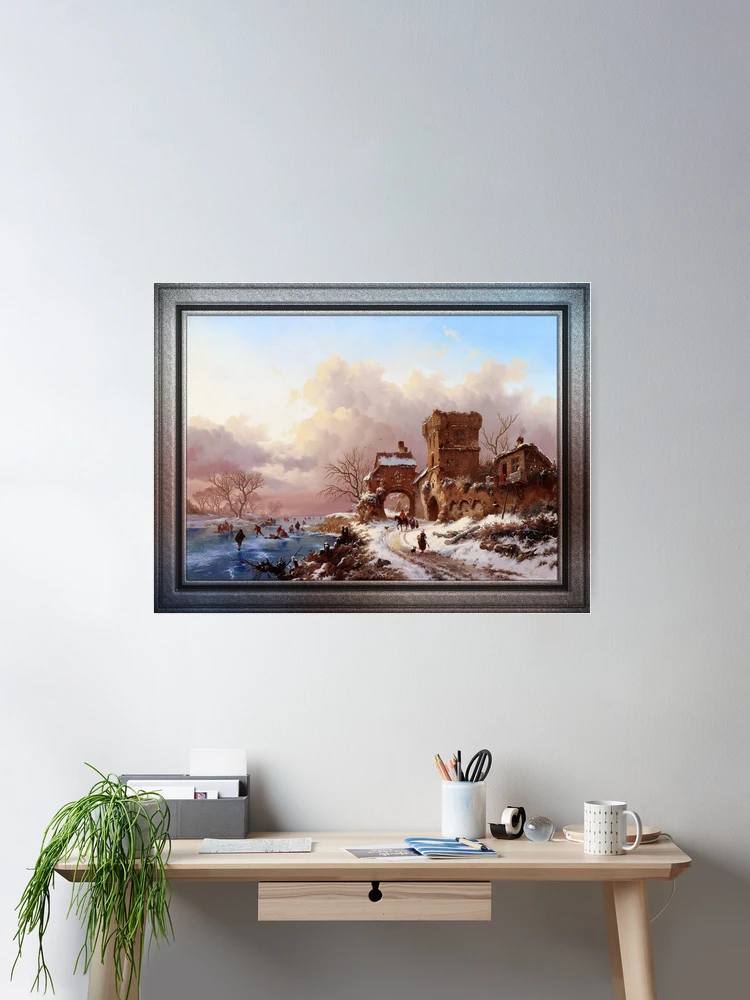
Table des matières
Sujet principal et composition
At the heart of the painting is a town gate, acting as the focal point of the composition. Cette structure, grand and imposing, stands against the backdrop of a serene but somewhat desolate winter scene. The gate leads into a quaint village or town, which is implied but not directly shown in the artwork. On either side of the entrance, towering bare trees stretch their limbs into the cold air, their gnarled branches reaching out toward the sky, their starkness enhanced by the absence of leaves. Ces arbres, mostly without foliage, evoke a sense of dormancy, signifying the depth of winter’s grip.
Just outside the town gate, the ground is blanketed in a layer of snow, its purity highlighted by the faint tinge of sunset light that reflects off its surface. The snow is soft and undisturbed near the gate, mais à mesure que cela s'étend plus loin dans la scène, le blanc intact est interrompu par les voyageurs à pied, créer un mouvement dynamique dans un paysage autrement immobile.
Ces chiffres, emballé dans des manteaux et des capes d'hiver, traverser le terrain glacé, leurs têtes baissées contre le vent froid, ajouter un sentiment de réalisme et d'humanité à la scène. La scène raconte ainsi la vie quotidienne en hiver, où les déplacements et les déplacements persistent malgré les conditions glaciales.
Objets et matériaux
L’attention portée aux détails par la peinture est évidente dans sa représentation des matériaux. La structure en pierre de la porte de la ville est texturée et patinée, avec des caractéristiques architecturales complexes qui reflètent le savoir-faire de l’époque. La porte elle-même sert de barrière symbolique entre la vie trépidante de la ville et le vaste, désert glacial dehors. La faible lueur de la fenêtre du bâtiment au sommet de la porte fait allusion à la chaleur intérieure, contrastant avec le froid rigoureux du monde extérieur.
La neige n'est pas qu'un élément passif de la scène; Kruseman l'utilise habilement pour mettre en valeur les effets de lumière du soleil couchant. La neige, avec sa délicatesse, texture poudrée, reflète les couleurs ambrées et pâles du ciel, qui se fondent doucement dans une douce teinte rosée près de l'horizon.
L'eau, visible au premier plan, a un éclat glacé, permettant aux voyageurs et aux patineurs de glisser sur sa surface. Il y a des personnages visibles sur la glace, engagé dans le sport du patinage, un passe-temps synonyme d'hivers froids dans les Pays-Bas au XIXe siècle. Les chiffres’ le mouvement contraste avec le calme des arbres et la porte imminente de la ville.
Terrain et environs
Le terrain environnant se compose d'une variété de textures et de couches, de la neige molle qui recouvre le sol à la rivière gelée au premier plan, ce qui ajoute de la profondeur et de l'intrigue à la scène. La rivière, partiellement gelé, reflète le ciel nuageux au-dessus, tandis que de fines fissures dans la glace suggèrent la nature fragile du paysage hivernal. Au loin, l'horizon est dominé par la lumière déclinante du coucher du soleil, projetant une lueur chaude sur la scène qui contraste avec les tons froids de la neige et de la glace.
Le chemin enneigé qui mène à la porte de la ville est marqué par les empreintes des voyageurs., dont les formes sombres se détachent sur le sol pâle. Ce chemin attire le regard du spectateur vers la porte, améliorer la sensation de mouvement dans une scène autrement calme. Kruseman capture la nature méticuleuse de l'hiver dans la campagne néerlandaise, utiliser des éléments naturels tels que la rivière glacée et les arbres sans feuilles pour transmettre la solitude tranquille du moment.
Style et technique
La maîtrise de la lumière et de l’ombre de Kruseman est évidente dans ce tableau, car il contraste efficacement les tons chauds du coucher de soleil avec les nuances plus froides du paysage hivernal. Le travail au pinceau est délicat, avec l'attention portée aux détails par Kruseman dans la représentation des arbres, neige, et architecture créant un équilibre harmonieux entre réalisme et expression artistique.
L’utilisation de la lumière par l’artiste joue un rôle important dans la création de l’ambiance du tableau.. Le doux, la lumière diffuse suggère la fin d'une journée, évoquant une atmosphère paisible et contemplative. Le spectateur est invité à imaginer le calme de la campagne au coucher du soleil., avec pour seuls bruits le craquement de la neige sous les pieds et les voix lointaines des voyageurs.
Les personnages du tableau sont rendus avec beaucoup de réalisme, avec Kruseman capturant les détails naturalistes de leurs vêtements et de leurs mouvements. Les manteaux et chapeaux de voyageur évoquent la mode pratique de l’époque, car ils étaient destinés à protéger celui qui les porte du froid mordant de l'hiver. La posture des voyageurs ajoute également une impression de réalisme : tête baissée face au vent., corps légèrement courbés lorsqu'ils se déplacent dans la neige.
Thème et humeur
L'humeur prédominante dans Paysage d'hiver avec des voyageurs près de la porte de la ville c'est une solitude tranquille, tempéré par la présence de la vie et du mouvement. La scène capture l'interaction entre la nature et l'humanité, montrant comment les personnages du tableau sont soumis aux forces de la nature, mais continuer à avancer malgré les conditions hivernales rigoureuses. Il y a un sentiment de résilience chez les voyageurs’ des progrès déterminés, contrastant avec le calme du paysage gelé.
Il s'agit du portrait d'une communauté qui endure la saison hivernale., tout en trouvant une certaine paix en lui. La porte de la ville agit comme un seuil à la fois littéral et symbolique, représentant la frontière entre la chaleur et la sécurité de la ville et la dureté du monde extérieur. La présence du voyageur suggère un monde au-delà de la porte, celui du mouvement et du passage, mais fait toujours partie du paysage naturel plus vaste.
En essence, Le travail de Kruseman reflète un profond respect pour le monde naturel, capturant la beauté austère de l'hiver tout en suggérant l'esprit durable de ceux qui y vivent. La peinture évoque les thèmes de l'endurance, le passage du temps, et la beauté tranquille trouvée dans les détails souvent négligés de la vie quotidienne.
Winter Landscape With Travelers est une reproduction retouchée de maîtres anciens d'art numérique d'une image du domaine public.
Cette création d'art numérique, comme toutes les œuvres d'art disponibles sur le site Web Xzendor7, elles sont disponibles à l'achat en ligne dans une variété de formats de matériaux, y compris des impressions sur toile., impressions acryliques, impressions métalliques, gravures sur bois, impressions encadrées, affiches, et sous forme d'impressions sur toile roulées dans une variété de tailles de 12 pouces à 72 pouces en fonction de la taille de l'œuvre d'art réelle et de la boutique d'impression à la demande auprès de laquelle vous choisissez d'acheter l'art.
L’œuvre d’art est également disponible sur une large gamme de vêtements pour hommes et femmes., tasses, fourre-tout, écharpes, cahiers et journaux et de nombreux produits de décoration intérieure.
À propos de l'artiste
Informations ci-dessous dérivées de Wikipedia.org
Frederik a reçu ses premiers cours de dessin du peintre de natures mortes Jan Reekers (1790 – 1858), qui était à l'époque directeur de l'Académie royale des beaux-arts d'Amsterdam; et qui avait aussi instruit son cousin Jan Adam[ tout en fréquentant une école professionnelle à Haarlem de 1832 à 1833.
Dans 1833 il a ensuite commencé à étudier la peinture avec Dutch Painter, Graveur, Lithographe, Aquarelliste et illustrateur Nicolaas Johannes Roosenboom (1805 – 1880).
Puis dans 1835 il a déménagé à Het Gooi dans le centre des Pays-Bas, où il a suivi des études avancées avec le peintre paysagiste néerlandais Jan van Ravenswaay (1789 – 1869); ainsi que d'étudier pendant une brève période avec le peintre paysagiste et lithographe néerlandais Barend Cornelis Koekkoek (1803 – 1862).
Il est ensuite retourné à Haarlem et de là à Kleve dans le nord-ouest de l'Allemagne où il a peint des paysages, avant de rentrer chez 1839.
Dans 1841 il s'installe à Bruxelles et y reste jusqu'à 1852, sauf pendant une brève période de quelques mois où il se rend à Paris. Dans 1852 il est rentré chez lui à Haarlem et y est resté quatre ans, après quoi il est allé en Belgique, où il resta jusqu'à sa mort en 1882.