

An Auburn Beauty
Artwork Description
“An Auburn Beauty” by French Painter Emile Vernon (1872 – 1920) is a delicate and vibrant portrayal of a young woman, painted during the late 19th century by the renowned French artist Emile Vernon. Known for his graceful and detailed depictions of women, Vernon encapsulates the idealized beauty of femininity during the Belle Époque era in France. This portrait, executed with remarkable finesse, captures both the elegance of the subject and the romanticism of the time. The artist’s ability to infuse life into the figure through intricate detail, soft color palette, and the careful rendering of textures makes this piece a stunning example of his work.
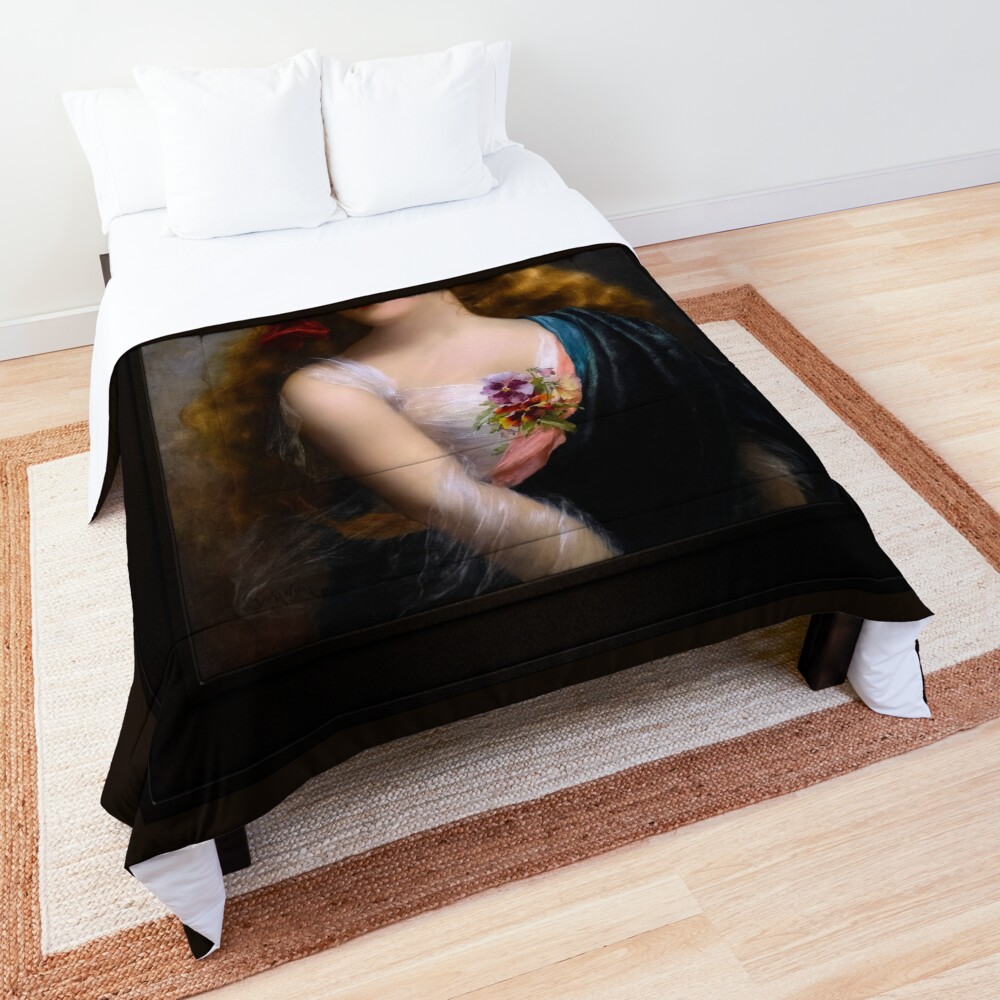
Table of Contents
Main Subject and Composition
The focal point of the artwork is a young woman with long, auburn hair, styled in loose waves that cascade down her shoulders. Her facial expression is serene, yet there is a quiet intensity in her gaze that seems to draw the viewer in. She turns her head slightly toward the viewer, her soft blue eyes glimmering with subtle emotion.
The woman is dressed in an exquisite gown of contrasting fabrics, predominantly a deep, rich teal, which flows gracefully over her shoulder. The material of the dress appears soft and flowing, with delicate folds that reflect the artist’s mastery in capturing light and shadow.
Resting gently on her shoulder is a cluster of fresh, vividly colored flowers, placed with intentional care. The blossoms, predominantly violets in shades of purple and yellow, are nestled in her gown, serving as both an accessory and a symbol of her gentle femininity.
The artist has rendered the flowers in great detail, using soft brushstrokes to convey their delicate nature and vibrant colors. This arrangement is not merely a decorative element but enhances the softness and grace of the subject.
Background and Surroundings
The background of the painting is subdued and out of focus, which further accentuates the subject’s prominence. It is painted in muted tones of grey and brown, providing a neutral backdrop that allows the woman and her attire to stand out. The hazy, almost indistinct setting creates a sense of intimacy, as if the subject is captured in a private, personal moment. This choice of background allows the viewer to focus entirely on the woman, without distraction, and enhances the atmosphere of tranquility and poise.
Style and Technique
Emile Vernon’s style is characterized by a blend of realism and romanticism, evident in his meticulous attention to detail and his ability to evoke a sense of beauty and grace. “An Auburn Beauty” is a prime example of these stylistic elements, with the artist using soft, flowing lines and delicate shading to capture the softness of the woman’s skin and hair.
The treatment of light in the portrait is masterful, with Vernon using light to emphasize the contours of the face and the texture of her gown. His application of oil paint is smooth and seamless, contributing to the dreamlike quality of the composition. Vernon also employs a subdued color palette, with warm golden hues in the woman’s hair and the deep teal of her gown creating a harmonious balance.
The artist’s technique in rendering the woman’s face is particularly notable. Each feature is finely crafted, with a gentle yet precise approach. The softness in the shadows around the eyes and cheeks, paired with the careful highlighting of her lips and brow, creates a lifelike quality that reflects the artist’s deep understanding of human anatomy and portraiture. This technique, combined with the romantic subject matter, evokes a sense of timeless beauty, typical of the Belle Époque period.
Theme and Mood
The mood of the painting is one of calm elegance and introspective beauty. The subject’s tranquil expression, paired with the soft texture of the fabric and the natural elegance of her posture, conveys a sense of serene femininity. The addition of the flowers may suggest a connection to nature, as well as a timeless symbol of innocence and grace. The subject is not posed in an overtly seductive or dramatic manner, but rather exudes a quiet strength through her graceful demeanor.
The theme of idealized feminine beauty, central to the painting, is enhanced by the choice of the woman’s attire, her expression, and the overall composition. Vernon’s work, like many artists of the time, reflects an era that valued beauty in its most delicate and refined form. His portrayal of women often emphasized an ethereal, almost unattainable, ideal, making the subjects of his paintings both captivating and aspirational.
Materials and Execution
Emile Vernon executed this work in oil paint, a medium well-suited for the delicate textures and soft blending of light that define the portrait. The artist’s brushwork is smooth, without visible strokes, giving the painting a flawless finish. The colors are carefully layered to create depth, particularly in the rendering of the fabrics and the skin tones. The deep contrasts between the lightness of the skin and the dark folds of the gown enhance the three-dimensional quality of the subject, making her appear as though she could step out of the canvas at any moment.
The artist’s approach to the flowers is equally detailed, with the soft petals almost appearing to come alive under the careful attention paid to their texture and colors. The flowers not only contribute to the aesthetic beauty of the piece but also add an additional layer of symbolism, tying the subject’s beauty to the natural world.
Conclusion
“An Auburn Beauty” by Emile Vernon remains an exemplary piece of Belle Époque art, representing both the artistic mastery and the cultural ideals of the period. The portrait captures the elegance and subtlety of feminine beauty through Vernon’s skilled technique, while the soft colors, gentle lighting, and serene expression of the subject evoke a sense of tranquility and timelessness. This work stands as a testament to the artist’s ability to blend realism with romanticism, creating an image that continues to captivate viewers with its graceful portrayal of a woman at the height of idealized femininity.
This is a remastered digital art old masters reproduction of a public domain image that is available as a canvas print online.
Artist Bio From Galerie Ary Jan
Émile Vernon was a student at the Fine Arts school in Tours where he won the first prize for drawing in 1888; afterwards he was then mentored by William Bouguereau and Auguste Truphème.
Then in 1898 he participated in the Tours exhibition of Fine Arts and Decorative Arts and later that year, in the French Artists Exhibition and regularly exhibited hie work there from 1898 to 1913; presenting portraits, landscapes, scenes from Brittany, still life bouquets that he painted in watercolor, as well as feminine figures, which later became is specialty.
Émile excelled in his paintings of softly lighted, adorable figures of children and elegant young women, with whom he often associated a pet such as a cat, dog or bird, and adorned his images with garlands or bouquets of flowers, throughout his career; but he was also a very versatile artist that could paint with rigor and power as in his works the portrait of Madame Vernon and Sous la Lampe (Under the lamp).