

Ariana
Ariadne c1831-35 by American Painter & Grabador Asher Brown Durand (1796 – 1886) formó parte del Movimiento de Arte del Romanticismo y se graduó de la Escuela del Río Hudson. El enfoque principal de Asher estaba en las pinturas de paisajes.
This painting of Ariana by Asher is from a copy of a painting by John Vanderlyn (1776 – 1852) which he did in preparation for the engraving he produced as was often the case; he would create an oil canvas of the size of the intended engraving.
Ariadne is the Cretan Princess of Greek Mythology who was briefly loved by Theseus (el rey mítico y héroe fundador de Atenas), who abandoned her on the island of Naxos after he tired of her company.
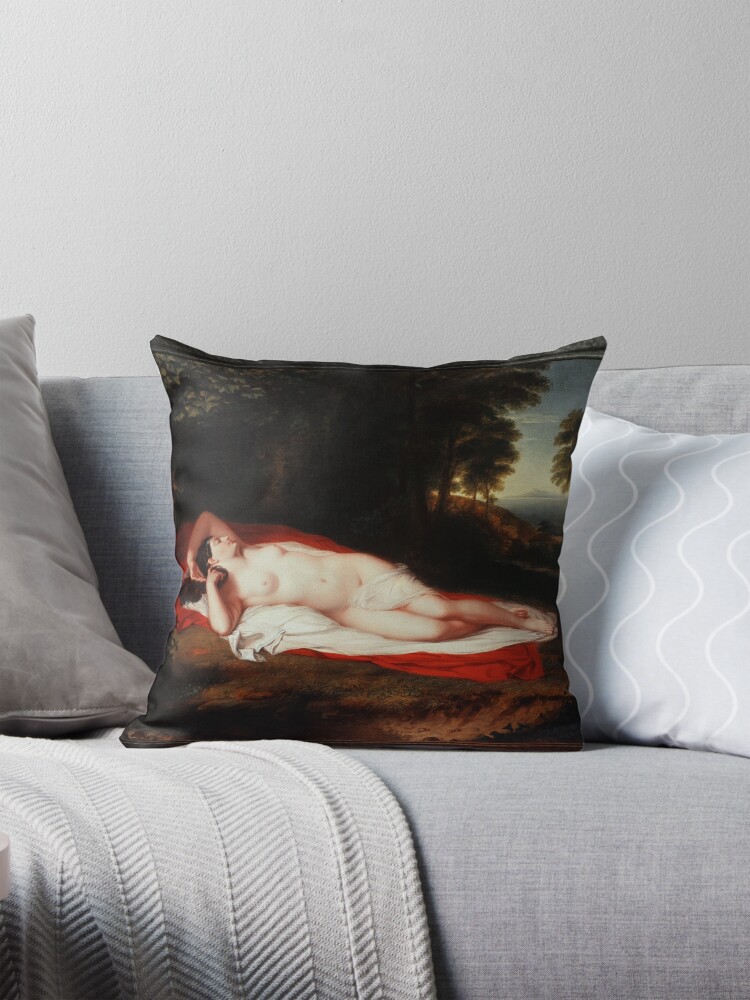
Tabla de contenido
Overview of “Ariana” by Asher Brown Durand
Asher Brown Durand, an American painter and engraver, is widely regarded as one of the central figures in the Hudson River School of landscape painting, a movement that celebrated the natural beauty of the American landscape. sin emabargo, Durand’s work often extended beyond landscapes, as seen in his 1831 – 1835 cuadro Ariana. This piece reveals Durand’s mastery not only in capturing natural forms but also in his ability to imbue his subjects with an ethereal, almost mythological presence.
The Subject of the Artwork: Ariana
At the center of Durand’s Ariana stands a woman in repose, surrounded by the lush, undisturbed wilderness of an ancient, almost idyllic landscape. The subject of the painting is Ariadne, a figure from Greek mythology, known for her connection to the myth of Theseus and the Minotaur. Ariadne is often depicted as a symbol of love, pérdida, and betrayal, and Durand captures her at a moment of serene contemplation.
Ariadne’s pose is languid and contemplative, lying on a bed of red drapery that contrasts with the soft hues of the surrounding natural world. The figure appears relaxed, almost sleeping, with her head gently turned to the side. Her body is draped in a flowing, translucent white cloth, with the rich crimson fabric beneath her evoking a sense of luxury and opulence. Despite her reclined position, the contours of her body remain graceful, with the painter capturing the natural curves of her form with great care and sensitivity. Su cara, though partially obscured by her positioning, seems peaceful, suggesting a deep inner calm or introspection.
The Landscape and Natural Setting
The backdrop of the painting is a lush, verdant landscape that stretches into the distance, bathed in the soft glow of an evening or early morning light. The scene is characterized by gently rolling hills, dense trees, and a distant body of water. Durand’s attention to detail in the depiction of nature reflects his dedication to the principles of the Hudson River School, where the natural world was revered and idealized. The foliage is painted in rich, deep greens, while the sky above is a delicate blend of soft blues and warm yellows, contributing to an atmosphere of tranquility and nostalgia.
The distant view across the water provides a sense of depth and space, inviting the viewer to imagine the vastness of the scene. The use of light in this painting is particularly notable; the artist’s careful rendering of shadows and highlights creates a sense of volume and texture, lending an almost three-dimensional quality to both the figure of Ariadne and the surrounding landscape. The light appears to envelop the figure, casting a soft glow on her skin and the folds of her drapery, while the shadowed areas deepen the sense of solitude and reflection.
The Symbolism of the Drapery
The red drapery beneath Ariadne is not just a visual element but also a symbolic one. In classical art, drapery often served as a vehicle for expressing both the subject’s emotional state and their physical form. En este caso, the deep red fabric can be interpreted as a symbol of passion, amor, or even sacrifice. Ariana, having been abandoned by Theseus after helping him escape the labyrinth, might be seen as embodying themes of loss and emotional turmoil, yet her peaceful repose and the lush, fertile landscape around her suggest a kind of quiet resolution or acceptance.
The white cloth she is draped in can be viewed as a symbol of purity or a new beginning, which is fitting given that the myth of Ariadne is often associated with transformation; both in the literal sense of her life being changed by her relationship with Theseus and in the mythological sense, where her fate takes a turn after her abandonment.
El estilo y la técnica artística
Durand’s Ariana is painted in a classical Romantic style, where realism and idealism merge to create a vision of beauty that transcends the ordinary. The artist employs a fine balance of realism in the portrayal of both the figure and the landscape, yet there is an underlying idealization that makes the scene feel timeless. Durand’s technical skill is evident in the delicate rendering of light and shadow, the softness of the fabric, and the naturalistic details of the landscape.
The figures and forms are modeled with great precision, and the soft transitions of color suggest the artist’s deep understanding of the human body and the play of light across different surfaces. Durand’s fine attention to detail extends beyond the human form to the natural environment, where every leaf, branch, and rock is meticulously painted, contributing to the painting’s overall sense of realism and harmony.
Mood and Emotional Atmosphere
El estado de ánimo de Ariana is one of tranquility, soledad, and quiet reflection. The soft light, gentle landscape, and languid pose of the subject all combine to create an atmosphere of serene contemplation. There is a sense of quiet beauty in the way the figure rests within the natural surroundings, suggesting both an intimate connection to nature and a contemplative escape from the tumult of the mythological world.
While the figure of Ariadne is deeply associated with themes of abandonment, betrayal, and emotional pain in the myth, Durand’s portrayal focuses on a more introspective aspect of her character. The absence of a direct narrative moment, such as her abandonment or subsequent marriage to Dionysus, allows the viewer to contemplate Ariadne in a state of quiet resolution. Her calm expression and relaxed pose suggest an emotional distance from her previous life’s trials and tribulations, allowing for a more meditative engagement with her figure.
Conclusión
En Ariana, Asher Brown Durand merges his skill in landscape painting with his sensitivity to human emotion, producing a work that is both visually stunning and emotionally resonant. The painting is a delicate balance of idealized beauty and reflective solitude, drawing upon the classical traditions of mythology and landscape painting while imbuing the scene with a uniquely Romantic sensibility. A través de esta pieza, Durand invites the viewer to contemplate not only the mythical figure of Ariadne but also the eternal beauty of the natural world, which offers a quiet sanctuary from the tumult of human life.

Al fondo, más allá de los árboles y la colina en la que está descansando, podemos ver un bote en la orilla de un lago., gente y un perro en la orilla, con el humo de una fogata elevándose en el aire; Por último, a lo lejos, podemos ver lo que parece ser una gran isla..
Esta es una reproducción de maestros antiguos de arte digital retocada de una imagen de dominio público que puede comprar como impresión de lienzo enrollado.
Información debajo de Wikipedia.org
Durand nació y finalmente murió en Maplewood., New Jersey (entonces llamado Jefferson Village). Era el octavo de once hijos.. El padre de Durand era relojero y platero..
Durand fue aprendiz de grabador de 1812 a 1817 y posteriormente se asoció con el propietario de la empresa, Charles Cushing Wright (1796–1854), quien le pidió que dirigiera la oficina de la empresa en Nueva York.
Grabó la Declaración de Independencia de John Trumbull durante 1823, que estableció la reputación de Durand como uno de los mejores grabadores del país..
Durand ayudó a organizar la Asociación de Dibujo de Nueva York durante 1825, que se convertiría en la Academia Nacional de Diseño; serviría a la organización como presidente desde 1845 a 1861.
Los grabados de Asher en billetes de banco se utilizaron como retratos para los primeros sellos postales de Estados Unidos., la 1847 serie. Junto con su hermano Ciro también grabó algunos de los siguientes 1851 asuntos.
Su principal interés pasó del grabado al óleo sobre 1830 con el apoyo de su patrón, Luman Reed. Durante 1837, acompañó a su amigo Thomas Cole en una expedición de dibujo al lago Schroon en las montañas Adirondacks y poco después comenzó a concentrarse en la pintura de paisajes..
Pasó los veranos dibujando en Catskills., Montañas Adirondack, y las Montañas Blancas de New Hampshire, haciendo cientos de dibujos y bocetos al óleo que luego se incorporaron a piezas terminadas de la academia que ayudaron a definir la Escuela del Río Hudson..
Durand es recordado particularmente por sus detalladas representaciones de árboles., rocas, y follaje. Fue un defensor de dibujar directamente de la naturaleza con el mayor realismo posible.. Durand escribió, “Dejar [el artista] aceptar escrupulosamente cualquier cosa [naturaleza] lo presenta hasta que, en un grado, se ha vuelto íntimo de su infinitud... nunca permita que él profane su carácter sagrado alejándose deliberadamente de la verdad.”
Como otros artistas de la escuela del río Hudson, Durand también creía que la naturaleza era una manifestación inefable de Dios.. Expresó este sentimiento y sus opiniones generales sobre el arte en su ensayo. “Cartas sobre pintura de paisaje.” en el crayón, una publicación periódica de arte de Nueva York de mediados del siglo XIX.. Escribió Durand., “[T]El verdadero ámbito del Arte del Paisaje es la representación de la obra de Dios en la creación visible…”
Durand se destaca por su 1849 pintura Kindred Spirits que muestra al artista de la Escuela del Río Hudson Thomas Cole y al poeta William Cullen Bryant en un paisaje de las Montañas Catskills. Esto fue pintado como un tributo a Cole tras la muerte de Cole durante 1848, y como regalo a Bryant.