

Belle Epoque Beauty Reclining On A Settee With Roses
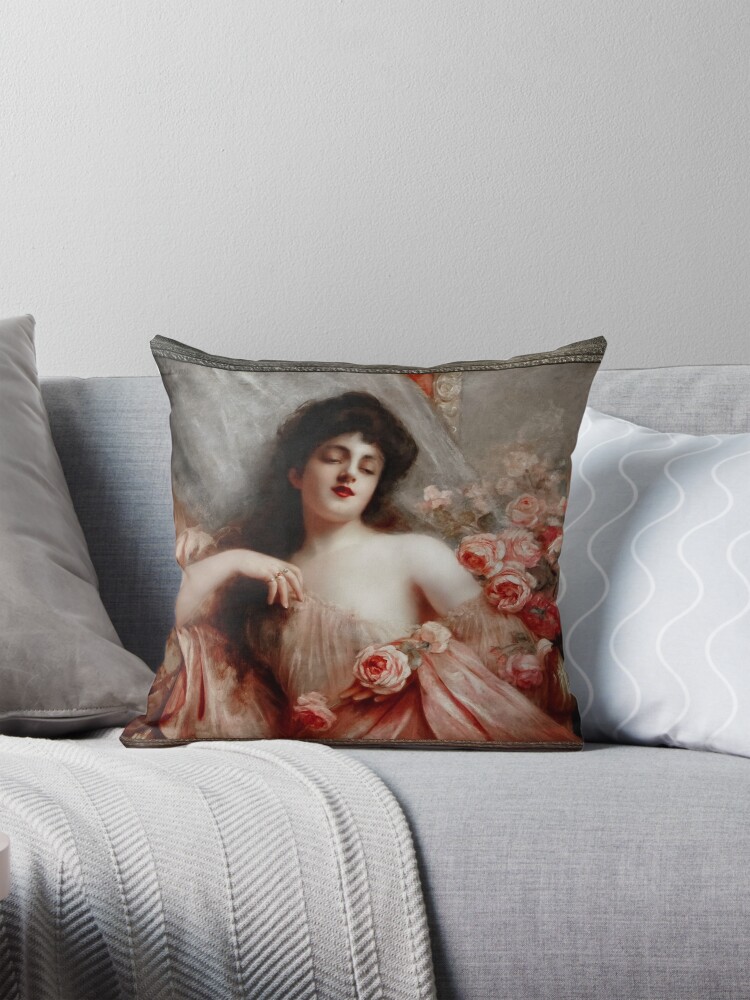
Auf dem Gemälde mit dem Titel “Belle Epoque Beauty Reclining On A Settee With Roses,” erstellt in 1907 by the esteemed French painter Paul Antoine De La Boulaye (1849 – 1926), the viewer is invited into an intimate scene that beautifully encapsulates the charm and grace of the Belle Epoque era. The piece is a vivid portrayal of a young woman, reclining on an opulent settee, surrounded by delicate roses.
Das Weiche, fluid brushwork and the romantic nature of the composition are characteristic of De La Boulaye’s masterful ability to evoke the aesthetic spirit of the early 20th century. The soft tones and rich textures of the painting bring to life the beauty of both the subject and the environment she inhabits. Through careful attention to detail, De La Boulaye creates a serene yet slightly sensual atmosphere, marked by the luxurious interior and the subject’s relaxed pose.
Inhaltsverzeichnis
Das Hauptthema
The focal point of the painting is the young woman who lies languidly across a plush settee, enveloped in soft fabrics. Her posture is one of ease and comfort, evoking a sense of relaxation and quiet elegance. She gazes gently to the side, her eyes half-closed, adding to the tranquility of the scene. Her pale, smooth skin contrasts delicately with her dark, voluminous hair, which cascades in gentle waves around her face and shoulders. The artist’s meticulous attention to her facial features, particularly the slight curve of her lips and the softness of her expression, conveys a serene beauty and a contemplative air.
The woman’s attire is a sheer gown with layers of soft pink fabric, which adds to her ethereal quality. Das Kleidungsstück, while suggestive of the fashion trends of the time, is draped in such a way that it enhances the graceful lines of her figure. A sense of fragility is portrayed, as though she is an embodiment of beauty that exists outside the realm of time. Her right hand rests lightly on her lap, adorned with an elegant ring, while her other hand is gently placed among the roses that surround her, reinforcing her connection with nature and the refined world of beauty that De La Boulaye so often sought to depict.
The Roses and the Settle
The surrounding elements in the painting play a significant role in enhancing the overall mood and themes of the composition. The settee, a key piece of furniture in the scene, is a sumptuous piece of furniture upholstered in rich, warm hues that mirror the softness of the woman’s gown. The upholstery has a slight sheen to it, which contrasts with the delicate textures of the roses resting against it.
These roses, scattered about her on the settee and spilling onto the floor, symbolize beauty, Romantik, and fragility. Das Weiche, muted pinks of the flowers complement the woman’s attire and the room’s overall palette, blending harmoniously with the serene ambiance of the painting. The roses also serve to symbolize a timeless connection between woman and nature, as though the woman herself is part of the organic beauty that surrounds her.
The artist’s choice to include the roses with such prominence in the composition draws attention to the fleeting nature of beauty and youth. Das Weiche, almost translucent petals of the roses contrast against the solidity of the settee, inviting the viewer to ponder the relationship between the transient beauty of the woman and the material world in which she exists.
The Environment and Mood
The background of the painting contributes significantly to the mood of the piece. It is soft and diffused, with gentle, almost dreamlike light filtering across the canvas. This light creates a sense of depth and warmth, which envelops the subject and the space. The palette is one of muted tones—subtle shades of pink, beige, and gray—creating an overall sense of softness and calm. The mood is serene and nostalgic, evoking a sense of peace and quiet luxury that was so prized during the Belle Epoque period.
The scene is intimate, yet grand. It suggests an upper-class setting, a private moment of repose in a luxurious home or salon. The painting captures the essence of a time when life seemed to slow down, when leisure was valued, and beauty was admired for its own sake. Der Hintergrund, wenn auch einfach, implies a sense of opulence through the textures and softness of the drapery, giving the piece a refined and aristocratic atmosphere.
Stil und Technik
“Belle Epoque Beauty Reclining On A Settee With Roses” is painted in a style that blends realism with the romanticized approach often seen in late 19th and early 20th-century French art. De La Boulaye’s technique emphasizes delicate, almost velvety brushstrokes that soften the details of the subject and environment, lending the painting a sense of timelessness.
The soft modeling of the woman’s face and figure highlights the artist’s skill in capturing the subtleties of human beauty, while the roses and fabric folds are rendered with remarkable detail, enhancing the overall texture and depth of the scene.
De La Boulaye’s use of light in the piece is particularly noteworthy. The warm light gently bathes the subject and her surroundings, creating an ethereal glow that speaks to the sense of tranquility and gentleness associated with the Belle Epoque period. This use of light heightens the sensual and romantic qualities of the painting, reinforcing its connection to the art and culture of the time.
Abschluss
Im “Belle Epoque Beauty Reclining On A Settee With Roses,” Paul Antoine De La Boulaye offers a masterful portrayal of feminine grace, Schönheit, and tranquility. Through his delicate rendering of the subject and her surroundings, he captures the essence of an era that valued elegance, Verfeinerung, and the celebration of life’s fleeting beauty.
The painting serves as a reminder of a time when the quiet, intimate moments of repose were cherished, and when beauty was not just seen, but felt in the very fabric of existence. This work stands as a testament to the enduring allure of the Belle Epoque period and to the artist’s remarkable ability to capture the spirit of the time.
Dies ist eine retuschierte Reproduktion eines gemeinfreien Bildes durch digitale Meister alter Meister.
Diese digitale Kunstschöpfung, Wie alle Kunstwerke, die auf der Xzendor7-Website zu finden sind, können sie online in einer Vielzahl von Materialformaten einschließlich Leinwanddrucken erworben werden, Acryldrucke, Metalldrucke, Holzdrucke, gerahmte Drucke, Plakate, und als gerollte Leinwanddrucke in verschiedenen Größen von 12 Zoll zu 72 Zoll, abhängig von der Größe des tatsächlichen Kunstwerks und dem Print-on-Demand-Shop, in dem Sie das Kunstwerk kaufen möchten.
Das Kunstwerk ist auch auf einer breiten Palette von Herren- und Damenbekleidung erhältlich, Tassen, Tragetaschen, Schals, Notizbücher und Tagebücher sowie viele Heimdekorationsprodukte.
Biografie des Künstlers
Informationen unten abgeleitet von Wikipedia.org
Paul Antoine De La Boulaye, der mit vollem Namen Charles Antoine heißt Paul Georgette du Buisson de La Boulaye wurde in Bourg-en-Bresse Frankreich in . geboren 1849, nach Eugène Georgette du Buisson de La Boulaye (1810 – 1888) und Adrienne de Graindorge d´Orgeville de Mesnil-Durand (1811 – 1859).
Paul war Mentor des französischen Porträtmalers Léon-Joseph-Florentin Bonnat (1833 – 1922); und in 1873 Paul stellte sein religiöses Gemälde David aus, Martyrium, Anbetung der Hirten im Salon; ein Gemälde, das dem Stil von Craravaggio ähnelt. Die kniende Jungfrau erscheint in Weiß gekleidet in einem Heiligenschein aus weißem Licht mit dem Jesuskind.
Im Laufe seiner Karriere verlagerte er seine künstlerische Arbeit nach und nach auf Bilder, die auf regionalen Bezügen basieren, beginnend mit seiner Arbeit Au sermon, Souvenir de la Bresse c1879, die von Bresse beeinflusst wurde (a Regionen Auvergne-Rhône-Alpes und Bourgogne-Franche-Comté in Ostfrankreich); ebenso wie seine Stücke Die Taufe der Waise c1884, die eine Bourbonnaise zeigt (war eine historische Provinz im Zentrum Frankreichs) beeinflussen.