

Dolce Far Niente
“Dolce Far Niente,” created by the British painter John William Godward en 1904, embodies the essence of leisurely tranquility in classical art. John William Godward (1861 – 1922) is renowned for his dedication to depicting serene and opulent scenes inspired by ancient Rome and Greece, often focusing on beautiful women in idealized settings.
en esta pintura, Godward captures a moment of pure relaxation, where the subject reclines in a luxurious setting, offering the viewer a window into a world of unhurried elegance. El título, which translates from Italian as “The Sweetness of Doing Nothing,” is a fitting description of the painting’s mood. This theme of languor and contentment is a hallmark of Godward’s work and reflects a classical ideal of living in harmony with nature and luxury.
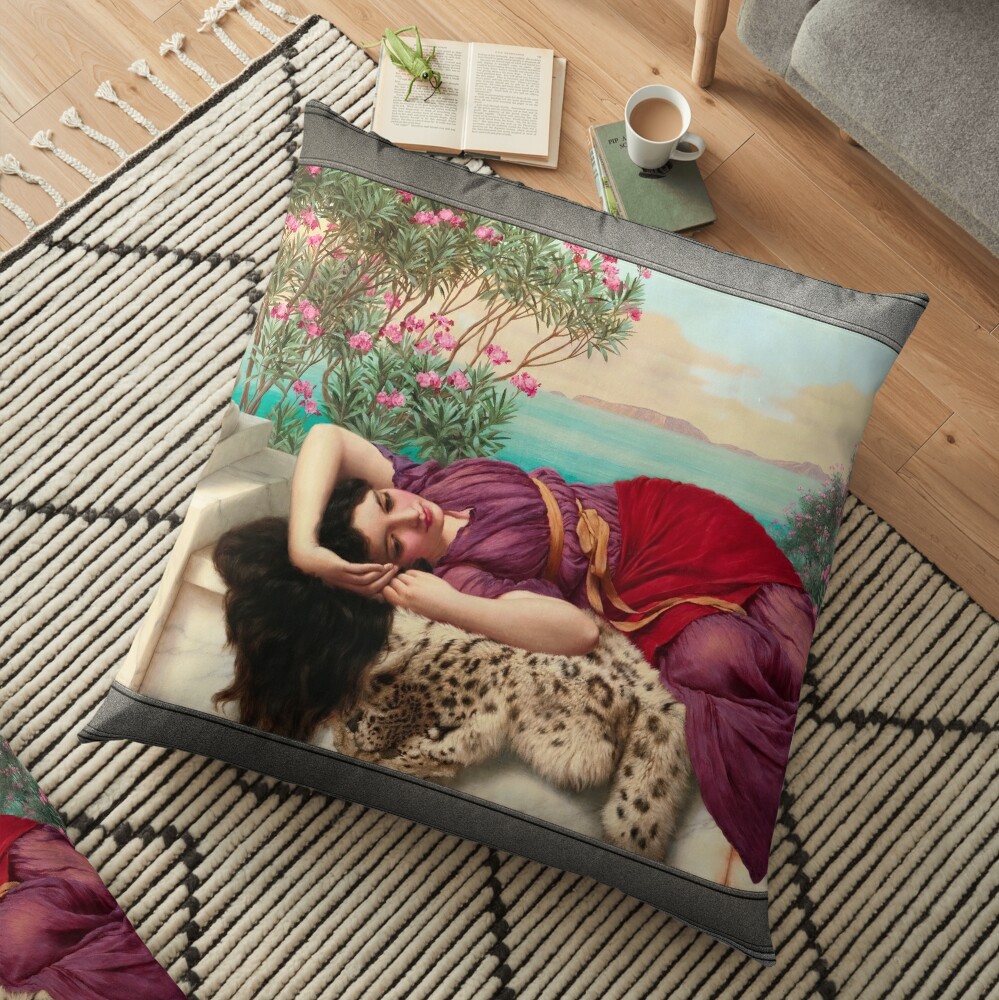
Tabla de contenido
El tema principal: Una mujer reclinada
At the heart of the composition lies a young woman, the focal point of the painting. Draped in flowing, telas ricas, she reclines languidly on a marble terrace. Her pose suggests both comfort and contemplation, her head resting gently on her right arm, while her other hand lies relaxed by her side. The woman’s attire is a blend of classical Greek and Roman influences, with a deep red robe cinched at the waist by a golden sash, flowing loosely around her body.
The fabric of her clothing flows with remarkable realism, draping gracefully over her form and pooling around her on the marble. The woman’s expressive face is calm and serene, exuding a sense of peace and satisfaction. su largo, dark hair tumbles softly over her shoulder and down her back, enhancing her delicate beauty.
The figure is sculpted in a manner that emphasizes classical ideals of beauty, graceful, slender, y armonioso. The figure’s serene expression is a key aspect of Godward’s work, reinforcing the theme of repose and quiet indulgence. Her classical beauty is not only visual but also imbued with the quiet strength of timeless femininity. Her natural poise suggests an air of nobility or refinement, which Godward often associated with the ancient world.
The Surrounding Environment
The setting is a classical terrace that overlooks a tranquil, Mediterranean-style landscape. The woman is positioned in front of a marble railing, part of a larger architectural structure, perhaps an ancient villa or temple. The terrace’s polished marble surface reflects light beautifully, its smooth, lustrous quality enhancing the overall luxurious atmosphere. The colors of the marble subtly contrast with the rich hues of the woman’s attire, bringing attention to her figure.
Beyond the terrace, the landscape stretches into a serene view of the sea. The coastline is bathed in soft, golden sunlight, with distant hills rolling gently toward the horizon. This idyllic landscape evokes a sense of peace and isolation, where nature and human beauty coexist harmoniously. Several clusters of lush foliage, including pink and purple flowers, border the scene, enhancing the natural beauty of the environment. The plants are rendered with incredible attention to detail, their vibrant colors and intricate shapes adding depth and dimension to the scene.
The landscape, with its gentle slopes and clear skies, reinforces the theme of relaxation and the gentle passage of time. The sea, calm and expansive, suggests infinity and timelessness, while the distant hills provide a sense of tranquility and permanence. These natural elements frame the scene in a way that invites the viewer to contemplate the idyllic stillness of the moment.
Materiales y Técnicas
Godward’s expertise in depicting texture and light is evident in his meticulous rendering of the materials in the painting. The marble terrace is finely detailed, its polished surface capturing the play of light and shadow in a way that heightens the realism of the scene. The luxurious fabrics of the woman’s attire are painted with such precision that one can almost feel the softness and weight of the cloth. The vivid reds and purples of her robe contrast beautifully with the more subdued tones of the landscape, drawing the viewer’s attention to her figure.
Godward’s brushwork is delicate and refined, with a focus on smooth surfaces and clarity of form. The light in the painting is soft and even, contributing to the overall sense of calm and timelessness. There are no harsh contrasts or sharp shadows, which emphasizes the restful mood of the piece. The artist’s use of color is also notable, as he employs a rich yet harmonious palette to evoke warmth and serenity. The overall composition is balanced, with each element of the scene working together to create a cohesive and pleasing visual experience.
The Style and Mood of the Artwork
“Dolce Far Niente” embodies the style of academic realism, a movement that prioritized the accurate depiction of human figures, classical themes, and idealized settings. Godward was a part of the late Victorian tradition, and his works often aligned with the aesthetic tastes of the time, which favored classical themes and polished finishes. El tema de la pintura, a beautiful woman at rest in an idyllic classical setting, is typical of Godward’s oeuvre, where he often sought to create timeless moments of beauty and serenity.
The mood of the painting is one of complete relaxation and peace. There is no urgency or turmoil; en cambio, the viewer is invited to share in the quiet pleasure of the woman’s repose. This sense of timeless, unhurried contentment is central to the painting’s appeal. The serene landscape, the softness of the light, and the tranquility of the scene combine to evoke feelings of nostalgia for a more harmonious and slower-paced world. El tema de “Dolce Far Niente” reminds the viewer of the simple joys of leisure, free from the pressures of modern life.
Conclusión
“Dolce Far Niente” is a masterful example of John William Godward’s ability to evoke the beauty of the classical world through the lens of academic realism. The painting captures a moment of pure relaxation, where the lines between the natural world and human beauty blur, creating a sense of timeless serenity. The luxurious setting, coupled with the delicate portrayal of the reclining woman, invites the viewer to step into a world where tranquility reigns and time seems to stand still.
Dolce Far Niente es una reproducción de maestros antiguos de arte digital remasterizada de una imagen de dominio público que está disponible como impresión de la lona en línea.
Esta creación de arte digital, al igual que todas las obras de arte que se pueden encontrar en el sitio web de Xzendor7, están disponibles para su compra en línea en una variedad de formatos de materiales, incluidas impresiones en lienzo, impresiones acrílicas, impresiones de metal, impresiones de madera, láminas enmarcadas, carteles, y como lienzos enrollados en una variedad de tamaños, desde 12 pulgadas a 72 pulgadas según el tamaño de la obra de arte real y la tienda de impresión bajo demanda en la que elija comprar la obra de arte.
La obra de arte también está disponible en una amplia gama de prendas de vestir para hombres y mujeres., tazas, totalizadores, bufandas, cuadernos y diarios y muchos productos de decoración del hogar..
Biografía del artista
Información debajo de Wikipedia.org
John William Godward era el mayor de cinco hijos., y fue nombrado en honor a su padre John y su abuelo William.
Expuso en la Real Academia de 1887. Cuando se mudó a Italia con una de sus modelos en 1912, su familia rompió todo contacto con él e incluso cortó su imagen de las fotografías familiares. Godward regresó a Inglaterra en 1921, murio en 1922, y está enterrado en el cementerio de Brompton, oeste de Londres.
Uno de sus cuadros más conocidos es Dolce far Niente (1904), que fue comprado para la colección de Andrew Lloyd Webber en 1995. Como en el caso de varias otras pinturas., Godward pintó más de una versión; en este caso, una anterior (y menos conocido) 1897 versión con más 1906 versión.
Se suicidó a la edad de 61 y se dice que escribió en su nota de suicidio que “el mundo no es lo suficientemente grande para [ambas cosas] yo y un picasso”.
Su familia separada, que había desaprobado que se convirtiera en artista, se avergonzaron de su suicidio y quemaron sus papeles. Solo se sabe que sobrevive una fotografía de Godward.
Godward fue un neoclásico victoriano, y por lo tanto, En teoria, un seguidor de Frederic Leighton. sin emabargo, está más estrechamente aliado estilísticamente a Sir Lawrence Alma-Tadema, con quien compartía una inclinación por la interpretación de la arquitectura clásica, en particular, Características del paisaje estáticas construidas con mármol..
La gran mayoría de las imágenes existentes de Godward muestran a mujeres con vestimenta clásica posando contra elementos del paisaje.; aunque hay algunas figuras semidesnudas y completamente desnudas incluidas en su obra, un ejemplo notable es “En el Tepidarium c1913”.
Un título compartido con una controvertida pintura de Alma-Tadema del mismo tema que reside en el “Galería de arte Lady Lever”. Los títulos reflejan la fuente de inspiración de Godward; que fue la civilizacion clasica, más notablemente el de la antigua Roma; un tema que vincula a Godward estrechamente con Alma-Tadema artísticamente.
Dado que la erudición clásica estaba más extendida entre la audiencia potencial de sus pinturas durante su vida que en la actualidad., la investigación meticulosa de los detalles fue importante para lograr una posición como artista en este género.
Alma-Tadema fue arqueóloga además de pintora, quien asistió a sitios históricos y coleccionó artefactos que luego usó en sus pinturas: Hacia Dios, también, estudió detalles como la arquitectura y la vestimenta, para asegurar que sus obras llevaran el sello de autenticidad.
Además, Godward concienzudamente y meticulosamente representó otras características importantes en sus pinturas., pieles de animales de las cuales las pinturas “Descanso del mediodía c1910” y “Un retiro fresco c1910” contiene ejemplos de dicha interpretación, así como flores silvestres “Nerissa c1906” y “Flores de verano c1903”.
La aparición de hermosas mujeres en poses estudiadas en muchos de los lienzos de Godward hace que muchos recién llegados a sus obras lo clasifiquen erróneamente como prerrafaelita., particularmente porque su paleta es a menudo de colores vibrantes. La elección del tema (civilización antigua versus, por ejemplo, leyenda artúrica) es más propiamente la del neoclásico victoriano.
En común con numerosos pintores contemporáneos a él., Godward era un 'soñador alto victoriano', producir imágenes de un mundo idealizado y romantizado que, en el caso de Godward y Alma-Tadema, llegó a ser criticado como una visión del mundo de los victorianos en togas.
Hacia Dios “rápidamente estableció una reputación por sus pinturas de mujeres jóvenes en un escenario clásico y su capacidad para transmitir con sensibilidad y maestría técnica la sensación de texturas contrastantes de la carne., mármol, pieles y telas.
La inclinación de Godward por crear obras de arte ambientadas en el período clásico probablemente provino del período de tiempo en el que nació.; ya que fue el último renacimiento clásico a gran escala en pinturas occidentales, que floreció en Inglaterra desde la década de 1860 hasta la de 1890.