

En La Arboleda Del Templo De Isis
“En La Arboleda Del Templo De Isis” por el artista británico John William Godward (1861 – 1922) captures an idyllic and timeless moment that transports the viewer to an ancient, mundo clásico. Known for his expertise in depicting the serene beauty of women, classical architecture, and lush landscapes, Godward presents an image filled with grace and elegance. Godward was a prominent figure in the Neo-Classical movement, a style which focused on the revival of ancient Greek and Roman ideals, yet with an air of romanticism. This particular work, executed at the peak of his career in 1915, continues to reflect his admiration for the classical world while showcasing his mastery over texture, color, y forma.
The painting features a woman poised in the shadows of a grove within the ruins of a temple dedicated to Isis, the ancient Egyptian goddess associated with fertility, magic, and motherhood. The backdrop of the temple ruins suggests the faded grandeur of antiquity, contrasting with the vibrant and alive portrayal of the woman. This juxtaposition between the lifeless stones of the temple and the youthful energy of the female figure is a testament to Godward’s ability to capture the passage of time while simultaneously celebrating beauty and vitality.
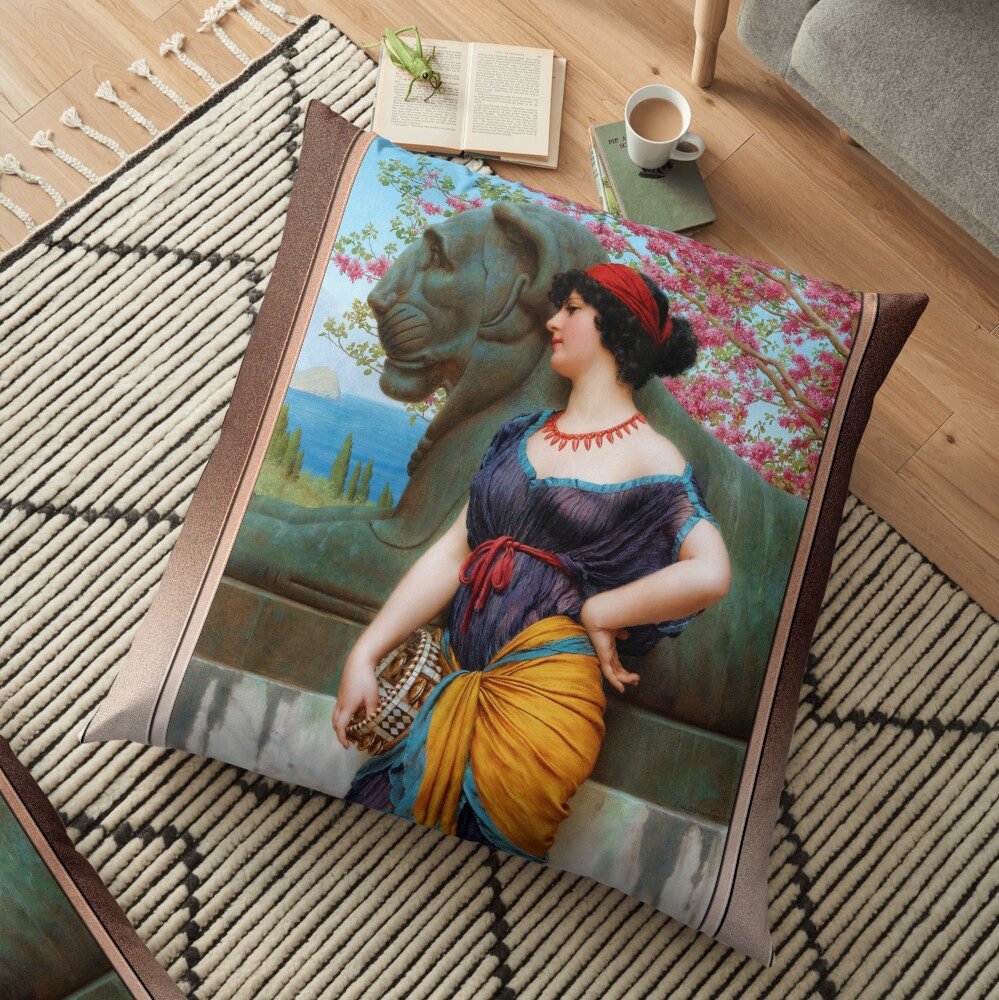
Tabla de contenido
El sujeto: The Woman in the Grove
The central subject of Godward’s piece is a young woman draped in flowing classical attire, reminiscent of the Greco-Roman style. Her rich, layered robes of indigo and yellow silk cascade down her figure with an intricate sense of movement. The contrast between the dark purple of the gown and the bright golden hue of the sash offers a rich, luxurious color palette that highlights the sensuality of the fabric as it clings to the woman’s curves. The light catches the delicate folds of her clothing, which seem to shimmer, as though alive with movement. Su postura, elegant yet relaxed, reflects the calm nature of the classical world that Godward is known for capturing in his works.
el rostro de la mujer, turned slightly toward the viewer, reveals a serene expression. Sus rasgos están finamente esculpidos., emphasizing the idealized beauty of women that was characteristic of Godward’s style. The small details such as her jewelry, un sencillo, yet elegant necklace, add to the sense of wealth and refinement. su cabello oscuro, pulled back and adorned with a red ribbon, complements the surrounding landscape and further enforces the sense of timeless grace. The woman appears absorbed in her surroundings, her gaze cast slightly down as if contemplating the ancient temple behind her, or perhaps reflecting on the mysteries of the past.
en sus manos, she holds a tambourine, which further connects her to the ritualistic and ceremonial life of the ancient world. This instrument, often associated with divine and sacred practices, hints at the religious or ritualistic theme of the painting, aligning with the temple’s association with Isis. The tambourine may also symbolize a connection to music and dance, which were intrinsic to the worship practices in ancient temples.
The Temple and The Setting
The painting’s background is dominated by the crumbling remnants of a classical temple, half-obscured by lush foliage. This juxtaposition between the temple ruins and the living woman symbolizes the enduring spirit of beauty amid the passing of time. las ruinas, which likely once formed part of a grand structure dedicated to Isis, appear weathered and aged, with portions of the stonework barely visible through the verdant overgrowth. This setting evokes the passage of centuries, with nature slowly overtaking human creations, but it also serves as a reminder of the power and grandeur of the ancient world.
Flanking the temple ruins are flowering trees, their pink blossoms in full bloom, creating a stark contrast to the ancient stone. El exuberante, almost dreamlike vegetation hints at a warm, Mediterranean climate, further connecting the work to the romanticized vision of antiquity. The flowers introduce a note of vitality, which not only enhances the visual beauty of the piece but also suggests the cyclical nature of life, with the blooming trees offering a sense of renewal in contrast to the decay of the temple. La luz, soft blues and greens of the distant landscape hint at the calm, peaceful existence of the classical world, a world where nature and humanity lived in harmony.
Materiales y técnica
Godward’s technique is characterized by meticulous attention to detail, as evidenced in every brushstroke of the fabric, the woman’s skin, and the architecture. The use of oil paints gives the piece its depth and richness, allowing Godward to play with texture and light to create an almost photographic realism. The smooth finish of the woman’s skin contrasts with the rough texture of the stone, while the translucent quality of her clothing enhances the softness of her form. Godward’s handling of light in the composition is another striking feature; the sunlight filtering through the trees highlights the contours of the woman’s face and body, while also casting soft shadows that create a sense of depth and realism.
El estado de ánimo y los temas
The overall mood of the painting is one of serenity and tranquility. The woman’s calm demeanor and poised stance convey a sense of peace, as though she is at one with the ancient world surrounding her. This peacefulness is further emphasized by the gentle presence of nature, with the flowering trees and soft landscape inviting contemplation and reflection. The colors, primarily rich purples, oros, and greens, create a harmonious balance that evokes a sense of timeless beauty and quietude.
Temáticamente, the painting touches on the idealization of ancient cultures, particularly those of Egypt and Rome, and the reverence for beauty that characterized the Neo-Classical movement. Godward’s ability to merge the ancient with the living, the mythological with the natural, brings forth an appreciation for the eternal aspects of culture and humanity. The temple ruins, la mujer, and the natural landscape together create a narrative of past grandeur and present serenity, reminding the viewer that beauty endures beyond the physical.
In The Grove Of The Temple Of Isis is a remastered digital art old masters reproduction of a public domain image that is available as metal, acrílico y impresiones en lienzo en línea.
Esta creación de arte digital, al igual que todas las obras de arte que se pueden encontrar en el sitio web de Xzendor7, están disponibles para su compra en línea en una variedad de formatos de materiales, incluidas impresiones en lienzo, impresiones acrílicas, impresiones de metal, impresiones de madera, láminas enmarcadas, carteles, y como lienzos enrollados en una variedad de tamaños, desde 12 pulgadas a 72 pulgadas según el tamaño de la obra de arte real y la tienda de impresión bajo demanda en la que elija comprar la obra de arte.
La obra de arte también está disponible en una amplia gama de prendas de vestir para hombres y mujeres., tazas, totalizadores, bufandas, cuadernos y diarios y muchos productos de decoración del hogar..
Biografía del artista
Información debajo de Wikipedia.org
John William Godward era el mayor de cinco hijos., y fue nombrado en honor a su padre John y su abuelo William.
Expuso en la Real Academia de 1887. Cuando se mudó a Italia con una de sus modelos en 1912, su familia rompió todo contacto con él e incluso cortó su imagen de las fotografías familiares. Godward regresó a Inglaterra en 1921, murio en 1922, y está enterrado en el cementerio de Brompton, oeste de Londres.
Uno de sus cuadros más conocidos es Dolce far Niente (1904), que fue comprado para la colección de Andrew Lloyd Webber en 1995. Como en el caso de varias otras pinturas., Godward pintó más de una versión; en este caso, una anterior (y menos conocido) 1897 versión con más 1906 versión.
Se suicidó a la edad de 61 y se dice que escribió en su nota de suicidio que “el mundo no es lo suficientemente grande para [ambas cosas] yo y un picasso”.
Su familia separada, que había desaprobado que se convirtiera en artista, se avergonzaron de su suicidio y quemaron sus papeles. Solo se sabe que sobrevive una fotografía de Godward.
Godward fue un neoclásico victoriano, y por lo tanto, En teoria, un seguidor de Frederic Leighton. sin emabargo, está más estrechamente aliado estilísticamente a Sir Lawrence Alma-Tadema, con quien compartía una inclinación por la interpretación de la arquitectura clásica, en particular, Características del paisaje estáticas construidas con mármol..
La gran mayoría de las imágenes existentes de Godward muestran a mujeres con vestimenta clásica posando contra elementos del paisaje.; aunque hay algunas figuras semidesnudas y completamente desnudas incluidas en su obra, un ejemplo notable es “En el Tepidarium c1913”.
Un título compartido con una controvertida pintura de Alma-Tadema del mismo tema que reside en el “Galería de arte Lady Lever”. Los títulos reflejan la fuente de inspiración de Godward; que fue la civilizacion clasica, más notablemente el de la antigua Roma; un tema que vincula a Godward estrechamente con Alma-Tadema artísticamente.
Dado que la erudición clásica estaba más extendida entre la audiencia potencial de sus pinturas durante su vida que en la actualidad., la investigación meticulosa de los detalles fue importante para lograr una posición como artista en este género.
Alma-Tadema fue arqueóloga además de pintora, quien asistió a sitios históricos y coleccionó artefactos que luego usó en sus pinturas: Hacia Dios, también, estudió detalles como la arquitectura y la vestimenta, para asegurar que sus obras llevaran el sello de autenticidad.
Además, Godward concienzudamente y meticulosamente representó otras características importantes en sus pinturas., pieles de animales de las cuales las pinturas “Descanso del mediodía c1910” y “Un retiro fresco c1910” contiene ejemplos de dicha interpretación, así como flores silvestres “Nerissa c1906” y “Flores de verano c1903”.
La aparición de hermosas mujeres en poses estudiadas en muchos de los lienzos de Godward hace que muchos recién llegados a sus obras lo clasifiquen erróneamente como prerrafaelita., particularmente porque su paleta es a menudo de colores vibrantes. La elección del tema (civilización antigua versus, por ejemplo, leyenda artúrica) es más propiamente la del neoclásico victoriano.
En común con numerosos pintores contemporáneos a él., Godward era un 'soñador alto victoriano', producir imágenes de un mundo idealizado y romantizado que, en el caso de Godward y Alma-Tadema, llegó a ser criticado como una visión del mundo de los victorianos en togas.
Hacia Dios “rápidamente estableció una reputación por sus pinturas de mujeres jóvenes en un escenario clásico y su capacidad para transmitir con sensibilidad y maestría técnica la sensación de texturas contrastantes de la carne., mármol, pieles y telas.
La inclinación de Godward por crear obras de arte ambientadas en el período clásico probablemente provino del período de tiempo en el que nació.; ya que fue el último renacimiento clásico a gran escala en pinturas occidentales, que floreció en Inglaterra desde la década de 1860 hasta la de 1890.