

Jupiter in der Gestalt von Diana, and the Nymph Callisto
Jupiter in der Gestalt von Diana, und die Nymphe Callisto c1759 von French Painter Francois Boucher (1703 – 1770); auch als Zeichner bekannt, Kupferstecher und Dekorateur im französischen Rokoko-Stil, that was well known for his lavish mythological, allegorische und erotische Motive und war der Hofmaler Ludwigs XV. und ein Favorit der Marquise de Pompadour.
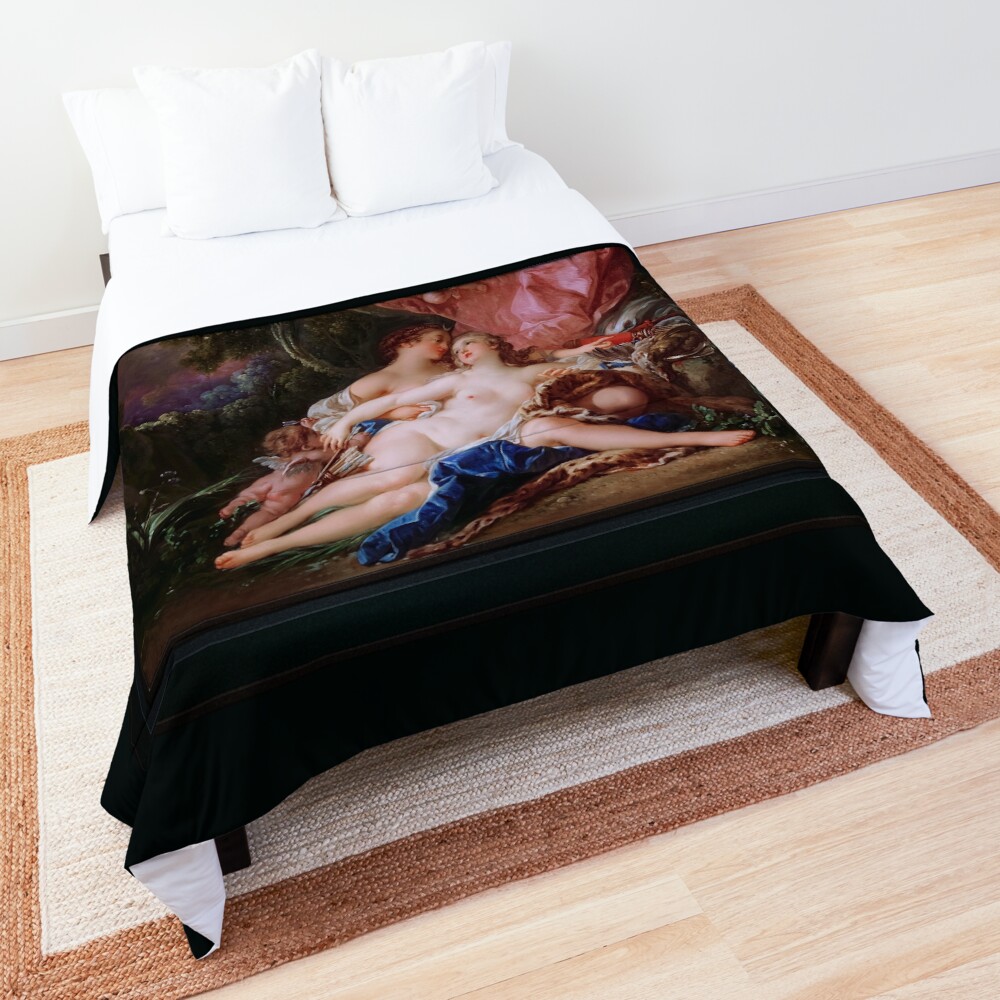
This is a beautiful scene depicting the characters from Roman mythology Jupiter (The Eagle), Diana (Göttin der Jagd), and Callisto the favorite Nymph of Diana.
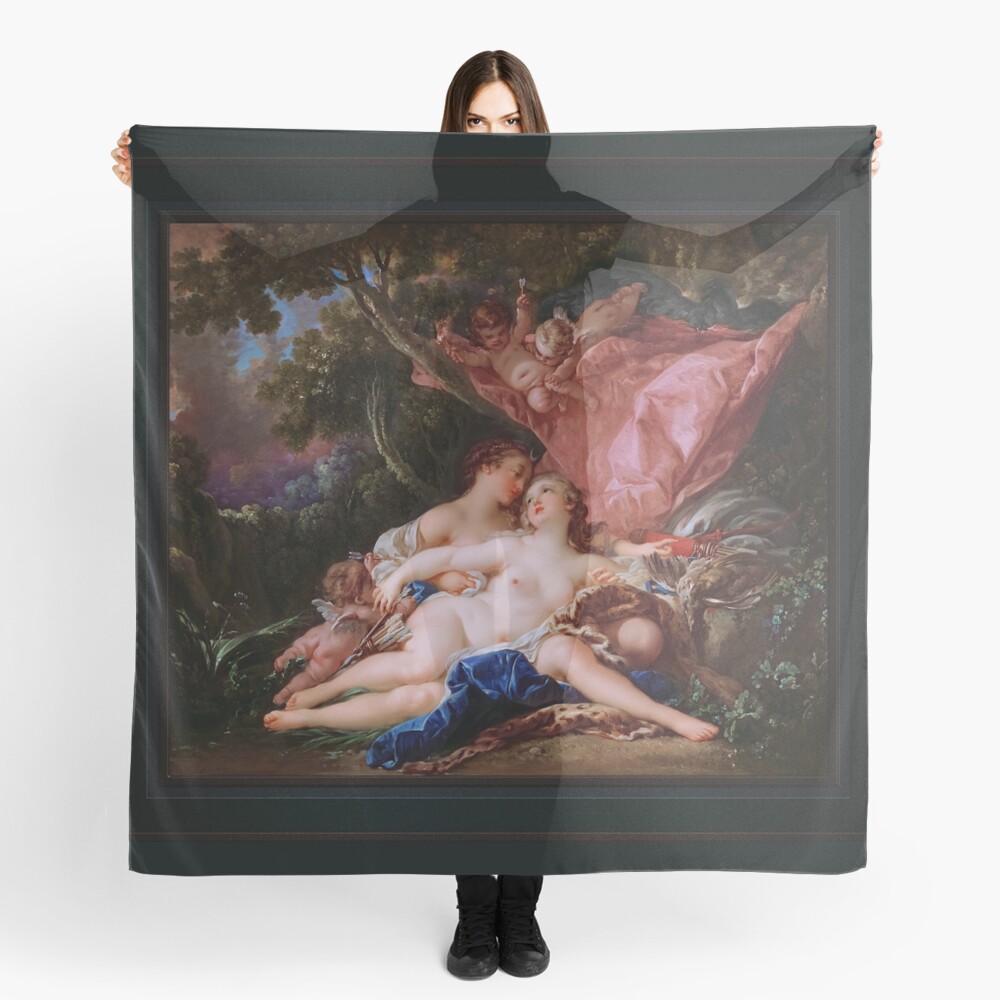
In this forest scene we can see six figures, two cherubs in a tree with a large rose drape hanging from one of its outstretched limbs, near the eagle Jupiter looking down on what appears to be Diana and her Nymph Callisto, with one holding an arrow in his left hand; with another on the ground by the pond that Diana and her Nymph Callisto are laying near with an arrow in its left hand and a quiver filled with arrows by its right side.
Jupiter, the King of the Gods taken by the beauty of Callisto, disguises himself as the huntress Diana to seduce her; embracing her while they relax by the pond on a cushion of leaves, a blue garment and leopard skin.
By the couple is a boulder that has on it a brown bird resting on the chest of light colored bird that has had its throat cut, with blood staining the rock.
Behind the birds is a red quiver filled with arrows and a bow and another wrapped up grey colored garment, that rest just under the pink drape and the eagle Jupiter.
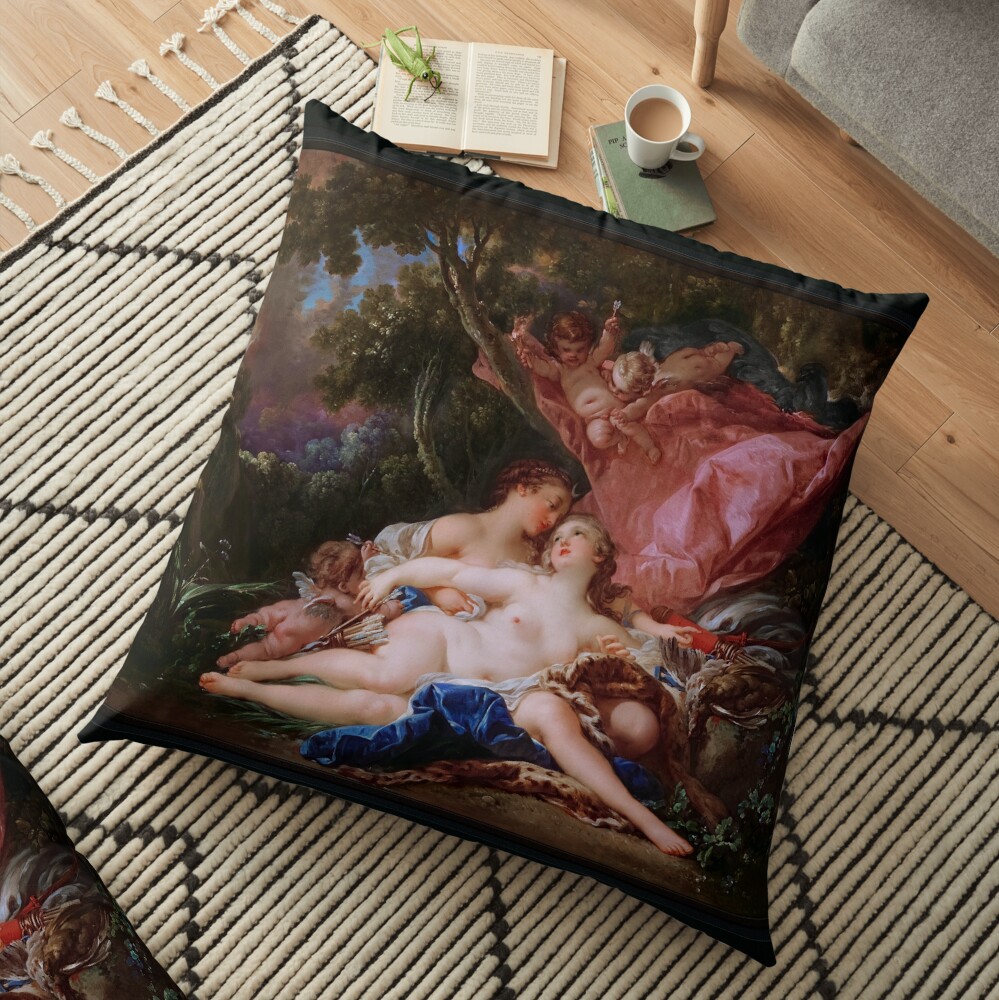
In the background is a colorful forest of many different hues and a light blue sky filled with many colored clouds, that seems to be illuminated by a setting sun.
Jupiter in der Gestalt von Diana, and the Nymph Callisto is a remastered digital art old masters reproduction of a public domain image that is available as a Leinwanddruck online.
Info unten abgeleitet von Wikipedia.org
Ein gebürtiger Pariser, Boucher war der Sohn eines weniger bekannten Malers Nicolas Boucher, wer gab ihm seine erste künstlerische Ausbildung. Im Alter von siebzehn Jahren, Ein Gemälde von Boucher wurde vom Maler François Lemoyne bewundert. Lemoyne ernannte später Boucher zu seinem Lehrling, aber nach nur drei Monaten, Er arbeitete für den Kupferstecher Jean-François Cars.
Im 1720, Er gewann den Elite Grand Prix de Rome für Malerei, nutzte aber erst fünf Jahre später die Gelegenheit, in Italien zu studieren, aufgrund finanzieller Probleme an der Royal Academy of Painting and Sculpture.[1] Nach seiner Rückkehr vom Studium in Italien wurde er in die neu gegründete Académie de Peinture et de Sculpture am aufgenommen 24 November 1731. Sein Empfangsstück (Empfangsstück) war sein Rinaldo und Armida von 1734.
Boucher heiratete Marie-Jeanne Buzeau in 1733. Das Paar hatte drei Kinder zusammen. Boucher wurde Fakultätsmitglied in 1734 und seine Karriere beschleunigte sich von diesem Punkt an, als er zum Professor und dann zum Rektor der Akademie befördert wurde, Inspektor der Royal Gobelins Manufaktur und schließlich Premier Peintre du Roi (Erster Maler des Königs) im 1765. Porträt von Marie-Louise O’Murphy c. 1752
Boucher starb am 30 Kann 1770 in seiner Heimat Paris. Sein Name, zusammen mit dem seiner Patronin Madame de Pompadour, war zum Synonym für den französischen Rokoko-Stil geworden, die Goncourt-Brüder zum Schreiben führen: “Boucher ist einer jener Männer, die den Geschmack eines Jahrhunderts repräsentieren, die ausdrücken, personifizieren und verkörpern es.”
Boucher ist berühmt dafür, dass die Natur es ist “zu grün und schlecht beleuchtet” (zu grün und schlecht beleuchtet).
Boucher war mit dem Edelsteinstecher Jacques Guay verbunden, wen er lehrte zu zeichnen. Er betreute auch den mährisch-österreichischen Maler Martin Ferdinand Quadal sowie den neoklassizistischen Maler Jacques-Louis David in 1767.[4] Später, Boucher fertigte eine Reihe von Zeichnungen von Werken Guays an, die Madame de Pompadour dann gravierte und als hübsch gebundenen Band an bevorzugte Höflinge verteilte