

La infanta Luisa Fernanda de Borbón, Duquesa de Montpensier
La infanta Luisa Fernanda de Borbón, Duquesa de Montpensier c1851 by Spanish Painter Federico de Madrazo y Kuntz (1815 – 1894); también litógrafo, escritor y político.
This is an elegant portrait of Luisa Fernanda de Borbón (1832 – 1897) the youngest daughter of King Ferdinand VII (1784 – 1833) of Spain and is fourth wife Maria Christina (1806 – 1878) of the Two Sicilies, the queen-regent, who also happened to be his niece.
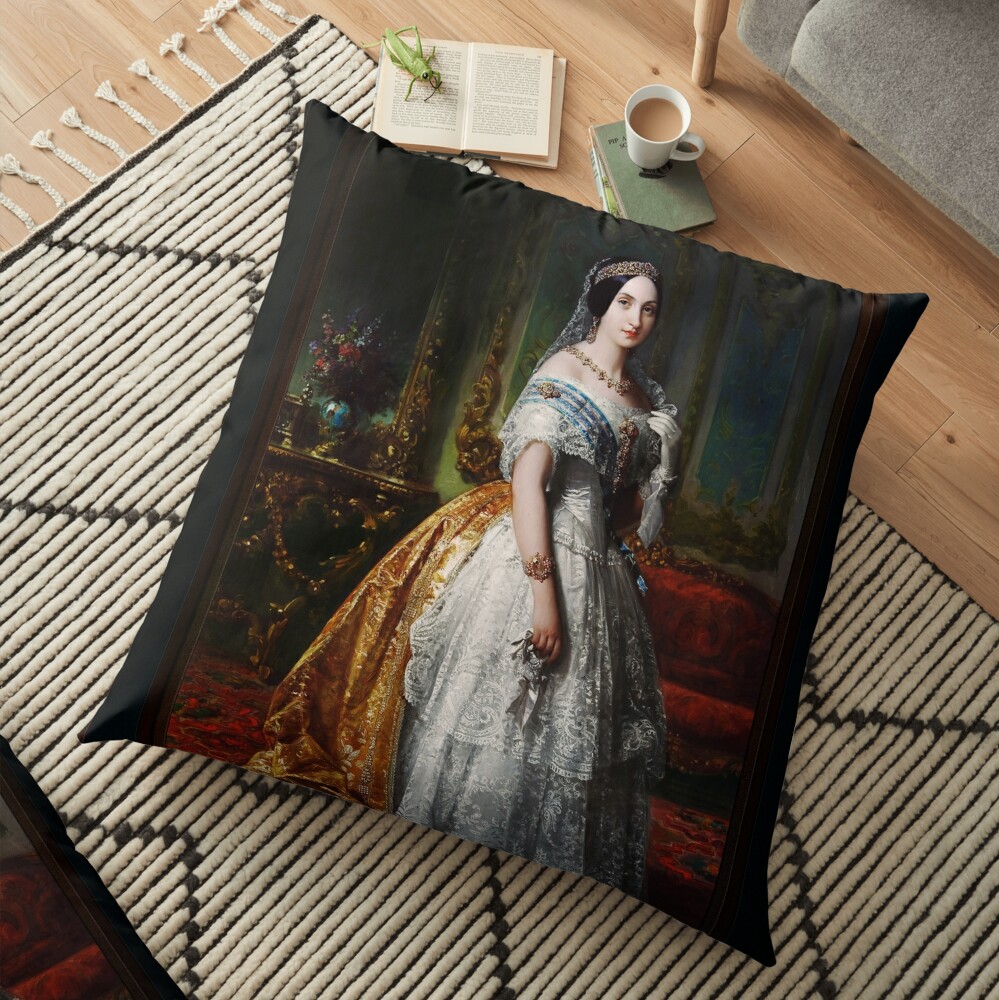
She is posed in a large lavish room standing on a colorfully patterned red carpet, which has in the background to the left of the image, a large wall mirror with gold accent gilding, that is positioned over an elaborately carved gold gilded table that has on top of it a decorative gold box, a beautiful blue spherical vase with a floral gold stand containing a bouquet of flowers.
In the middle wall panel is more decorative gilded wood work and a sculpted face high up; and on the last wall panel that has more decorative wood work is a decorative wall shelf with a blue vase on it and below that a decorative love with a gilded wood border.
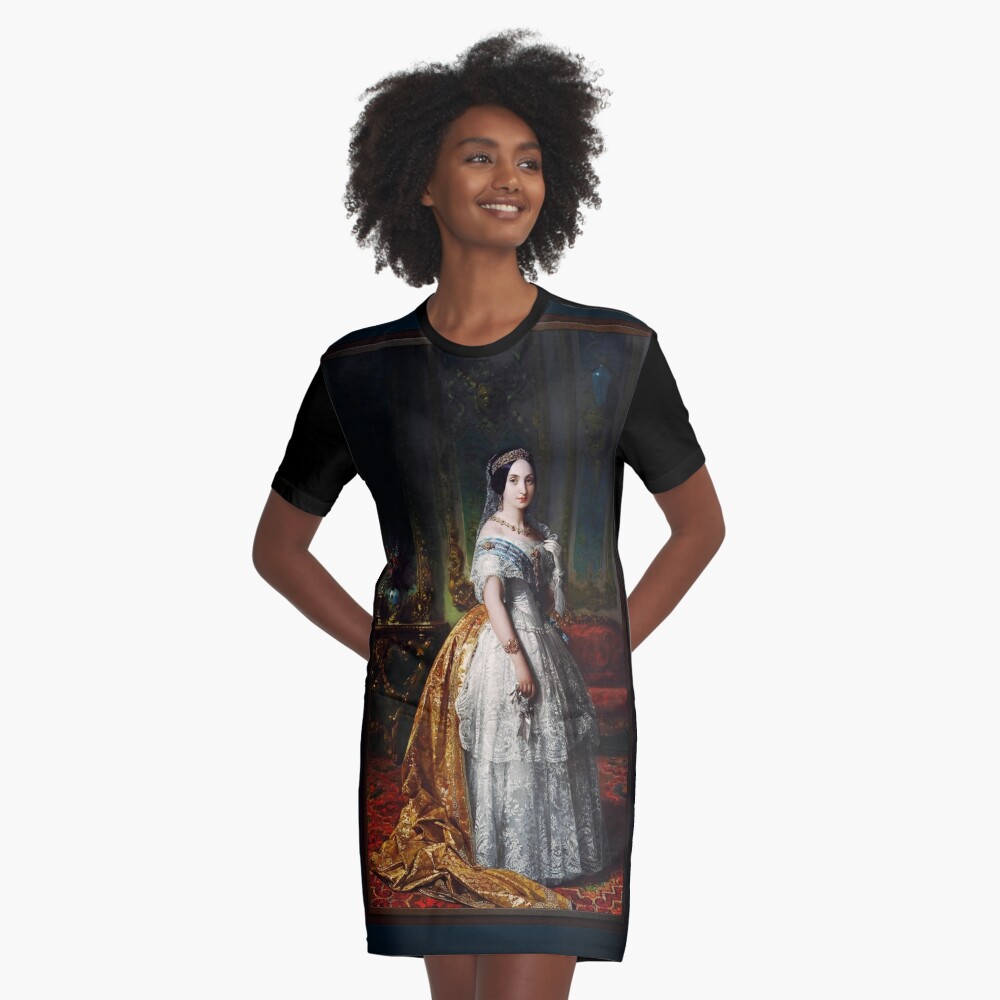
Luisa is shown wearing a full length white embroidered lace gown that is complemented by a gold tail like trailing material with silver floral embroidered details and pearls, that flows from the back of her dress at the waist and wraps around to her right side on the floor.
She has a royal blue, white and pink sash that carries from her right shoulder down to the left side of her waist with an attached blue and white ribbon hanging from her left side.
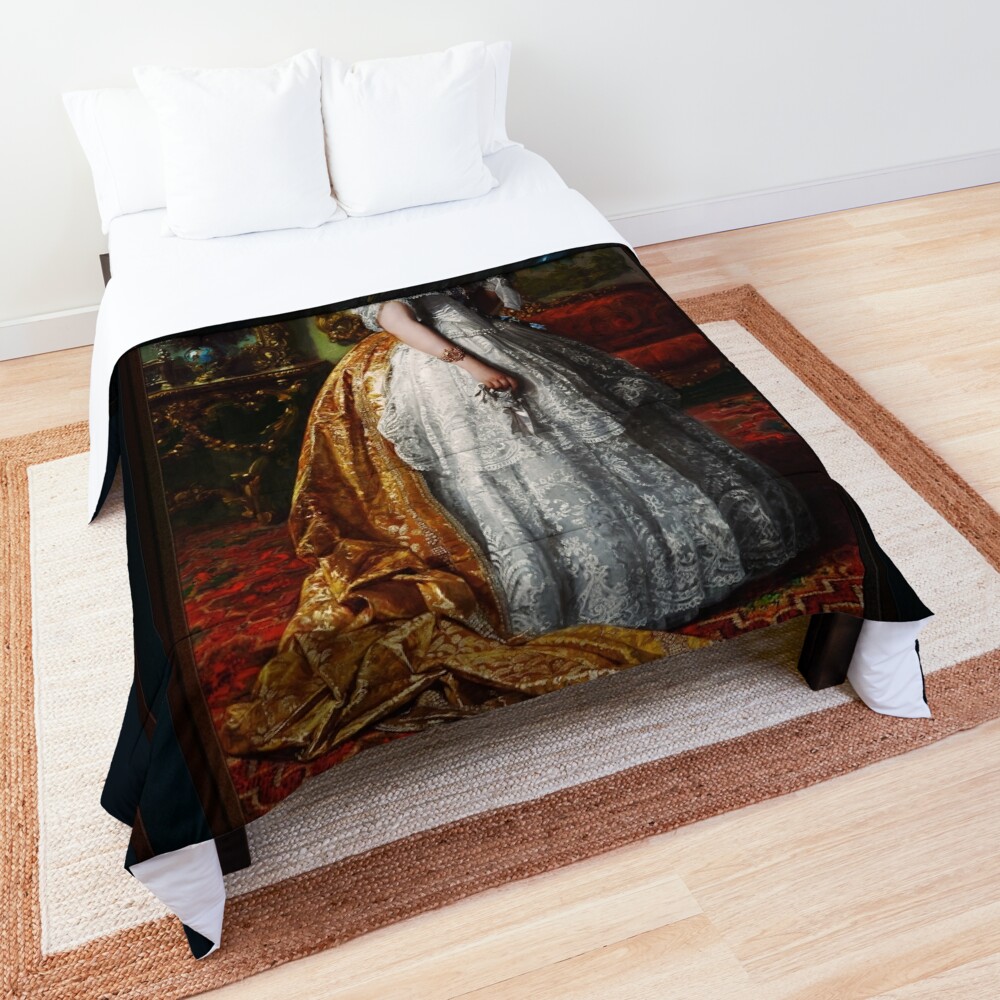
On her left hand which is positioned near the left side of her chest has a white silk evening glove on to and sheer handkerchief tucked into it; while her right hand holds the other evening clove to the right side of her body.
On her black hair, hang from the back she has a silk white lace kerchief that matches her dress; and around her head she is wearing a tiara comprised of silver and gold, with ruby gemstone.
The tiara is complemented with earrings, a necklace, a bracelet, a large brooch on the front of her dress and two smaller ones on the shoulders of the dress that bear the same and similar pattern.
La infanta Luisa Fernanda de Borbón, Duquesa de Montpensier is a remastered digital art old masters reproduction of a public domain image that is available as a metal, acrílico, madera, impresión de la lona en línea.
Información a continuación derivada de Wikipedia.org
Federico was born in Rome to José de Madrazo y Agudo (1781 – 1859), pintor y exdirector del Museo del Prado; y fue parte de una línea de grandes artistas, eso incluía a su abuelo por parte de su madre; Tadeusz Kuntze (1733 – 1793), un pintor polaco.
Otros miembros de esta familia creativa incluyen a sus hermanos., quiénes fueron el pintor luis de madrazo (1825 – 1897), Pedro de Madrazo (1816 – 1898), un crítico de arte y Juan de Madrazo (1829 – 1880), un arquitecto.
Entre los hijos de Federico se encontraba el pintor Ricardo de Madrazo. (1851 – 1917), Raimundo de Madrazo y Garreta (1841 – 1920) and Cecilia de Madrazo y Garreta (1846 – 1932) que se casó con el gran artista orientalista, Marià Fortuny (1838 – 1874).
La familia Madrazo ha sido descrita como una de las dinastías pictóricas españolas más importantes del siglo XIX.; que dominó por completo la pintura en España durante ese período.
Federico comenzó a recibir lecciones artísticas de su padre., y mientras aún asistía a la Real Academia de San Fernando, pintó su primer cuadro La resurrección de Cristo c1829; que fue comprado por la reina Cristina.
Poco después de esa pintura, creó a Aquiles en su tienda., y luego presentó a la Academia La Continencia de Escipión, lo que le aseguró la admisión como miembro “por mérito”.
Tres años más tarde, Federico se fue a París, donde estudió en Franz Winterhalter y pintó retratos del barón Taylor e Ingres. (un pintor neoclásico francés).
En 1837 recibió el encargo de crear un cuadro para la galería de Versalles, por lo que pintó “Godofredo de Bouillon proclamado rey de Jerusalén”; poco después regresó a Roma y emprendió proyectos creando retratos para la aristocracia española.