

Der Schlaf: A Study in Restful Repose by Aimée Pagès-Brune
Aimée Pagès-Brune (1803 – 1866) was a French artist whose career flourished during the Romantic era, a period known for its emphasis on emotion and individualism. While less celebrated than some of her contemporaries, Pagès-Brune carved out a significant space for herself within the Parisian art scene, particularly recognized for her intimate depictions of women in domestic settings. “Der Schlaf,” or “The Sleep,”Herumgemalt 1830, exemplifies this focus, offering a glimpse into a private moment of tranquility and vulnerability. The artwork is currently housed at Musée Crozatier in Le Mans, Frankreich.
Inhaltsverzeichnis
Kompositionselemente & Technik
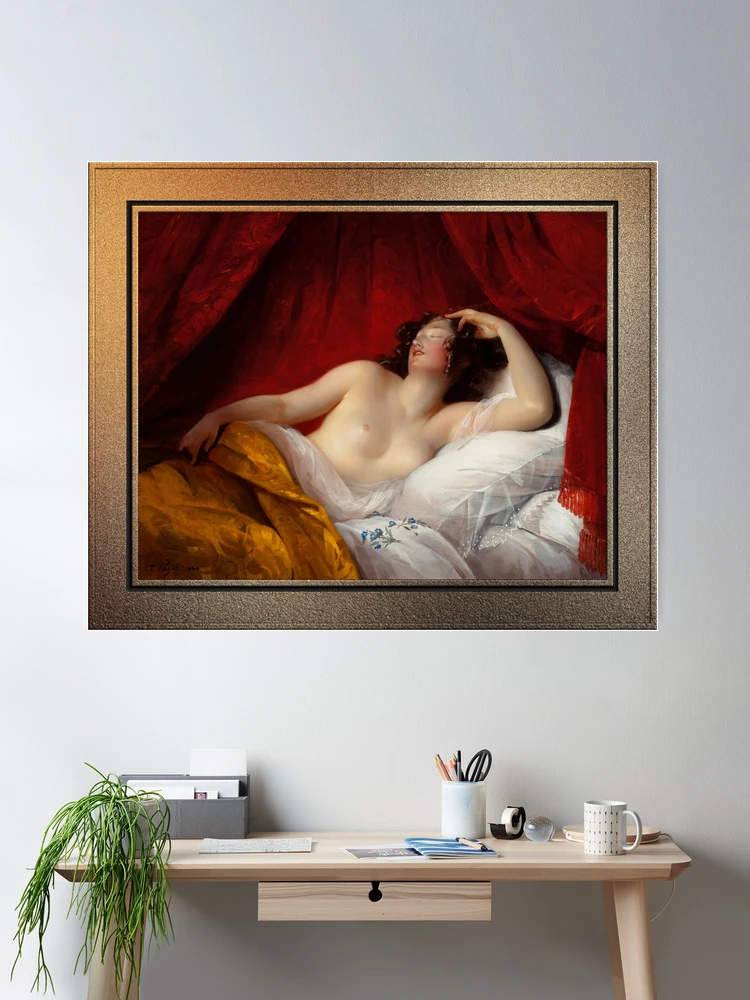
The painting’s composition immediately draws the viewer’s attention to the central figure: ein nackt woman reclining languidly upon a bed. The arrangement isn’t rigidly structured; stattdessen, it possesses an organic flow that mirrors the naturalness of sleep itself. Pagès-Brune masterfully utilizes a triangular structure, with the woman forming the apex and the draped fabrics creating the base. This compositional choice provides stability while simultaneously guiding the eye across the canvas.
The artist’s technique is characterized by loose brushstrokes and a delicate handling of light and shadow. The application of paint isn’t smooth or blended; eher, it retains a visible texture that contributes to the overall sense of immediacy and intimacy. This approach aligns with the Romantic aesthetic, which favored expressive mark-making over meticulous realism. The use of impasto is evident in areas like the folds of the bedclothes and the highlights on the woman’s skin, der Szene Tiefe und Dimension verleihen.
Farbpalette & Beleuchtung
A rich and warm color palette dominates “Le Sommeil.” The dominant hues are variations of red, Creme, und Gold, creating a sense of warmth and comfort. A large crimson curtain forms a dramatic backdrop, its deep tones contrasting with the lighter shades of the bed linens and the woman’s skin. This contrast enhances the figure’s luminosity and draws attention to her form.
Die Beleuchtung im Gemälde ist weich und diffus, suggesting an early morning or late evening hour. It appears to emanate primarily from an unseen source outside the frame, gently illuminating the scene without harsh shadows. The subtle gradations of light across the woman’s body highlight the curves of her form while maintaining a sense of quietude. The interplay of light and shadow contributes significantly to the painting’s overall mood of peacefulness and repose.
Thema & Kontext
“Der Schlaf” is part of a broader artistic trend in 19th-century France that focused on depicting scenes of domestic life, particularly those involving women. These paintings often explored themes of privacy, Intimität, and the idealized image of womanhood within the home. jedoch, Pagès-Brune’s approach differs from some of her contemporaries; she avoids overt sentimentality or moralizing narratives. Stattdessen, she presents a straightforward observation of a woman at rest, emphasizing the beauty and serenity of the moment.
The painting reflects the broader cultural context of the Romantic era, which valued emotion, Vorstellung, and individual expression. The focus on interior spaces and private moments aligns with this emphasis on subjectivity and introspection. While not overtly political or socially critical, “Der Schlaf” subtly challenges conventional representations of women by portraying her in a state of vulnerability and relaxation, free from the constraints of public scrutiny.
Künstlerische Einflüsse & Vermächtnis
Pagès-Brune’s work demonstrates influences from several artistic traditions. The composition and subject matter bear similarities to works by artists like Jean-Auguste-Dominique Ingres, known for his neoclassical depictions of female figures in repose. jedoch, Pagès-Brune’s looser brushwork and more expressive use of color distinguish her style from Ingres’s precise and polished technique.
Außerdem, the painting echoes elements found in the works of earlier masters like Peter Paul Rubens, particularly in its depiction of the human form and the dramatic use of drapery. Pagès-Brune skillfully synthesizes these influences into a unique artistic voice that is both elegant and emotionally resonant.
Despite being somewhat overlooked during her lifetime, Pagès-Brune’s legacy has been reevaluated in recent decades. “Der Schlaf” stands as a testament to her talent and vision, offering a compelling glimpse into the world of 19th-century French art and the evolving role of women artists within that sphere. The painting remains an important example of Romantic era artistry, celebrated for its intimate portrayal of feminine repose and skillful execution.
Retouching Video Of The Classical Fine Art Piece Der Schlaf c1830 by Aimée Brune Pagès
Künstler Bio abgeleitet von Wikipedia.org
Aimée Brune Pagès war Schülerin des französischen Historienmalers Charles Meynier (1763 oder 68 – 1832) von Ereignissen des späten 18. und frühen 19. Jahrhunderts. Während ihrer Zeit stand sie unter der Herrschaft mehrerer politischer Regime, das beinhaltete Die Restauration, Die Juli-Monarchie, Die Zweite Republik und das Zweite Imperium.
Sie gilt als eine der angesehensten französischen Malerinnen, und sie stellte regelmäßig im Salon von . aus 1822 zu 1853; manchmal in Zusammenarbeit mit ihrem Mann, dem französischen Landschaftsmaler Christian Brune (1793 – 1849).
Dies ist eine retuschierte Reproduktion eines gemeinfreien Bildes durch digitale Meister alter Meister.