

Maureen O’Hara
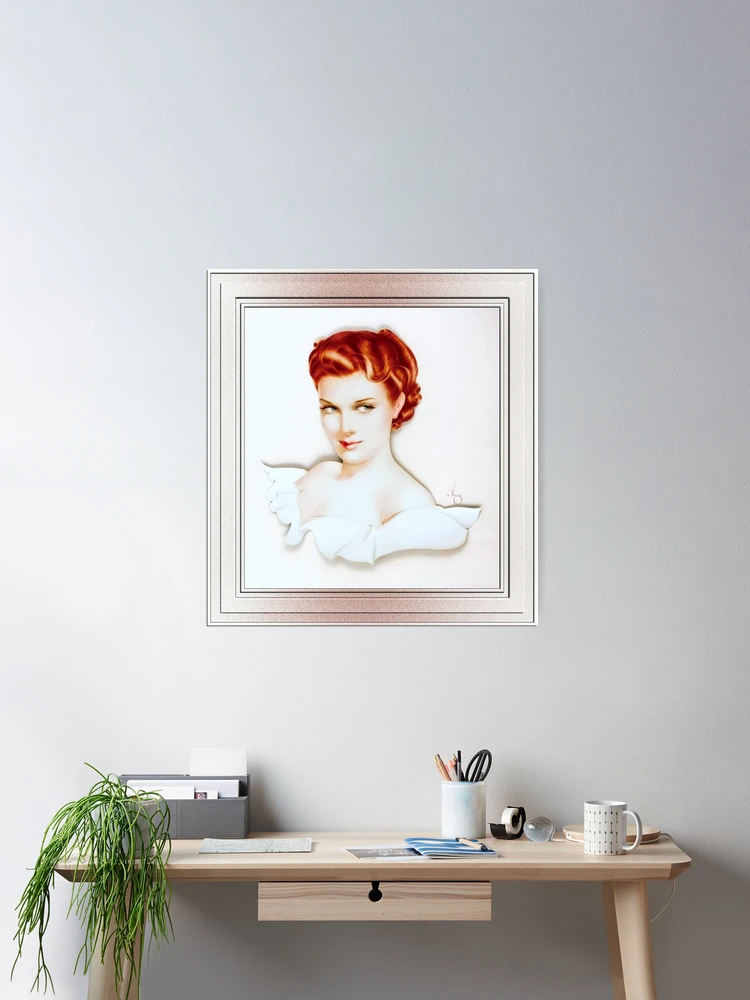
Maureen O’Hara by the celebrated Peruvian artist Ìomhaigh neach-àite Alberto Vargas, renowned for his captivating and sensual portrayals of women, ann am meadhan an 20mh linn. Rugadh e a-steach 1896 and active for much of the 20th century until his death in 1982, Vargas brought a unique style to pin-up and portrait art that highlighted the idealized form of beauty. Anns an dealbh seo, he captures the famous actress Maureen O’Hara in an intimate and glamorous manner, reflecting both her allure and the timeless charm of classic Hollywood.
Vargas’s depiction of Maureen O’Hara is done in a soft, yet highly detailed manner that emphasizes the delicacy of the human form while maintaining a sense of naturalism. The work showcases his characteristic airbrush technique, wherein he utilized smooth, almost ethereal transitions of light and shadow to create an almost dreamlike representation of the subject. The figure of O’Hara is presented in a close-up portrait, her face framed by soft curls of red hair and delicate makeup that highlights her striking features—her sharp eyebrows, Làn na bilean, and intense gaze. The warm tones of her skin are complemented by the soft, neutral background, which ensures that the viewer’s attention remains solely on her serene expression.
Clàr-innse
Am Prìomh Chuspair: Maureen O’Hara
At the heart of this piece is the famed Irish-American actress Maureen O’Hara, widely recognized for her roles in Hollywood classics such as The Quiet Man agus Miracle on 34th Street. Her signature fiery red hair, as portrayed in this artwork, remains one of her most iconic attributes, and Vargas renders it with great care and attention to detail. The hair cascades in soft waves around her face, creating a fluid and almost graceful movement that adds to the dynamic quality of the composition.
Her facial expression is one of quiet confidence, tinged with a slight hint of a smile that suggests mystery and warmth. The gaze that O’Hara directs toward the viewer is compelling and magnetic, further enhancing the portrait’s allure. The artist has captured her in a moment of vulnerability and strength, an eternal quality that speaks to her larger-than-life presence as a film star. O’Hara’s features are depicted in delicate yet exaggerated forms—her cheeks flushed, lips slightly parted, and eyes slightly narrowed—as though she is caught in the midst of a moment, reòta ann an ùine.
Na stuthan agus na dòighean-obrach
Alberto Vargas was known for his exquisite use of airbrushing, a technique he mastered to perfection. His use of smooth gradients and soft transitions between highlights and shadows allows the subject to appear almost luminescent, as if glowing. An cùl-raon, air a thoirt seachad ann am bog, muted tones of beige and light cream, contrasts delicately with the vibrancy of O’Hara’s red hair and the warmer tones of her skin. The fine details of her collarbone and shoulders are emphasized with precise brushstrokes, giving the work a three-dimensional quality that heightens the realism of the subject.
The medium of Vargas’s work often combined airbrush and watercolor, which allowed for the fine detail and soft transitions seen in this portrait. His understanding of color, particularly the warm tones of the skin and the coolness of the background, reflects his mastery of light and shadow. The careful rendering of the fabric of O’Hara’s gown—soft, voluminous ruffles in white—conveys a sense of refinement and elegance. The contrast of her white attire against the beige background further accentuates the richness of her features and the glowing quality of her skin.
Stoidhle agus mood
Vargas’s style is often associated with the glamour and sensuality of the 1940s and 1950s pin-up art, yet it transcends mere eroticism by focusing on the beauty and elegance of the human form. His figures are often idealized, exuding a sense of grace, sòghalachd, and feminine strength. Ann an Maureen O’Hara, the artist takes these qualities and applies them to a portrait that is both intimate and reverential, as though capturing a moment of pure beauty.
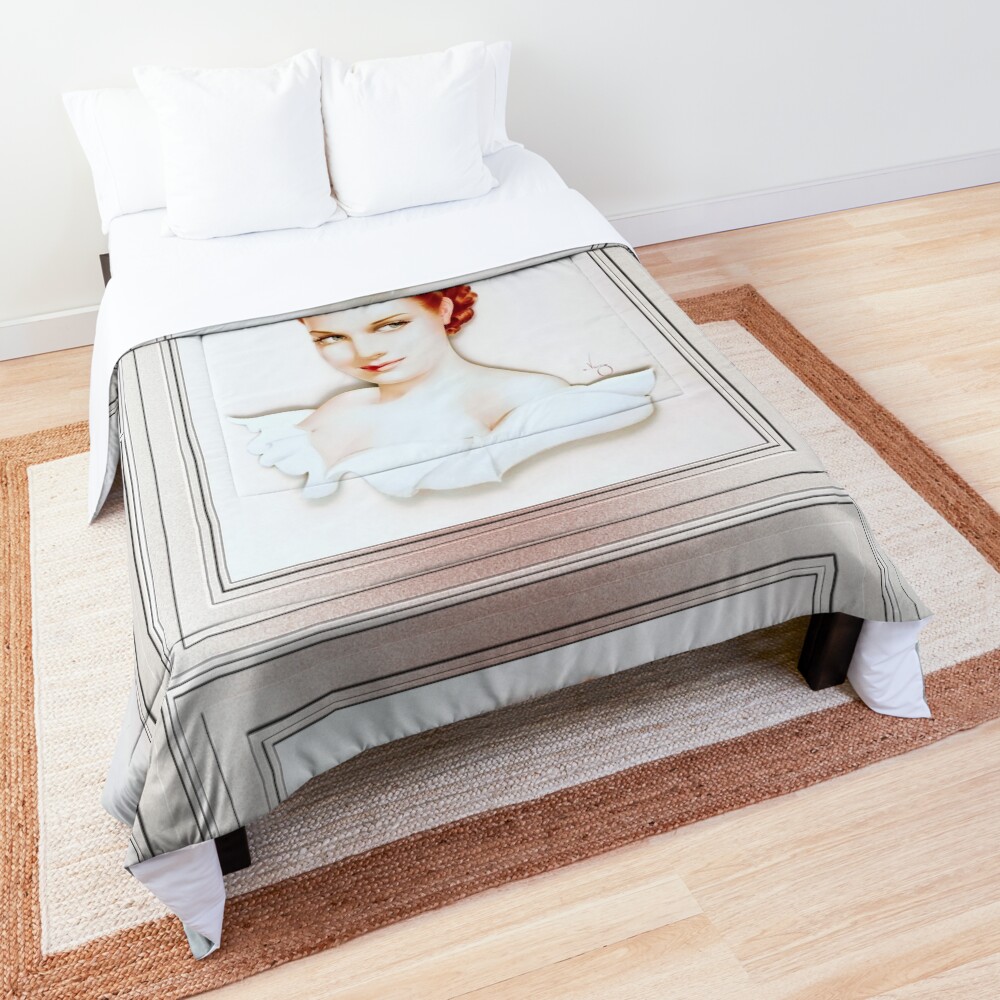
The mood of the artwork is both serene and alluring, striking a balance between tenderness and seduction. Am bog, subtle lighting that Vargas applies to O’Hara’s face lends the portrait an almost ethereal quality, inviting the viewer to not only admire the subject’s external beauty but also to feel a connection with the person portrayed. The calmness of her demeanor contrasts with the underlying sensuality of her appearance, emphasizing the complexity of her persona as both a film star and an icon.
Vargas’s rendering of Maureen O’Hara could be seen as an homage to the actress’s cinematic roles, where she often portrayed strong, spirited characters. The softness of the image, paired with the strength of her gaze, conveys the duality of her on-screen persona—elegant and graceful, yet undeniably powerful.
Overall Theme
The overall theme of the portrait reflects the Hollywood glamor and the Golden Age of cinema. Maureen O’Hara’s timeless beauty is preserved here not just as a movie star, but as an embodiment of the cultural ideal of feminine allure that permeated the mid-20th century. Vargas captures the essence of O’Hara’s star power, making her a muse in his work. The image speaks to the way in which Hollywood icons were immortalized through art, capturing not just their physical appearance but the emotional resonance they carried as symbols of beauty, neart, agus gràs.
Co-dhùnadh
Tha alberto vargas Maureen O’Hara is a portrait that transcends the simple act of likeness; it is an exploration of the complex emotions and ideals that the actress represented. The airbrushed delicacy, the soft rendering of her face, and the subtle interplay of light and shadow invite the viewer into a world of vintage glamour. As with many of Vargas’s works, this piece is a celebration of femininity, eireachdas, agus ciallity, capturing a moment in time that forever immortalizes O’Hara’s presence both on and off the screen.
Is e seo seann mhaighstirean cadail ath-chuairteachaidh air ath-shuidheachadh ìomhaigh fearann poblach a tha ri cheannach mar clò-bhualadh canabhas air-loidhne.
Neach-ealain Bio
Fiosrachadh gu h-ìosal bho Wikipedia.org
Rugadh e ann an Arequipa, Peru, bha e na mhac leis an dealbhadair ainmeil Peruach Max T.. Vargas. Ghluais Alberto Vargas dha na Stàitean Aonaichte a-steach 1916 às deidh dha sgrùdadh a dhèanamh air ealain san Roinn Eòrpa, Zurich, agus Geneva ron Chiad Chogadh.
Fhad ‘s a bha e san Roinn Eòrpa thàinig e air an iris Frangach La Vie Parisienne, le còmhdach le Raphael Kirchner, a thuirt e a thug buaidh mhòr air an obair aige.
Bha a dhreuchd tràth ann an New York a ’toirt a-steach obair mar neach-ealain airson na Ziegfeld Follies agus airson mòran stiùidio Hollywood. Chroch Ziegfeld an dealbh aige de Olive Thomas aig an taigh-cluiche, agus bhathas den bheachd gur i aon de na caileagan Vargas as tràithe.
Vargas’ bha am pìos film as ainmeil airson postair an 1933 film The Sin of Nora Moran, a tha a ’sealltainn Zita Johann a tha cha mhòr lomnochd ann an suidheachadh dòrainn. Tha am postair air ainmeachadh gu tric mar aon de na postairean film as motha a chaidh a dhèanamh a-riamh.
Bha e ainmeil fad is farsaing anns na 1940an mar neach-cruthachaidh ìomhaighean ainmeil àm an Dàrna Cogaidh airson an iris Esquire ris an canar “Nigheanan Vargas.” Eadar 1940 agus 1946 Vargas air a thoirt a-mach 180 dealbhan airson an iris.
Chaidh ealain sròin mòran de phlèanaichean Ameireagaidh agus an Dàrna Cogadh a bhrosnachadh agus atharrachadh bho na h-iomairtean prìne Esquire sin, a bharrachd air an fheadhainn aig Seòras Petty, agus luchd-ealain eile.