

Portrait vun enger Fra
Franz Xaver Winterhalter’s Portrait vun enger Fra (c. 1850s) stands as a quintessential representation of mid-19th-century European portraiture. Wanterschlof (1805 – 1873), a German artist renowned for his highly polished, elegant works; and older brother of German painter Hermann Fidel Winterhalter (1808 – 1891), often painted the aristocracy and elite of Europe, capturing them in ways that highlighted both their opulence and refinement.
Dëse Portrait, an example of his mastery, features a lady in a delicate pose, her somber yet poised expression framed by the soft, almost ethereal quality of her attire and the setting. Dem Kënschtler seng virsiichteg Opmierksamkeet op Detailer, and his ability to create lifelike textures and warm tones, bring the subject to life with remarkable realism and grace.
Inhaltsverzeechnes
D'Thema a Kompositioun
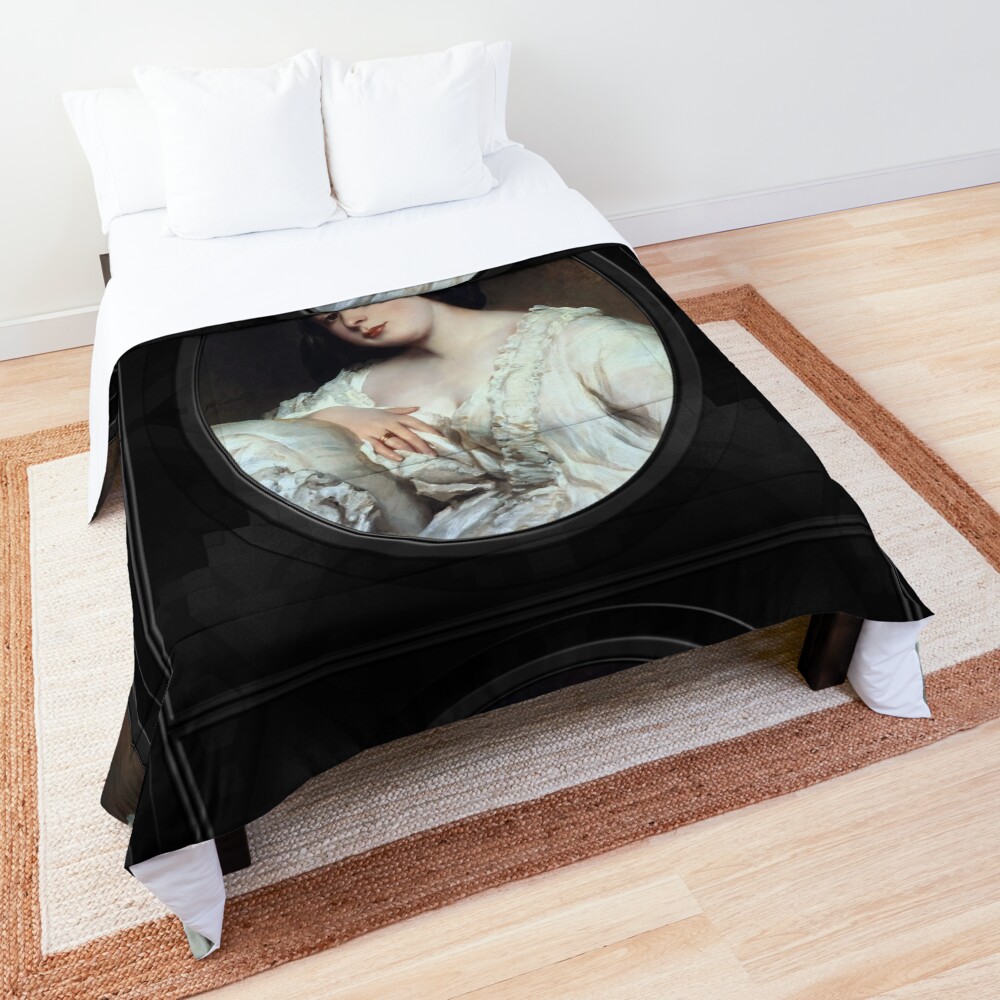
The portrait is a close-up of a young lady, likely from the European upper classes, given the sophistication and quality of her attire. Her white gown, characterized by soft ruffles and intricate folds, drapes gently across her shoulders and chest, creating a sense of movement and grace.
Her calm yet enigmatic expression is the focal point of the piece, drawing the viewer’s attention to her delicate features. The lady’s dark hair, parted in the center and styled in a smooth, controlled manner, contrasts beautifully with the light fabric of her dress, enhancing the overall balance of light and dark within the composition.
Her hand rests lightly on her lap, fingers elegantly spread, with a ring visible on her left hand, signifying her status and perhaps an important relationship or heritage. The subtle gesture adds an air of refinement and nobility to the scene, encapsulating the dignity of the subject. Winterhalter captures the soft textures of her skin and the luminosity of her skin tone with the same reverence that he bestows upon the fabric of her gown. This is a hallmark of his style, an obsession with texture that enhances the lifelike quality of the subjects he painted.
Materialien an Technik
Winterhalter worked with oils, employing a layered technique that allowed him to achieve remarkable depth and nuance in his colors. Der mëller, almost translucent nature of the lady’s white dress suggests Winterhalter’s ability to master the subtleties of fabric, creating lifelike textures that capture the way light interacts with different materials. The texture of her skin, delicate and luminous, is painted with equal precision, as is the smoothness of her black hair, which appears to shimmer under the light.
The use of shadows in the portrait is also striking. Winterhalter’s mastery of chiaroscuro, where light and dark are carefully balanced, gives the painting a sense of three-dimensionality, making the subject appear as though she could step off the canvas. The background is softly blurred, with dark, muted tones that help the figure stand out sharply. Dës Technik, which blurs the boundary between figure and ground, is characteristic of the artist’s work and helps the viewer focus entirely on the subject, free from distraction.
Thema a Stëmmung
The overall theme of this portrait can be understood as one of quiet elegance, vun wou Schéinheet, Adel, and refinement are represented not through grand gestures but through subtlety and restraint. The lady in the portrait, while dressed in a lavish gown, does not express exuberance or overt joy. Amplaz, there is an air of quiet contemplation or perhaps melancholy. Her serious expression suggests introspection, possibly hinting at the societal pressures or expectations placed upon women of her class during the time.
The mood of the painting is serene and dignified. Déi gedämpft Faarfpalette, with its emphasis on soft whites, schwaarz, and warm browns, evokes a sense of tranquility, while the lady’s composed demeanor adds a layer of solemnity. Hirem Bléck, directed slightly to the left, seems contemplative, wéi wann hatt am Gedanken verluer ass, or perhaps pondering something beyond the viewer’s reach. This gives the portrait an almost timeless quality, as though it captures a fleeting moment in the life of the subject, one that is both personal and universally relatable.
The Style of Winterhalter
Franz Xaver Winterhalter was known for his refined, flattering portraits of aristocrats and royalty. His style blends elements of both academic realism and romanticism, capturing the likeness of the subject with precision while also idealizing their form.
Der mëller, smooth lines, glowing flesh tones, and harmonious composition suggest an aesthetic ideal that was highly popular during the mid-19th century, especially in the courtly circles Winterhalter often painted for. While his subjects are rendered realistically, there is an element of stylization in the way he emphasizes elegance and poise, presenting his sitters as paragons of beauty and grace.
The soft focus of the background, with minimal detail, allows the subject to be the central focus of the composition. Dës Technik, paired with Winterhalter’s skill in capturing human emotion and character, made his portraits highly sought after by royal families and aristocrats.
The portrait’s atmosphere, combined with the artist’s characteristic style, speaks to the social and cultural values of the time: the ideal of refined beauty, the status of the subject, and the artist’s desire to create a lasting, timeless image of aristocratic life.
Conclusioun
Portrait vun enger Fra by Franz Xaver Winterhalter remains an exemplary piece of 19th-century portraiture. With its exquisite detailing, careful attention to the subject’s demeanor, and the subtle interplay of light and shadow, the work embodies the grace and sophistication that Winterhalter was known for.
The painting captures not only the physical likeness of the subject but also evokes the mood and atmosphere of the time, one of poised elegance and quiet introspection. Winterhalter’s ability to depict the subject’s character, through both the delicate textures of her attire and the nuanced expression on her face, makes this painting a lasting testament to the high art of portraiture during the Victorian era.
Portrait of a Lady is a retouched digital art old masters reproduction of a public domain image.
Kënschtler Bio vum Wikipedia.org
De Franz Xaver Winterhalter gouf am klengen Duerf Menzenschwand gebuer, (elo Deel vun Sankt Blasien), am Schwarzwald an Däitschland[1] an der Wielerschaft vu Baden, Skulpturen 20 Abrëll 1805.[2] Hie war dat sechst Kand vum Fidel Winterhalter (1773-1863), e Bauer a Harzproduzent am Duerf, a seng Fra Eva Meyer (1765-1838), e Member vun enger laanger etabléierter Menschenschwand Famill.
Säi Papp war vun Bauerefänkerei a war e staarken Afloss a sengem Liewen. Vun den aacht Bridder a Schwësteren, nëmmen véier iwwerlieft Kandheet. Säi Liewe laang blouf de Franz Xaver ganz no bei senger Famill, virun allem sengem Brudder Hermann (1808-1891), deen och Moler war.
No der Schoul an engem Benediktinerklouschter zu St. Blasien, Winterhalter lénks Menzenschwand an 1818 am Alter vun 13 Zeechnen an Gravuren ze studéieren. Am Atelier vum Karl Ludwig Schüler huet hien sech als Zeechner a Lithograph ausgebilt (1785-1852) zu Freiburg im Breisgau. An 1823, am Alter vun 18, hien ass op München gaangen, gesponsert vum Industriellen Baron von Eichtal (1775-1850).
An 1825, hie krut e Stipendium vum Ludwig I, Groussherzog vu Baden (1763-1830) an huet e Studium op der Konschtakademie zu München beim Peter von Cornelius ugefaangen (1783-1867), deenen hir akademesch Methoden him onwuel gemaach hunn. De Winterhalter huet e méi sympathesche Mentor am fashionable Portraitist Joseph Karl Stieler fonnt (1781-1858). Während dëser Zäit, hien huet sech als Lithograph ënnerstëtzt.
Winterhalter koum an d'Geriichtskreesser wann an 1828 hie gouf d'Zeechmeeschter vun der Sophie Margravine vu Baden, zu Karlsruhe.[6] Seng Geleeënheet fir sech iwwer Süddäitschland ze etabléieren koum eran 1832 wéi hien an Italien konnt reesen, 1833-1834, mat der Ënnerstëtzung vum Grand-Duc Leopold vu Baden. Zu Roum huet hien op d'Manéier vum Louis Léopold Robert romantesch Genreszeenen komponéiert a sech un de Krees vum Direkter vun der Franséischer Akademie verbonnen., Horace Vernet. Bei sengem Retour op Karlsruhe huet hien Portraite vum Groussherzog Leopold vu Baden a senger Fra gemoolt., a gouf zum Moler um Grand-ducal Haff ernannt.
Trotzdem, hien huet Baden verlooss fir a Frankräich ze plënneren, wou seng italienesch Genre Zeen Il dolce Farniente Notiz op de Salon vun 1836. Den Il Decameron e Joer méi spéit gouf och gelueft; béid Biller sinn akademesch Kompositioune am Stil vum Raphael. Am Salon vun 1838 hien huet e Portrait vum Prënz vu Wagram mat senger jonker Duechter ausgestallt. Seng Carrière als Porträtmoler war séier geséchert, wéi hien am selwechte Joer d'Louise Marie vun Orléans gemoolt huet, Kinnigin vun de Belsch, an hire Jong. Et war wahrscheinlech duerch dëst Bild datt Winterhalter d'Maria Amalia vun den zwou Sizilien op d'Been gestallt huet, Kinnigin vun de Fransousen, Mamm vun der Kinnigin vun de Belsch.