

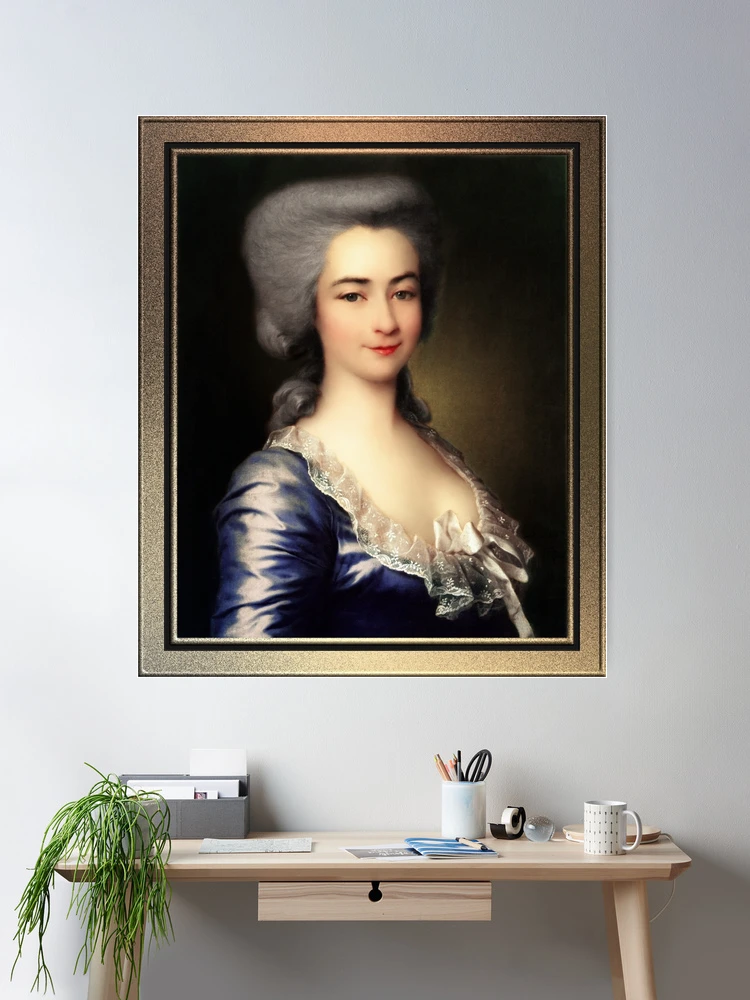
Das “Portrait Of An Unknown Woman” c1784 by Russian painter Dmitry Grigorievich Levitsky (1735 – 1822) is an exquisite example of portraiture during the late 18th century. Levitsky was renowned for his ability to capture the subtle nuances of his subjects’ Persönlichkeiten, and this portrait is no exception. This work encapsulates the elegance of the Russian aristocracy of the period, as well as the refinement of the artist’s technique. The image presents an unnamed woman, whose grace and beauty are immortalized in the delicate brushstrokes of Levitsky’s hand.
Inhaltsverzeichnis
The Subject and Its Presentation
The focal point of the artwork is a schöne junge frau, whose serene expression and composed posture suggest both nobility and a sense of quiet dignity. Her facial features are finely rendered, mit weich, round cheeks, a gentle smile, and eyes that seem to gaze beyond the viewer. The artist has carefully captured the contours of her face with a soft, almost ethereal light that emphasizes the smoothness of her complexion. Die Augen, though calm, reveal a depth of character, suggesting an intelligent, poised personality beneath her outward beauty.
She is dressed in an elegant gown of rich blue, a color that was both fashionable and indicative of wealth in the 18th century. The gown features intricate lace detailing along the neckline, where a soft ruffle cascades down the front, highlighting the delicacy of her attire. The fabric of her dress appears to shimmer with the play of light, a testament to Levitsky’s mastery in rendering texture and material. The lace is meticulously painted, demonstrating the artist’s ability to convey the fine details of fashion with precision.
The subject’s hair, styled in a voluminous updo, is powdered and set in a typical 18th-century fashion. Soft curls are swept to the sides of her face, umrahmt ihre zarten Gesichtszüge. The hair’s light gray tones provide a contrast to the vivid colors of her gown, further highlighting her refined appearance. There is a subtle air of formality in the way she is posed, yet there is also an intimacy in her expression, as though she is about to speak or engage in conversation.
Der Hintergrund und die Einstellung
The background of the portrait is a soft gradient, mit tief, dark hues that suggest the presence of a shadowed, undefined space. This choice of background creates a dramatic contrast with the figure, ensuring that the woman remains the primary focus of the composition. The lack of any elaborate setting or architectural elements speaks to the personal nature of the portrait, allowing the viewer to concentrate solely on the subject herself. The simplicity of the background also serves to emphasize the fine details of her attire and features, directing all attention to her.
Stil und Technik
Levitsky’s style is characterized by his delicate treatment of light and shadow, which is particularly evident in this portrait. His ability to create a soft, glowing effect on the skin and clothing gives the painting a lifelike quality, making the subject appear as though she could step out of the canvas at any moment. Der Einsatz von Licht im Porträt ist meisterhaft, with soft highlights on the face and fabric, contrasted against deeper, more muted shadows. This interplay of light and shadow enhances the three-dimensionality of the figure and adds a sense of depth to the otherwise flat background.
Levitsky’s brushstrokes are smooth and fluid, creating a sense of softness and refinement throughout the piece. His skillful attention to detail is apparent in the rendering of the lace, the folds of the gown, and the texture of the hair. Every element in the painting has been given meticulous attention, from the delicate fabric to the subtle highlights on the skin, demonstrating Levitsky’s dedication to realism and his technical proficiency.
The portrait is painted with a fine attention to realism, but there is also an element of idealization. The woman’s features are slightly softened, lending her an air of timeless beauty that transcends any individual traits. This idealization was a common technique in portraiture at the time, as it was customary for the artist to present the subject in the most flattering light, often highlighting their best qualities while downplaying imperfections.
Die Stimmung und Atmosphäre
The overall mood of the portrait is one of elegance and composure, but there is also a sense of calm introspection. The subject’s serene expression, combined with the soft lighting and muted background, creates a sense of quiet sophistication. There is a certain mystery to the woman’s gaze, as if she is caught in a moment of contemplation. Diese, coupled with the subdued yet rich colors of the painting, evokes a mood of refined nobility.
The atmosphere is one of grace and dignity, yet there is a subtle invitation to wonder about the life and personality of the woman portrayed. The artist has managed to capture not just her physical appearance, but also the essence of her character — a rare feat in portraiture. Levitsky’s ability to create an emotional connection between the subject and the viewer is what elevates this work beyond mere representation to something more profound.
Abschluss
Das “Portrait Of An Unknown Woman” c1784 is a remarkable example of Dmitry Grigorievich Levitsky’s talent as a portrait artist. Through his meticulous attention to detail, his refined rendering of textures, and his ability to capture the character of his subject, Levitsky has created an image that transcends time. The woman’s serene and dignified presence invites the viewer to contemplate her story, though her identity remains a mystery. Auf diese Weise, Levitsky has not only immortalized a moment in time but has also created a work that continues to provoke thought and admiration to this day.
Künstler Bio abgeleitet von Wikipedia.org
Dmitry Levytsky wurde in Kiew geboren, Kosaken-Hetmanat, im Russischen Reich in 1735 an den ukrainischen Geistlichen und Kupferstecher Gregory Levitsky.
Dmitrys Vater war sein erster Kunstlehrer, und später wurde er Schüler des russischen Künstlers Aleksey Antropov, der nach Kiew kam, um die Kathedrale von St . zu malen. Andreas; die letzte barocke Kathedrale, die in Sankt Petersburg gebaut wurde, Russland; zwischen 1805 – 1817 vom Architekten Andreyan Zakharov (1761 – 1811); und dem Apostel Andreas gewidmet, der Schutzpatron der russischen Marine.
Im 1770, Als Porträtmaler wurde Levitzky nach der Ausstellung von sechs seiner Porträts in der Kaiserlichen Akademie der Künste in St . berühmt. Petersburg, Russland.
Für sein Porträt von Alexander Kokorinov (1726 – 1772), der Direktor und Erster Rektor der Akademie der Künste in St. Petersburg, in dem er gemalt hat 1769; Dmitry wurde zum Akademiker gewählt (ein vollwertiges Mitglied einer künstlerischen, literarisch, Ingenieurwesen, oder wissenschaftliche Akademie), und zum Professor der Klasse für Porträtmalerei an der Akademie der Künste berufen, in dieser Position bleiben bis 1788.
Von 1772 zu 1776 Levitzky arbeitete an einer Reihe von Porträts der Schüler der privilegierten Frauen, die Studentinnen des Smolny-Instituts für junge Damen in St . waren. Petersburg; im Auftrag von Katharina II. Die Mädchen sind dargestellt, die Tänze aufführen, Musik-, Theaterstücke.