

Portrait of Grand Duchess Alexandra Iosifovna
Portrait of Grand Duchess Alexandra Iosifovna (1830 – 1911) c1859 by German Painter Franz Xaver Winterhalter (1805 – 1873); ainmeil airson a dhealbhan de rìoghalachd meadhan na naoidheamh linn deug agus bràthair nas sine don pheantair Gearmailteach Hermann Fidel Winterhalter (1808 – 1891).
This is an elegant Portrait of Grand Duchess Alexandra Iosifovna, née Princess of Saxe-Altenburg (Portrait of Großfürstin Alexandra Iosifowna, geb. Prinzessin von Sachsen-Altenburg).
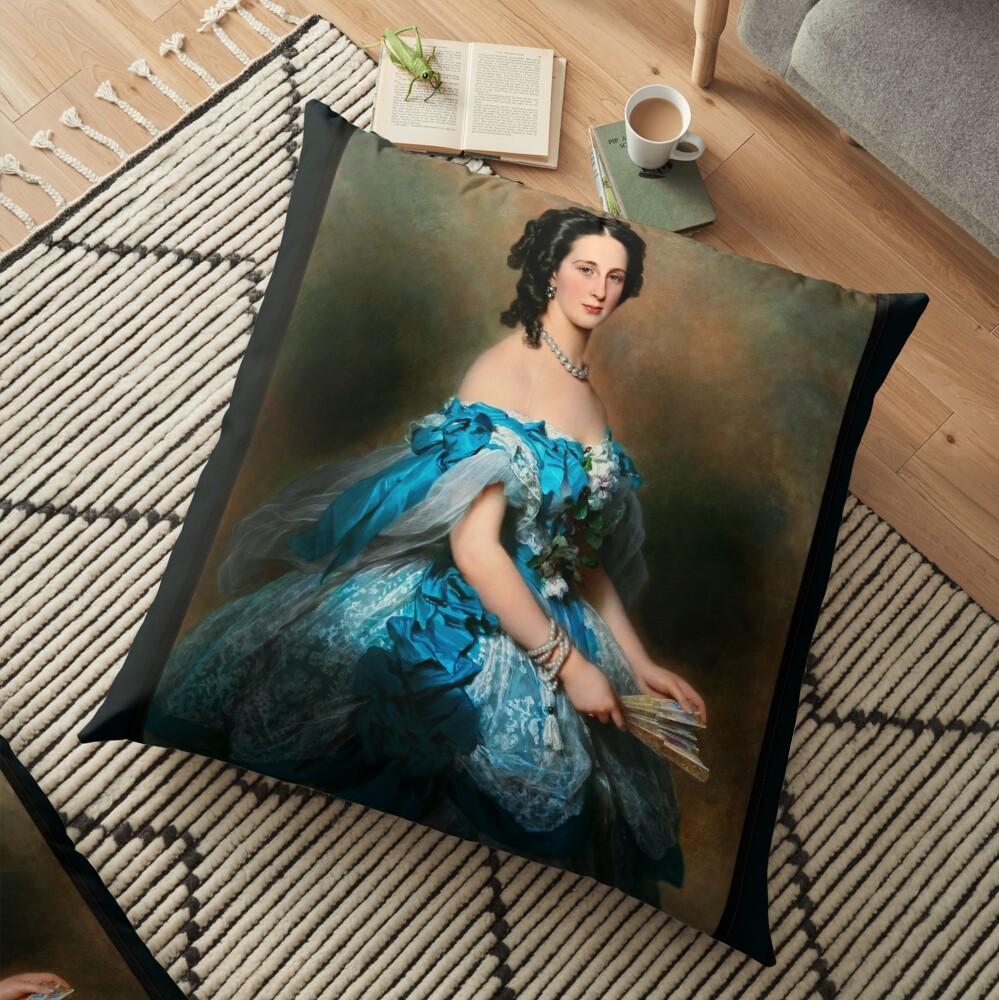
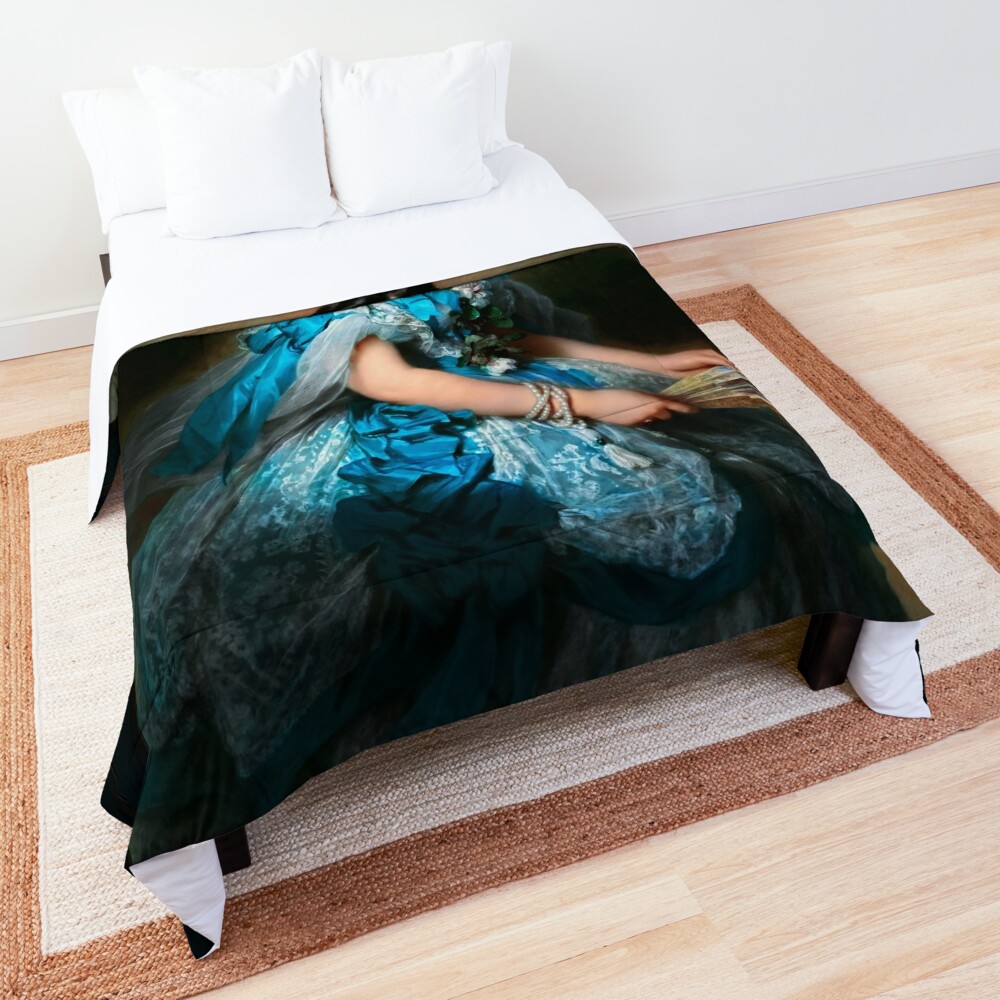
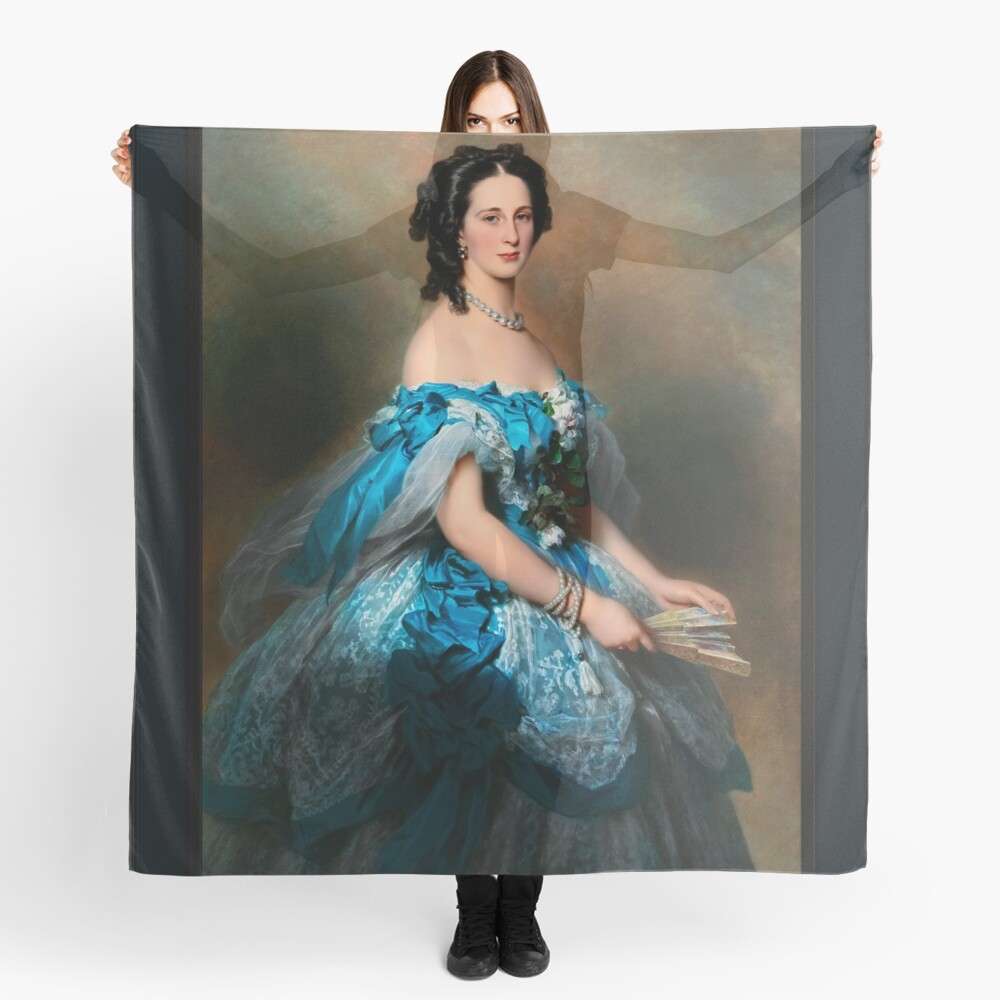
She is in a three quarter profile standing pose with her right shoulder facing the viewer, positioned in front of a multi-colored wall with two large dark spots framing her with one at her back and the other in front at her waist.
She is adorned in a a lavish off shoulder blue dress with large silk ribbon accents along the sides, shoulders and as edge trim; with an additional embroidered white sheer overlay and a very light blue linen shawl, with added white and blue flowers that are placed at the center chest that go down to her waist.
She is also wearing large diamond earrings, a large pearl necklace and a wrap around pearl bracelet with a blue gemstone connected to a silk tassel on her right wrist, a gold ring with an embedded ruby on the fourth finger of her right hand; which is also holding a gold accented foldable fan.
Portrait of Grand Duchess Alexandra Iosifovna is a remastered digital art old masters reproduction of a public domain image that is available as a clò-bhualadh canabhas air-loidhne.
Fiosrachadh gu h-ìosal a thàinig bho Wikipedia.org
Rugadh Franz Xaver Winterhalter ann am baile beag Menzenschwand, (a-nis na phàirt de Sankt Blasien), ann an Coille Dhubh na Gearmailt ann an Luchd-bhòtaidh Baden, air a' Ghiblean 20, 1805.
B’ esan an siathamh leanabh aig Fidel Winterhalter (1773 – 1863), tuathanach agus riochdaire roisinn anns a’ bhaile, agus a bhean Eva Meyer (1765 – 1838), na bhall de theaghlach Menzenschwand a bha stèidhichte o chionn fhada.
Bha athair de luchd-tuatha agus bha buaidh chumhachdach aige na bheatha. De na h-ochdnar bhràithrean is pheathraichean, cha mhair ach ceathrar 'nan leanabachd.
Fad a bheatha dh ’fhan Franz Xaver gu math faisg air a theaghlach, gu sònraichte dha bhràthair Hermann (1808 – 1891), a bha cuideachd na pheantair.
Às deidh dha a dhol dhan sgoil aig manachainn Bhenedictine ann an St.. Blasien, Dh ’fhàg Winterhalter Menzenschwand a-steach 1818 aig aois 13 sgrùdadh a dhèanamh air dealbh agus gràbhaladh.
Rinn e trèanadh mar neach-dealbhaidh agus lithographer ann am bùth-obrach Karl Ludwig Schüler (1785 – 1852) ann am Freiburg im Breisgau. Ann an 1823, aig aois 18, chaidh e gu Munich, le taic bhon neach-gnìomhachais Baron von Eichtal (1775 – 1850).
Ann an 1825, chaidh stìpean a thoirt dha le Ludwig I., Grand Duke of Baden (1763 – 1830) agus thòisich e air cùrsa sgrùdaidh aig Acadamaidh nan Ealan ann am Munich còmhla ri Peter von Cornelius (1783 – 1867), bha na dòighean acadaimigeach aige ga fhàgail mì-chofhurtail.
Lorg Winterhalter comhairliche nas congenial anns an dealbhadair fasanta Eòsaph Karl Stieler (1781 – 1858). Rè na h-ùine seo, thug e taic dha fhèin ag obair mar lithographer.
Chaidh Winterhalter a-steach do chearcaill cùirte nuair a bha e a-staigh 1828 thàinig e gu bhith na mhaighstir dealbhaidh gu Sophie Margravine à Baden, aig Karlsruhe.
Thàinig an cothrom aige e fhèin a stèidheachadh taobh a-muigh ceann a deas na Gearmailt 1832 nuair a bha e comasach dha siubhal dhan Eadailt, le taic bho Grand Duke Leopold à Baden.
Anns an Ròimh rinn e seallaidhean gnè romansach ann an dòigh Louis Léopold Robert agus cheangail e e fhèin ri cearcall stiùiriche Acadamaidh na Frainge, Horace Vernet.
Nuair a thill e gu Karlsruhe, pheant e dealbhan de Grand Duke Leopold à Baden agus a bhean, agus chaidh ainmeachadh mar pheantair don chùirt grand-ducal.
A dh'aindeoin sin, dh' fhag e Baden agus ghluais e do'n Fhraing, far an do tharraing an sealladh gnè Eadailteach Il dolce Farniente fios aig Salon of 1836, agus bliadhna an dèidh sin choisinn e moladh airson a dhealbh Il Decameron; tha an dà dhealbh seo nan sgrìobhaidhean acadaimigeach ann an stoidhle Raphael.
Ann an Salon of 1838 sheall e dealbh de Phrionnsa Wagram còmhla ri a nighean òg; agus goirid às a dhèidh sin chaidh a dhreuchd mar pheantair dhealbhan a dhèanamh tèarainte, nuair anns an aon bhliadhna a pheant e Louise Marie à Orleans, Banrigh na Beilge, agus a mac.
Is dòcha gur ann tron dealbh seo a thàinig Winterhalter gu aire Maria Amalia às an Dà Sicilies, Banrigh na Frainge, màthair Banrigh na Beilge.