

Redhead Beauty
“Redhead Beauty” is a captivating portrait created by British painter Abbey Abraham Altson, who lived between 1866 and 1949. Known for his refined portraiture, Altson’s work elegantly captures the essence of his subjects with a focus on delicate details and subtle, lifelike tones. This particular painting stands as a prime example of his technical prowess and unique ability to bring depth and humanity to the canvas. The composition features a young woman, her piercing eyes inviting the viewer into a world of elegance and mystery. The sitter’s features are delicate and graceful, with a subtle yet powerful presence that commands attention.
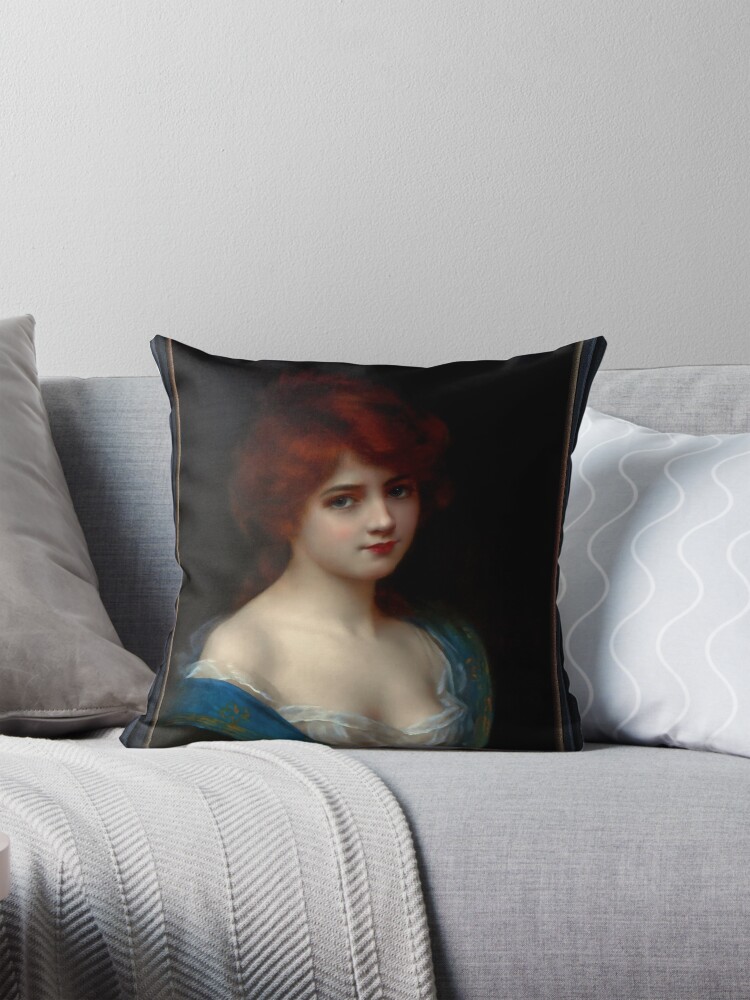
Table of Contents
The Subject
The central focus of “Redhead Beauty” is the young woman portrayed in the portrait. She exudes a timeless charm, characterized by her striking red hair, which forms a soft halo around her face. The artist skillfully captures the sheen and texture of her hair, rendering it with a warm, natural glow that contrasts beautifully with the dark background. Her facial expression is serene yet engaging, with slightly parted lips that suggest a quiet contemplation. Her eyes, large and expressive, hold an enigmatic quality, as if inviting the viewer to delve into her thoughts, yet remaining elusive in their full meaning.
The woman is depicted in a classical, almost ethereal manner. She has a delicate, porcelain-like complexion, with subtle blushes of pink at her cheeks, giving her an almost angelic appearance. The simplicity of her attire, with its elegant neckline and minimal ornamentation, further directs attention to her face and the emotional depth she embodies. This restrained use of clothing and jewelry allows Altson to focus on the soft contrasts of light and shadow that define the subject’s features.
Materials and Techniques
Abbey Abraham Altson’s choice of materials and his mastery of technique are evident throughout this portrait. The painting is executed with oil paints, a medium that allows for the rich blending of hues and a smooth finish that enhances the lifelike quality of the piece. Altson’s application of paint is both soft and controlled, with each brushstroke contributing to the overall harmony of the work. The artist’s ability to build layers of color creates depth, particularly in the textures of the woman’s skin and hair. The delicate handling of the skin tones contrasts with the richness of the deep blues and greens in her attire, further enhancing her radiance.
The artist’s attention to detail is particularly evident in the depiction of the woman’s hair. Altson has captured the vibrancy of her red locks, utilizing light and shadow to give the hair volume and movement. The subtle highlights and dark shadows within the hair suggest its natural texture and richness, providing a dynamic contrast to the smoothness of her skin and the soft drapery of her clothing.
The background of the portrait is intentionally dark, which serves to emphasize the figure and elevate her presence. The soft transition from light to dark behind her creates a sense of depth, drawing the viewer’s eye directly to the subject’s face. The lack of excessive detail in the background allows the viewer to remain focused on the woman, making her the central figure in the painting.
Style and Theme
“Redhead Beauty” is firmly rooted in the classical tradition of portraiture, with its emphasis on realism and subtle emotional expression. Altson, a British artist who worked during the late 19th and early 20th centuries, drew upon the techniques and styles popularized by the Old Masters while also infusing his works with a sense of modernity. The smooth finish, fine details, and balanced composition all speak to the artist’s classical training, while the subject’s poised yet introspective nature suggests a more contemporary sensibility.
The painting’s theme is one of beauty and quiet elegance, focusing on the timeless nature of the human form. The choice of a young woman as the subject allows for an exploration of youth and grace, yet there is also a sense of maturity in the way her face is rendered. Altson’s attention to her expressive eyes suggests that there is more to her than mere beauty—there is depth, thoughtfulness, and a certain reserve that draws the viewer in, creating a compelling visual narrative.
The mood of the painting is gentle, introspective, and slightly mysterious. The soft light that bathes the woman’s face and the calmness of her expression convey a sense of tranquility, while her gaze creates a subtle tension, as if there is something more beneath the surface that the viewer is not fully privy to. This dynamic interplay between serenity and mystery makes the painting not just a simple portrait, but a work that invites the viewer to linger and contemplate the subject’s inner world.
Conclusion
Abbey Abraham Altson’s “Redhead Beauty” stands as a testament to the artist’s ability to capture both the physical beauty and emotional depth of his subject. The fine details, smooth execution, and timeless elegance all contribute to a portrait that speaks to the viewer on multiple levels. Through careful use of light, shadow, and texture, Altson not only creates a lifelike image but also imbues the painting with an emotional resonance that lingers long after the viewer has turned away.
The painting’s refined style, classical influence, and enigmatic mood make it a work of enduring appeal. It transcends its time, evoking a sense of quiet sophistication and inviting viewers to reflect on the deeper emotional currents that lie beneath the surface of beauty.
This is a retouched digital art old masters reproduction of a public domain image that is available for purchase online as a rolled canvas print.
Artist Bio From ArtRecord.com
Abbey Abraham Altson was born in Middlesbororough-on-Tees, Yorkshire in the year 1864. In September of 1883 he and his brother Barnett Hayman Altson went to Australia ; and beginning in 1885 Abraham began to study drawing two nights a week at the National Gallery School of Design, located in Melbourne.
I 1886 he then enrolled as a full time student in the School of Painting; studying with other well known artist, such as Fred McCubbin, John Longstaff, Emmanuel Phillips Fox, David Davies, Tudor St. George Tucker and Fred Williams.
Abraham won prizes each year he was at the school, and critics herald him as a most promising pupil of the future.