

Ripplin Rythm
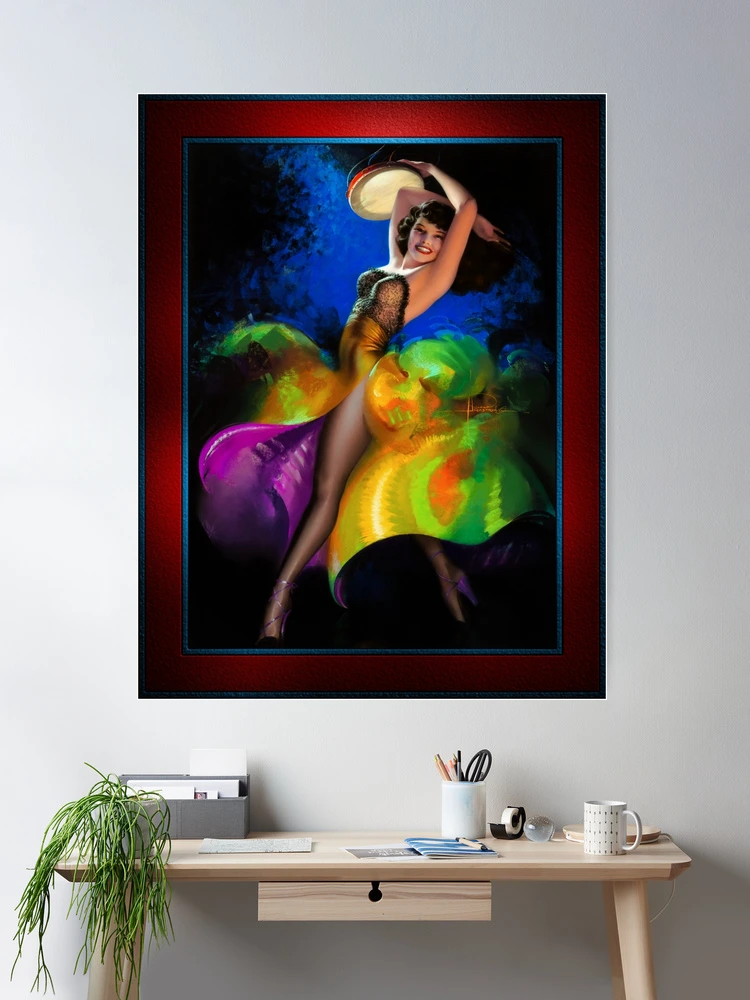
“Ripplin Rhythm,” created by the renowned American artist Rolf Armstrong (1889 – 1960), stands as a testament to the vibrant beauty of pin-up art during the mid-20th century. Armstrong, a prominent figure in the golden era of American commercial art, expertly merges movement, kleur, and emotion within this piece, offering a glimpse into the glamour and sensuality that defined the era.
Berne yn 1889, Armstrong’s work was marked by a mastery of light and color, making his images highly sought after in advertisements, illustrations, and fine art. He utilized a unique blend of techniques that brought dynamism to his subjects, en “Ripplin Rhythm” encapsulates this with its fluid and energetic portrayal of a woman in motion.
Ynhâldsopjefte
Haad ûnderwerp: The Vibrant Dancer
Yn it hert fan “Ripplin Rhythm” is a captivating depiction of a dancer in mid-performance. It ûnderwerp, a woman, exudes confidence and joy as she spins gracefully, her flowing dress rippling around her body like the waves of an ocean. The dancer’s attire is a burst of color, with swirling shades of green, giel, and purple creating a striking contrast against the deep blue background.
The woman’s posture is elegant yet exuberant, her arms raised in a celebratory gesture as she holds a tambourine above her head. Her face radiates happiness, a wide smile revealing her playful spirit. Armstrong has captured not only her motion but also her essence, making her appear as though she is alive with energy and rhythm.
The woman’s vibrant costume, designed to reflect the rhythm of her movements, is a fusion of bold colors. The soft metallic sheen of her golden bodice catches the light, enhancing the dynamic flow of her skirt. Armstrong’s use of color in this piece is masterful, with each hue seemingly chosen to emphasize the woman’s graceful spinning and the lively atmosphere of her performance. De rok, which flares out around her like an explosive flower, ripples with energy, suggesting the dancer’s movement and the pulse of the music she is engaged with.
De objekten: Tambourine and Flowing Garments
The tambourine held by the dancer is a key object in the painting, not only because it symbolizes the musical rhythm she embodies but also because it ties the composition together. The tambourine’s small yet intricate form contrasts the large, swirling mass of the dancer’s gown, yet it maintains a presence that complements the overall movement within the scene.
The circular shape of the tambourine subtly mirrors the curves and flow of her garments, creating a visual harmony between the two. This object, while seemingly simple, amplifies the sense of rhythm and dance in the composition.
The cascading layers of the dancer’s gown are another vital aspect of the work. Armstrong’s skillful handling of fabric and texture brings the dress to life, with each fold and curve appearing as if it is caught mid-movement. The gown, with its vibrant, rippling folds, seems to echo the fluidity of the dancer’s form. The luxurious colors and glossy textures of the skirt create a feeling of both elegance and freedom, enhancing the theme of lively celebration.
Terrein: The Colorful Background
De eftergrûn fan “Ripplin Rhythm” is one of the key elements that contribute to the piece’s overall mood. A deep blue hue forms the backdrop, providing a striking contrast to the warm colors of the dancer’s attire. This color choice highlights the subject and makes her appear as if she is emerging from a dreamlike or fantastical environment.
Armstrong uses the swirling shapes and dark tones in the background to evoke movement and rhythm, as if the air itself is alive with the same energy that drives the dancer. De floeiberens fan 'e kleuren op' e eftergrûn suggerearret beweging, blending with the dancer’s own movements, creating a seamless connection between subject and environment.
Styl: Art Deco and Glamour
“Ripplin Rhythm” is a quintessential example of Armstrong’s signature style, which draws heavily from Art Deco influences. The streamlined elegance of the figure, the dynamic compositions, and the use of bold, contrasting colors all reflect the Art Deco movement, which was characterized by its celebration of modernity, lúkse, and glamour.
De glêde, graceful lines of the dancer’s body and the geometric shapes within the composition convey a sense of sophistication and energy that are central to the Art Deco aesthetic. Tagelyk, the work also embodies the exuberance and glamour of the pin-up style, which Armstrong helped define. His portrayal of women was not only sensual but celebratory, en “Ripplin Rhythm” is a perfect example of this, as it captures a moment of joyous self-expression.
The dancer’s radiant smile and energetic pose speak to the optimistic and carefree mood of the era. Armstrong’s work is imbued with a sense of youthful vitality, and this painting exemplifies the vibrant energy of American culture during the 1940s. It reflects a time of confidence and joy, set against the backdrop of a world on the cusp of dramatic change.
Tema en stimming: Celebration of Movement and Music
It tema fan “Ripplin Rhythm” is centered around the celebration of movement, muzyk, en froulikens. Armstrong captures the essence of dance as an expression of joy and liberation, highlighting the dynamism and beauty of the human form in motion.
The artist has skillfully conveyed the idea that rhythm is not just a sound but a force that can be seen and felt in the movements of the body. The dancer’s bright smile and the lively swirl of her dress communicate a sense of freedom, playfulness, and enthusiasm, making the painting feel like an invitation to partake in the celebration.
The overall mood of the artwork is one of joy and excitement. Armstrong’s use of color and form conveys a sense of lightness and exuberance, and the dancer herself appears to be in the midst of a joyous performance, lost in the music and her own movement. The piece encapsulates a spirit of happiness, optimism, and youthful vitality, evoking a time when life seemed to be filled with endless possibilities.
Konklúzje
“Ripplin Rhythm” by Rolf Armstrong is more than just a beautiful portrait of a woman in motion; it is a vibrant celebration of life, kleur, and music. The dynamic composition, bold use of color, and joyful expression of the dancer all contribute to a sense of energy and rhythm that makes the painting come alive. Armstrong’s mastery of movement and his ability to capture the spirit of an era make this work a timeless example of American art. Through the use of elegant forms, flowing garments, and vibrant hues, Armstrong successfully conveys the joy of dance, the celebration of femininity, and the power of music to inspire movement and expression.
The Enchantress is a retouched digital art old masters reproduction of a public domain image.
Artist Bio From Wikipedia.org
Rolf Armstrong waard berne as John Scott Armstrong yn Bay City, Michigan op april 21, 1889, oan Richard en Harriet (Scott) Armstrong. Syn heit hie de Boy-Line Fire Boat Company, dy't in line fan passazjiersskippen omfette. Guon waarden ynset yn Chicago foar gebrûk op 'e Chicago World Fair dêr yn 1893.
lykwols, de heit syn bedriuw en famylje wiene muoite, en de húsfesting fan 'e famylje waard ferlern gien foar foreclosure. Yn 1899, de famylje ferhuze nei Detroit, Michigan. Rolf syn heit stoar yn 1903, en in jier letter ferhuze hy en syn mem nei Seattle, Washington, nei de fuotstappen fan syn âldste broer, Willem, dy't der in jier earder hinne ferhuze wie. Tsjintwurdich wiene Rolf syn artistike ynteresses opkommen ta mear as in parttime wille.
Hy ferhuze nei Chicago yn 1908, dêr't er letter studearre oan it Keunstynstitút. Dêrnei gie er troch nei New York, dêr't er studearre by Robert Henri. Nei in reis nei Parys yn 1919 om te studearjen oan de Académie Julian, hy gie werom nei New York en stifte in atelier. Yn 1921 hy gie nei Minneapolis om kalinderproduksje te studearjen by Brown & Bigelow.
Yn de jierren 1920 en 1930, syn wurk ferskynde op in protte stikken blêdmuzyk, likegoed as op 'e omslach fan in protte tydskriften, meast ferneamd om filmfan-tydskriften lykas Photoplay en Screenland. Syn wurk bestiet meast út froulju; Mary Pickford, baby daniels, en Greta Garbo binne mar in pear fan de tal fan er skildere.
Armstrong syn wurk foar de Pictorial Review wie foar in grut part ferantwurdlik foar dat blêd in oplage fan mear as twa miljoen troch 1926. In jier letter, hy wie de bêst ferkeapjende kalinder artyst by Brown & Bigelow. Yn 1930, RCA hierde him om pin-ups te skilderjen om har produkten te advertearjen, en yn 1933 de Thomas D. Murphy Calendar Company tekene him om in searje skilderijen te produsearjen foar har line.
Yn maart 1940, Jewel Blommen, in famke út Lumberton, Noard-Karolina, stjoerde in foto fan harsels nei Armstrong yn reaksje op in advertinsje dy't er pleatst hie yn 'e New York Times. Armstrong, 50 op dat stuit, hie west basearre op it Hotel des Artistes op West 67th Street yn Manhattan sûnt 1939, en wie op syk nei nije modellen.
Hy noege Blommen út foar in ynterview. Op maart 25, 1940, Blommen begon te modellen foar Armstrong. Harren profesjonele gearwurking en freonskip duorre foar twa desennia. It earste skilderij, titele “Hoe giet it mei my?”, nei alle gedachten omdat Flowers, net wend oan modellewurk, frege Armstrong ferskate kearen “Hoe giet it mei my?” tidens de modellering sesje, waard foar it earst publisearre nei de Twadde Wrâldoarloch.
It wie Brown & Bigelow syn bêst ferkeapjende kalinder foar 1942 yn in tiid dat it bedriuw miljoenen kalinders yn Amearika ferkocht, en it waard ien fan Armstrong syn meast reprodusearre foto. Blommen wiene populêr by Amerikaanske militêren yn 'e Twadde Wrâldoarloch, guon fan wa't har brieven stjoerde mei it foarstellen fan houlik. Armstrong's kalinders en silhouetten fan Flowers waarden kopiearre op bommewerpers en oare fleantugen as nose art en skildere op tankturrets.
Se waard sa bekend yn de oarloch, hoewol mear as in ferneamd gesicht as by namme, dat in tsjinstman syn brief oanpakt gewoan as “Jewel Blommen, New York-Stêd” waard levere korrekt. Foar in protte Amerikaanske militêren yn it bûtenlân, sy fertsjintwurdige de “Wêrom We Fight” geast. ús. Presidint Franklin D. De regearing fan Roosevelt rôp har yn om oarlochsbannen te befoarderjen.
Jannewaris 1, 1945 edysje fan TIME tydskrift opnommen Armstrong's “Toast fan 'e stêd” skilderij fan Blommen yn in artikel oer Calendar Art. It artikel konstatearre dat kalinders mei “famke skilderijen” wiene “kocht swier troch gieterijen, masine winkels, auto-supply dealers.”
Blommen troude yn 1946. Sy en har man wenne op ferskate plakken wylst hy besocht in oantal saaklike ûndernimmingen, ynklusyf Laguna Beach, Kalifornje, Greenville, Súd-Karolina, Reno, Nevada, dêr't se nei alle gedachten wurke yn as card dealer foar in tiid, en New York City. Neffens Michael Wooldridge, coauthor fan Pin up Dreams: The Glamour Art of Rolf Armstrong, Armstrong belle har in oantal kearen yn 'e perioade dat se har man fan plak nei plak folge, om har te besykjen om werom te gean nei New York en foar him model te meitsjen.
Har modelkarriêre einige mei de dea fan Armstrong yn 1960. Hy liet in grut part fan syn persoanlike rykdom nei Flowers. Yn totaal, Armstrong makke sa'n fyftich oant sechtich wurken mei Flowers as model.
Rolf Armstrong stoar yn 1960 op it eilân Oahu, Hawaii as ien fan de bêste “pin-up” keunstners fan de earste helte fan de tweintichste ieu.