

Sainte Jeanne d’Arc c1909
“Sainte Jeanne d’Arc” is a captivating oil painting created in 1909 by the renowned French artist Paul Antoine De La Boulaye (1849 – 1926). Known for his mastery in historical and religious depictions, De La Boulaye’s portrayal of Joan of Arc is both emotive and powerful. This piece stands as a testament to the artist’s deep connection with historical themes and his dedication to capturing the grandeur and gravitas of his subjects.
The subject of this painting is none other than Jeanne d’Arc, the Maid of Orleans, a national heroine and a symbol of courage, faith, and resistance during the Hundred Years’ War. She is depicted as a young, fierce woman, her face full of determination and strength, seemingly ready for battle or a decisive action, reflecting the intense emotional depth that De La Boulaye aimed to convey.
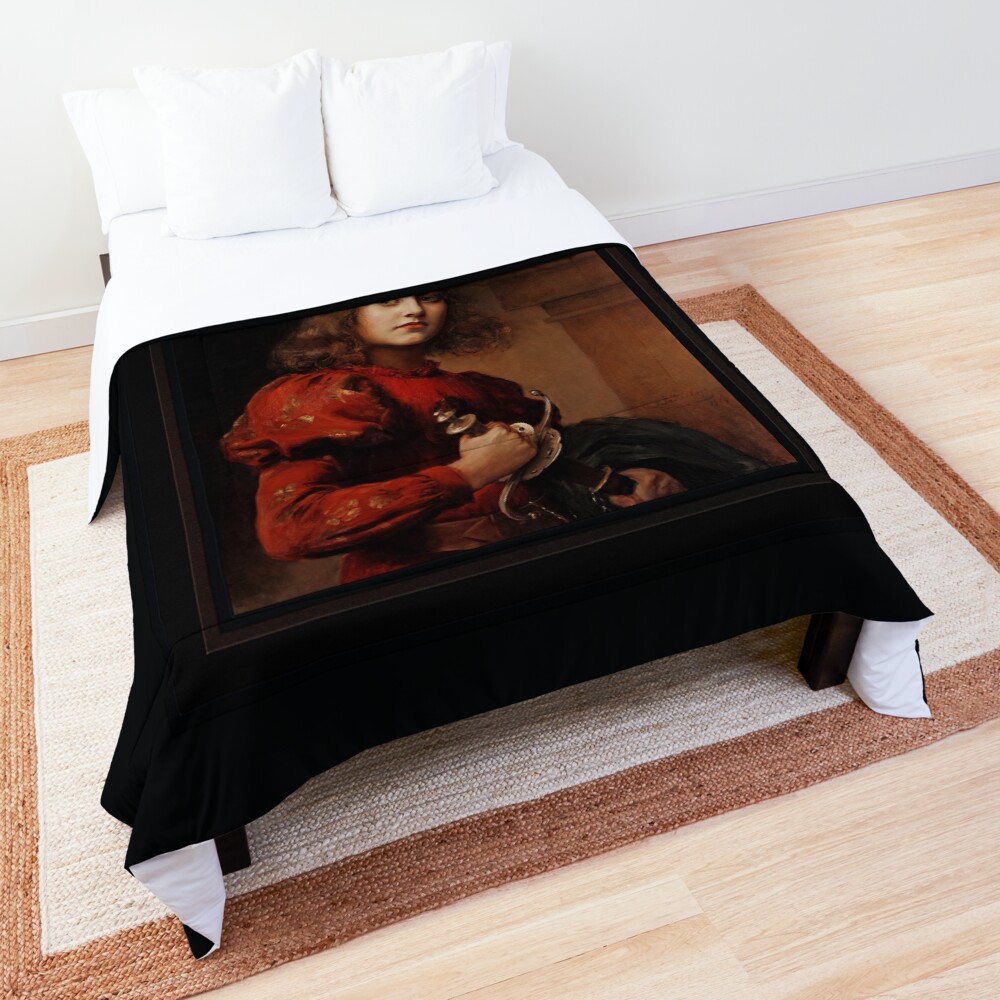
Table of Contents
The Main Subject: Sainte Jeanne d’Arc
In this painting, Joan of Arc is presented as a youthful yet formidable figure, exuding both grace and authority. The artist has captured her in a moment of contemplation or preparation, with her gaze directed slightly upwards. This positioning suggests that she is deep in thought, perhaps reflecting on her divine mission or preparing for the challenges ahead. The slight tilt of her head, coupled with the intensity in her eyes, conveys a sense of inner strength and conviction, as if she is resolutely ready to face her destiny.
Joan’s face is soft yet strong, a juxtaposition that conveys her purity and youthful energy, alongside the weight of the responsibility she carries. Her facial expression is not one of fear, but rather of resolve—a key element in De La Boulaye’s attempt to humanize the iconic figure while still emphasizing her unyielding spirit. The artist uses delicate brushwork to create a soft yet textured rendering of Joan’s features, emphasizing her beauty and inner resolve.
Clothing and Details: Symbols of Strength and Spirituality
Joan’s attire in the painting is a blend of historical accuracy and artistic interpretation. She is dressed in a deep red gown with voluminous sleeves, which highlights the richness of her character and the importance of her role. The fabric’s fine detailing suggests a sense of nobility, though it also retains the simplicity that might be associated with her humble origins. The soft, textured fabric of the gown flows gently, contrasting with the firmness in her posture and the tight grip she holds on the sword in her hands.
The color red is a significant choice by De La Boulaye, as it symbolizes not only the passion and fire that fueled Joan’s mission but also the danger and violence that were an inevitable part of her journey. The red also signifies courage and blood, tying directly to her fate.
In her hands, Joan holds a sword, another symbol of her role as a warrior and leader. The weapon is not simply a tool of war but a representation of her divine mission and the miraculous nature of her victories. Her left hand grips the hilt firmly, suggesting she is prepared for combat, while the sword’s edge rests downward, a subtle indication of her contemplative, non-violent nature in contrast to her role as a military leader.
Her head is adorned with a simple, red cap that complements her gown, reinforcing her connection to both the nobility of her mission and her personal modesty. The soft curls of her hair peek out from under the cap, further emphasizing her youth and purity.
Background and Terrain: The Subtle Setting
De La Boulaye’s background is purposefully understated. The muted tones and blurred figures of the background direct all attention to the central figure of Joan. The faint shadow of a column or architectural element hints at the suggestion of a grand hall or royal space, further reinforcing her connection to both the battlefield and the court. There is no overt symbolism or dramatic setting in the background, which allows Joan’s image to dominate the painting.
The artist’s choice to avoid an elaborate background shifts the focus entirely to Joan and her emotional state. The soft, gradient-like transitions in the shadows surrounding her lend a sense of depth and quiet intensity to the painting, allowing her face and posture to stand out.
Technique and Materials: The Mastery of Oil on Canvas
De La Boulaye’s technique is highly refined, using oil on canvas to create a texture that is both soft and highly detailed. The oil medium allows for smooth transitions in light and shadow, giving the painting a richness and depth that would be difficult to achieve with any other medium. The brushwork is fine and controlled, with De La Boulaye using light and shadow not only to add dimension to Joan’s form but also to express the psychological depth of her character.
The rich tonal contrasts between the deep reds of Joan’s gown and the darker, more neutral tones of the background allow the central figure to almost glow with a quiet power. The textures, both of her clothing and of her hair, are meticulously rendered, creating a tactile sensation that draws the viewer’s eye to each individual fold of fabric and curl of hair.
Mood and Theme: Heroism, Faith, and Determination
The mood of the painting is one of reverence and quiet strength. There is no sense of drama or loud emotion in this depiction of Joan of Arc; instead, De La Boulaye presents her in a manner that emphasizes her calm composure and unwavering resolve. It speaks to her deep faith, her commitment to her divine mission, and her role as a beacon of hope and courage in a time of despair.
The theme of the artwork is undeniably heroic, yet it also delves into the spiritual aspects of Joan’s life and mission. This painting is not just a portrayal of a historical figure; it is an exploration of the inner resolve, the faith, and the courage that propelled Joan to accomplish what she did. There is a spiritual serenity in her expression, which contrasts beautifully with the military leader that history remembers her as.
The artist has encapsulated Joan’s essence not through grand gestures or dramatic action, but through a subtle, dignified portrayal that focuses on her humanity as much as her heroism. The soft tones and the intensity of her gaze invite the viewer to reflect on the legacy of Joan of Arc, not just as a warrior, but as a woman of deep conviction, guided by faith, and unwavering in the face of adversity.
Sainte Jeanne d’Arc c1909 by French Painter Paul Antoine De La Boulaye (1849 – 1926); specialized in creating peasant genre scenes, religious inspired artwork, still life imagery, portraits and depictions of exotic women.
This is a retouched digital art old masters reproduction of a public domain image that is available for purchase as a canvas print online.
Artist Bio Derived From Wikipedia.org
Paul Antoine De La Boulaye who’s full name is Charles Antoine Paul Georgette du Buisson de La Boulaye was born in Bourg-en-Bresse France in 1849, to Eugène Georgette du Buisson de La Boulaye (1810 – 1888) and Adrienne de Graindorge d’Orgeville de Mesnil-Durand (1811 – 1859).
Paul mentored with the French Portrait Painter Léon-Joseph-Florentin Bonnat (1833 – 1922); and in 1873 Paul exhibited his religious painting David, Martyrdom, Adoration of the Shepherds at the Salon; a painting that resembles the style of Craravaggio. The kneeling Virgin appears dressed in white in a halo of white light with the Child Jesus.
As his career progressed he gradually shifted is artwork to images based on regional references starting with his work Au sermon, souvenir de la Bresse c1879 which was influenced by Bresse (a regions of Auvergne-Rhône-Alpes and Bourgogne-Franche-Comté of eastern France); as does his pieces The Baptism of the Orphan c1884, which shows a Bourbonnaise (was a historic province in the centre of France) influence.