

Beatha Fhathast Anns an Atelier
Beatha Fhathast Anns an Atelier c1868 le peantair Fionnlannach Ferdinand von Wright (1822 – 1906); dealbhaiche cruth-tìre agus ainmhidhean bhon 19mh linn
Is e seo dealbh beò-beò breagha le dath beairteach de stiùidio neach-ealain a tha a’ cuimseachadh dìreach air deasc fiodha beairteach donn dorcha le slige le tarraing air a shnaigheadh gu grinn..
Air an deasg tha lampa ola bùird breagha le bonn copair, mullach umha agus cruinneach porcelain air a dhèanamh ann an stoidhle Bhictòrianach; a tha mar mheadhan an t-seallaidh; le mion-fhiosrachadh mionaideach mu na feartan sgeadachaidh anns a 'mheatailt, ola anns an loch tasgaidh glainne leis an wick rioban air a thoirt a-steach.
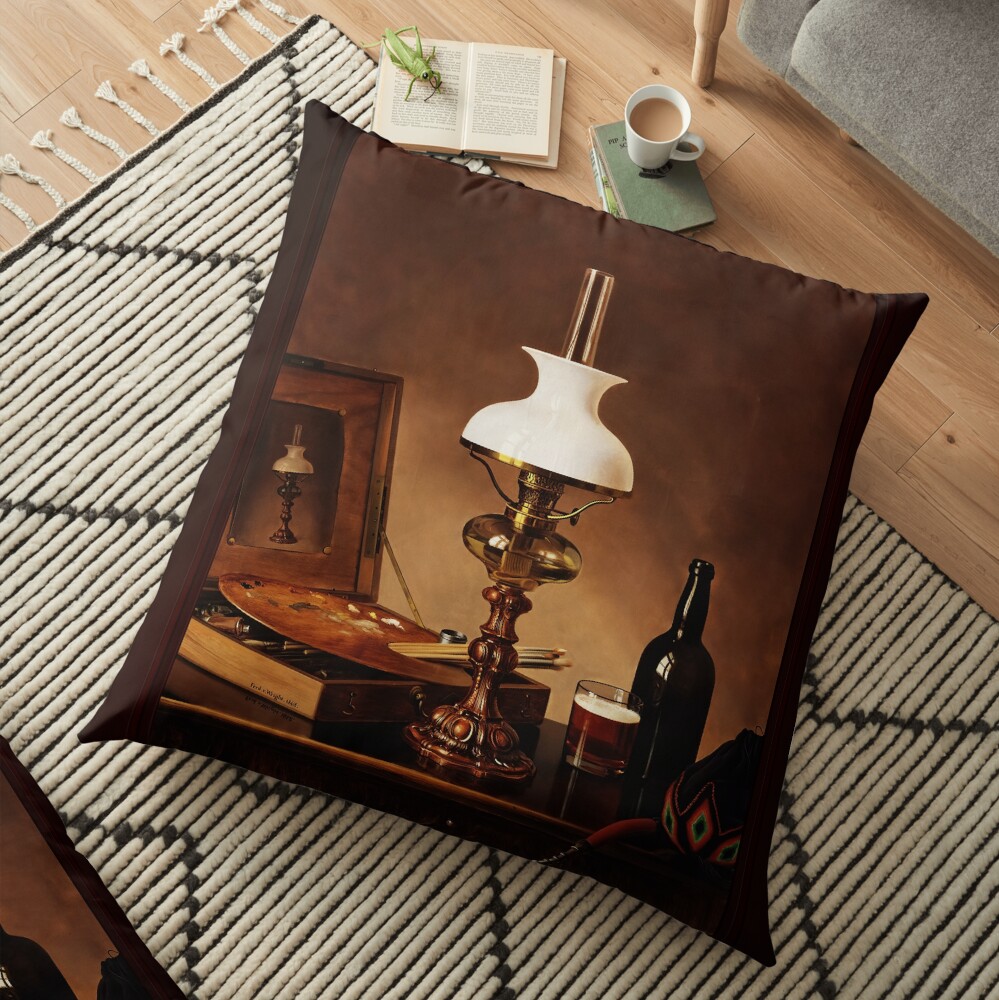
Air an taobh cheart tha botal lionn dubh agus ri taobh a’ bhotal tha glainne ghoirid làn de lionn air ùr-dhòrtadh agus ri taobh sin tha pìob smocaidh Nargile le baga tombaca ri thaobh..
Air taobh clì an t-seallaidh tha paileas fiodha peantairean anns a bheil cupa meatailt air a’ chuid as ìsle, agus tha dabs de gheal air sin, buidhe, dearg, uaine, peant gorm is dubh timcheall an iomall a-muigh le bruisean peant a’ stobadh a-mach às an toll a tha an neach-ealain a’ cur òrdag.
Tha seo an urra ri bogsa solarachaidh stòraidh neach-ealain fosgailte, aig a bheil barrachd bhruisean fon phalet a bharrachd air tiùban peant agus nithean eile; agus air mullach a-staigh a' bhogsa tha dealbh de lampa ola coltach ris a chaidh a chleachdadh mar iomradh airson an t-seallaidh.
Still Life In The Atelier is a remastered digital art old masters reproduction of a public domain image that is available as a clò-bhualadh canabhas air-loidhne.
Fiosrachadh gu h-ìosal a thàinig bho Wikipedia.org
Ferdinand was the last of nine surviving children to the retired Finnish Major Henrik Magnus von Wright; his two older brothers Magnus von Wright (1805 – 1868) and Wilhelm von Wright (1810 – 1887) were painters and illustrators and he followed in their footsteps, showing an early aptitude for art, which was developed during the time he spent hunting and exploring nature, recording what he had observed in his sketchbooks.
Ann an 1837 he left Finland and traveled to Sweden with his second eldest brother Wilhelm; whom at the time was working as an illustrator for the Swedish Zoologist Bengt Fredrik Fries (1799 – 1839); an uairsin a-steach 1838 he went back to Sweden to work for the Swedish amatuer Ornithologist Count Nils Bonde (1685 – 1760).
After going back to Finland on completion of his work; he then returned to Sweden in 1842 and briefly attended the Royal Swedish Academy of Arts studying under the Swedish sculptor Johan Niclas Byström (1783 – 1848); then two years later returned home to Finland.
An uairsin a-steach 1849 he traveled to Turku, Finland where he took additional painting lessons from Swedish Romantic Painter Robert Wilhelm Ekman (1808 – 1873); following his studies, he and his brothers went to Helsinki, the capital of Finland and set up a studio; and six years later he traveled to Dresden, Germany to study under the noted German animal painter Johann Siegwald Dahl (1827 – 1902).
During the 1870s he suffered several strokes that kept him bedridden; but he continued to paint, agus a-steach 1881 made his last trip to Orust to visit his brother Wilhelm who was also sick.
From this point on his work became more commercial, agus a-steach 1886 he produced his best known painting “The Fighting Capercailles” and was contributing articles to various ornithological publication.
About this time he received a state artists pension; and during the 1890s many of his former students came to visit, while in the late 90s bird painter Matti Karppanen (1873 – 1953) stayed on to be his pupil and assistant.