

Der Lauscher
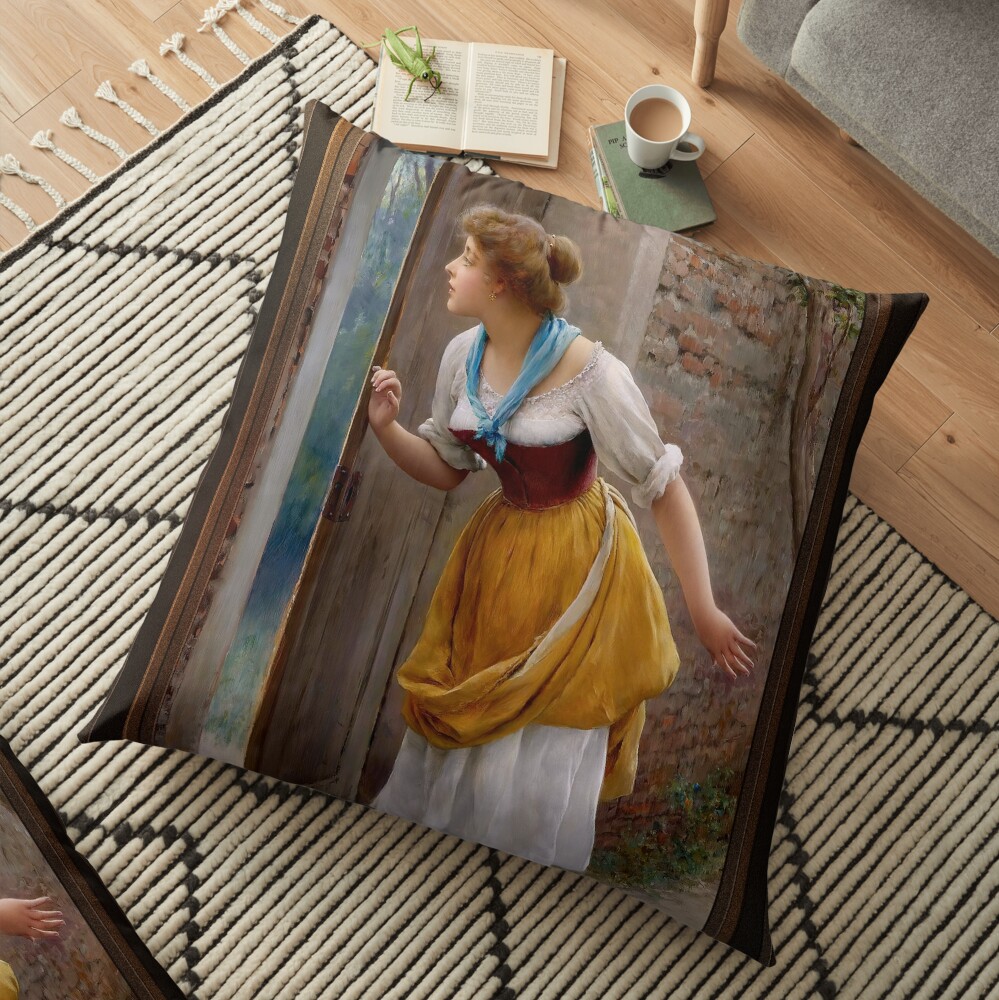
“Der Lauscher,” erstellt in 1906 vom italienischen Maler Eugen von Blaas (1843–1931), ist eine beeindruckende Darstellung einer jungen Frau, die in einem Moment der Neugier und Intrige gefangen ist. Das Werk veranschaulicht die Fähigkeit des Künstlers, sowohl die Unschuld als auch die subtile emotionale Komplexität seiner Motive darzustellen.
Vor einem rustikalen Hintergrund aus gedämpften Erdtönen, Das Gemälde ist eine elegante Mischung aus Realismus und intimer Erzählung. Die junge Frau, mit dem Kopf zu einer teilweise geöffneten Tür gedreht, Blicke mit konzentrierter Aufmerksamkeit, als würde sie etwas auf der anderen Seite hören. Die Komposition fängt einen ruhigen, aber dennoch spannenden Moment ein, perfekt geeignet für das Genre der Genremalerei, für das von Blaas bekannt ist.
Inhaltsverzeichnis
Hauptthema
Im Mittelpunkt dieser Arbeit steht die junge Frau, ihre zarte Gestalt umrahmt von der verwitterten Tür. Sie trägt ein traditionelles europäisches Bauernkostüm, eine Kombination aus Erdtönen, die einen scharfen Kontrast zur Lebendigkeit ihres auffälligen blauen Schals und der weichen weißen Bluse bildet. Die Kleidung der Frau, ihr Mieder eng und purpurrot, fließender Rock mit gelbem Farbton, verleiht ihr sowohl Demut als auch Anmut.
Die weichen Falten ihres Rocks und ihrer Schürze lassen darauf schließen, dass es sich wahrscheinlich um eine Hausangestellte oder eine Person mit bescheidenem gesellschaftlichem Ansehen handelt. Ihre Haltung ist eine der Vorfreude, Ihr Körper neigte sich zur Tür, eine leichte Neigung des Kopfes, die den Eindruck erweckt, als würde sie aufmerksam auf etwas hören, das sie nicht hören sollte.
Ihre Hand liegt sanft auf der Tür, als ob sie es gleich weiter aufziehen würde, bleibt aber in einem Moment der Unentschlossenheit hängen. Die Figur wird durch ihre Bewegung und die Lebensechtheit, die von Blaas eingefangen hat, in Bewegung gesetzt. Der Blick der Frau ist knapp über die Türkante hinaus gerichtet, Ihr Gesichtsausdruck schwankte zwischen Neugier und Zögern, Ihre Augen suchten scheinbar nach Hinweisen, Sie suchte nach der Quelle dessen, was ihre Aufmerksamkeit erregte. Die Konzentration auf ihren Gesichtsausdruck trägt zur Faszination bei, Der Betrachter fragt sich, was er gehört oder gesehen hat.
Objekte und Details
Die Präsenz der Frau in der Szene wird durch die Umgebung noch deutlicher. Die Einstellung ist eng, rustikale Gasse oder Innenhof, erkennbar an dem grob behauenen Mauerwerk und der reichen Textur der Backsteinmauer hinter ihr. Die Architektur und das Gelände dieser Kulisse verraten viel über die Zeit und das soziale Umfeld. Die Wand ist alt und verwittert, verleiht der Szene einen Hauch von Geschichte, als würde dieser Moment des Abhörens in einem Raum stattfinden, der schon viele solcher privaten Begegnungen erlebt hat.
Auch die Tür selbst ist ein Schlüsselelement der Komposition, sein Holz ist dunkel und gealtert, sichtbare Gebrauchsspuren aufweisen. Ein rostiger Metallgriff kontrastiert mit der reichen Textur der Ziegel, dem Kunstwerk ein gewisses Maß an Realismus zu verleihen. Die Hand der Frau hat fast direkten Kontakt mit diesem Griff, Betont die Zerbrechlichkeit des Augenblicks, Sie steht an der Schwelle zu etwas Unbekanntem, eine Grenze zwischen dem, was öffentlich und privat ist.
Natur, auch, spielt im Gemälde eine wesentliche Rolle. In der oberen linken Ecke, a small tree or shrub grows beside the stone wall, a gentle hint of greenery that adds a touch of life to an otherwise neutral-toned environment. Die Pflanzen, though sparse, help to temper the rigid, industrial feel of the brickwork, bringing warmth and organic balance to the composition.
Stil und Technik
Eugen von Blaas was known for his meticulous attention to detail and his ability to create paintings that seemed to almost breathe with life. “Der Lauscher” is a prime example of this. The artist’s technique is deeply rooted in the realist tradition, with an emphasis on natural light, Textur, and the precise rendering of human figures. The folds of the woman’s skirt and the fine fabric of her blouse are painted with great care, capturing every nuance of material and texture. Das sanfte Lichtspiel auf ihrem Gesicht und die Schatten rund um die Tür verleihen ihr Tiefe und Dimension, einen glaubwürdigen dreidimensionalen Raum schaffen.
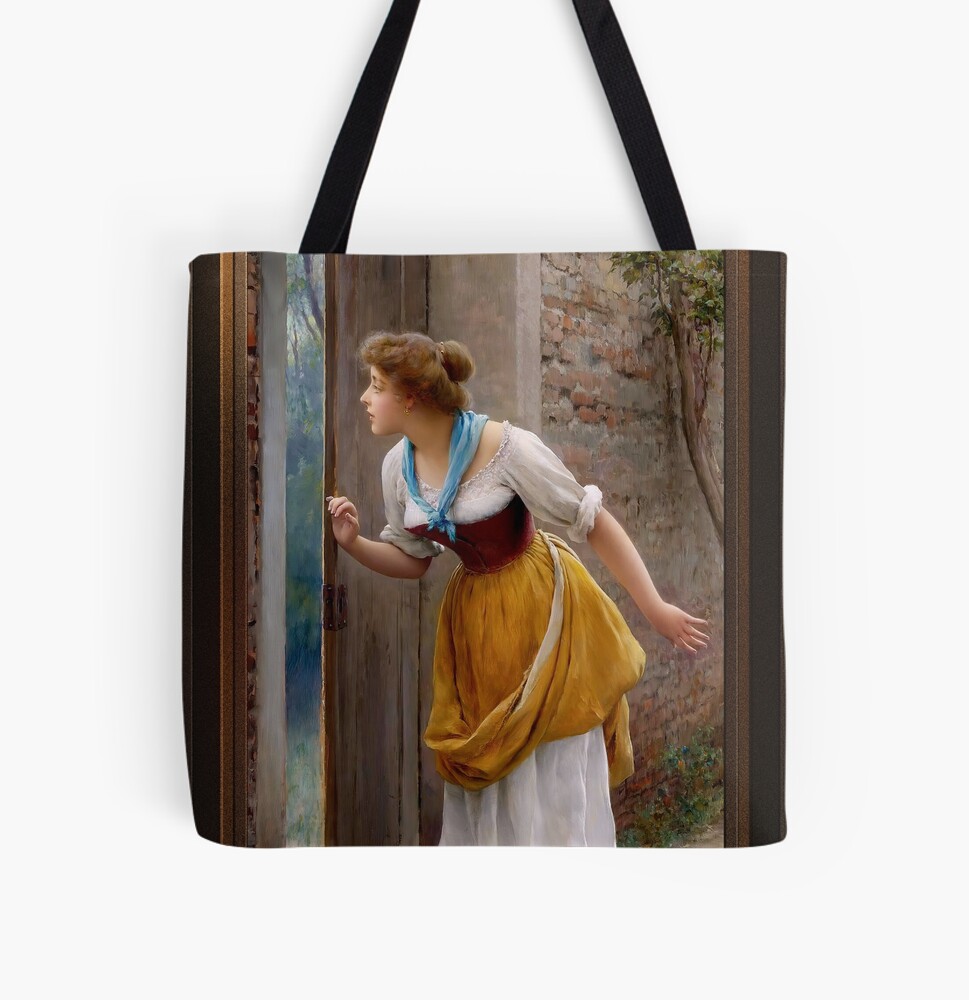
Die Farben in diesem Stück sind warm und dennoch zurückhaltend, wobei die erdigen Töne der Ziegel und die Kleidung der Frau eine harmonische Palette bilden. Die sanften Gelb- und Weißtöne ihrer Kleidung kontrastieren mit den gedämpfteren Farben des Hintergrunds, Schaffung eines Schwerpunkts in der Figur der Frau.
Der blaue Schal, um den Hals gebunden, dient als markanter optischer Akzent, lenkt die Aufmerksamkeit auf ihr Gesicht und verleiht ihm ein Gefühl von Weichheit und Ruhe. Dieser Farbkontrast verstärkt den emotionalen Gesamtton des Werks, contributing to the mood of quiet suspense.
The brushwork in “Der Lauscher” is both precise and fluid. The artist’s handling of textures, from the rustic bricks to the delicate folds of fabric, is incredibly detailed. The face of the woman is rendered with a softness that invites the viewer to connect emotionally with her, emphasizing the realism that von Blaas sought to achieve. The painting has a photographic quality, capturing a fleeting moment with such clarity that it almost seems as though it could have been a real scene witnessed by the artist.
Thema und Stimmung
Das Thema von “Der Lauscher” is one of curiosity, suspense, and perhaps even secrecy. The woman’s actions imply a sense of eavesdropping—something forbidden or private that she is trying to uncover. This sense of voyeurism adds an element of psychological depth to the piece, drawing the viewer into a narrative of hidden knowledge and the consequences of discovering something that was never meant to be heard.
The mood of the painting is one of quiet tension. While there is no overt action, the woman’s body language and her gaze create a sense of suspense. There is an implicit suggestion of something unfolding just beyond the door, something that the woman cannot see fully, but is nonetheless drawn to. The muted background and the stillness of the moment heighten the suspense, allowing the viewer to project their own interpretation onto the scene.
Abschluss
Eugen von Blaas’s “Der Lauscher” is a masterful depiction of a fleeting moment in time, skillfully capturing the emotional nuances of curiosity and the tension between public and private spaces. Der Realismus und die Liebe zum Detail laden den Betrachter dazu ein, nicht nur über die physische Umgebung, sondern auch über die innere Welt des Motivs nachzudenken. In seiner stillen Spannung, Das Gemälde spricht universelle Themen der menschlichen Natur an – unseren Wunsch zu wissen, was jenseits der Schwelle liegt, und die komplexen Emotionen, die mit der Aufdeckung von Geheimnissen einhergehen, die nicht für unsere Ohren bestimmt sind.
Dies ist eine remasterte digitale Kunst-Reproduktion alter Meister eines gemeinfreien Bildes, das als verfügbar ist Leinwanddruck online.
Diese digitale Kunstschöpfung, Wie alle Kunstwerke, die auf der Xzendor7-Website zu finden sind, können sie online in einer Vielzahl von Materialformaten einschließlich Leinwanddrucken erworben werden, Acryldrucke, Metalldrucke, Holzdrucke, gerahmte Drucke, Plakate, und als gerollte Leinwanddrucke in verschiedenen Größen von 12 Zoll zu 72 Zoll, abhängig von der Größe des tatsächlichen Kunstwerks und dem Print-on-Demand-Shop, in dem Sie das Kunstwerk kaufen möchten.
Das Kunstwerk ist auch auf einer breiten Palette von Herren- und Damenbekleidung erhältlich, Tassen, Tragetaschen, Schals, Notizbücher und Tagebücher sowie viele Heimdekorationsprodukte.
Biografie des Künstlers
Info unten abgeleitet von Wikipedia.org
Er wurde in Albano geboren, in der Nähe von Rom, an einen Tiroler Vater und eine italienische Mutter. Sein Vater Karl, auch ein Maler, war sein Lehrer. Seine Mutter, Agnesina Auda, war eine wohlhabende Römerin. Die Familie zog nach Venedig, als Karl Professor an der Akademie von Venedig wurde. Er malte oft Szenen in Venedig, aber auch Porträts und religiöse Gemälde.
Zu seinen Werken gehören Die Hochzeitsform in der Sakristei; Bingo in Campielo in Venedig; Eine Puppenszene in einer Schule; und La Ninetta. Der Kunstkritiker Luigi Chirtani, als das Gemälde in der Mostra Nazionale di Venezia ausgestellt wurde, beschrieb es als schön, schmeichelhaft, hübsch, gestreichelt, gereinigt, poliert, Wäscherin in einem Gemälde von Mr. Blase, der beliebteste Porträtmaler großer venezianischer Aristokraten, in Gala-Satin gekleidet, glänzender Schmuck, Frisuren der Reichen.
Seine farbenfrohen und eher theatralischen Bilder der venezianischen Gesellschaft, z.B. Auf dem Balkon (1877; Privatsammlung), waren ganz anders als zarte Pastelle und Radierungen der Höfe, Balkon und Kanäle des modernen Venedigs.
Eugene de Blaas’ Gemälde wurden in der Royal Academy ausgestellt, Gesellschaft für bildende Kunst, Neue Galerie und Arthur Tooth and Sons Gallery in London, und auch in der Walker Art Gallery in Liverpool