

Kysset

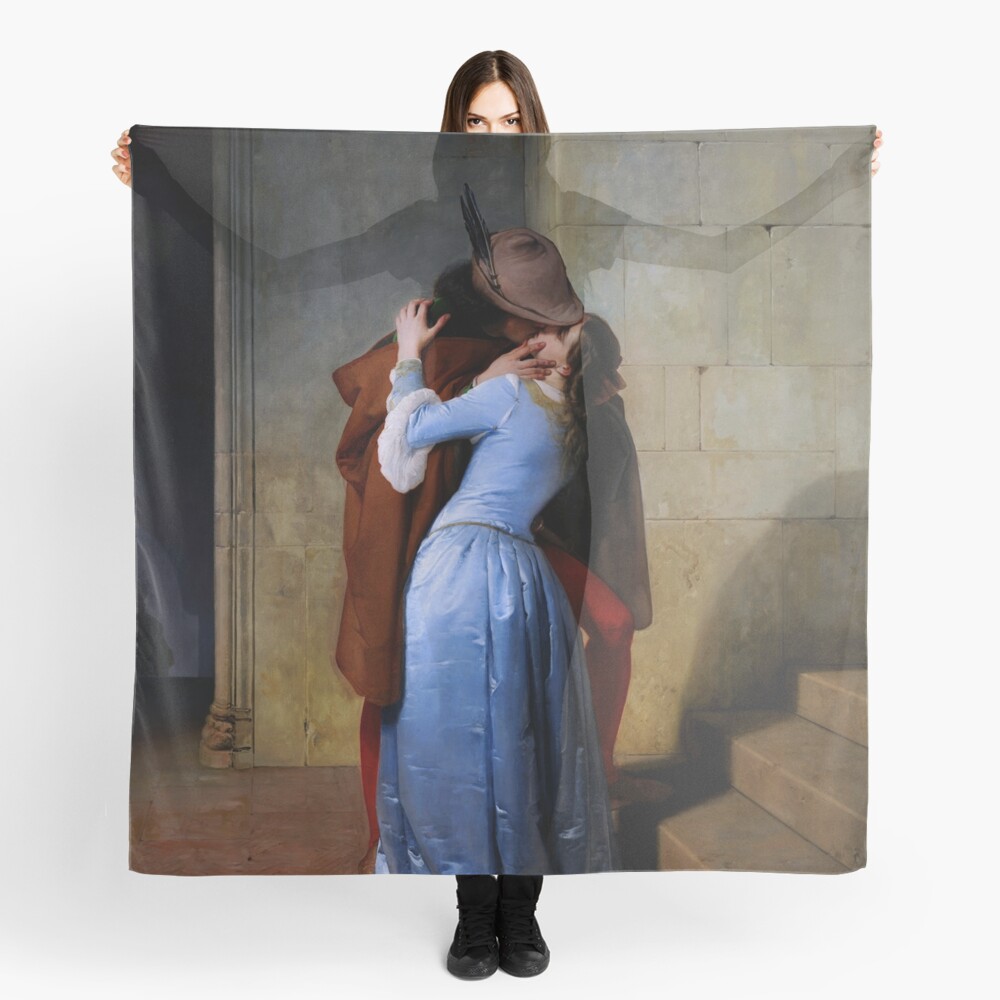
Kysset (Kysset) c1859 av den italienske maleren Francesco Hayez (1791 – 1882); ble sett på som den ledende maleren i romantikkperioden på midten av 1800 -tallet i Milano, Italia. Han var kjent for sine store historiske malerier, politiske allegorier og eksepsjonelle fine portretter.
“De Kysse” is a powerful and evocative painting by the renowned Italian artist Francesco Hayez, opprettet i 1859. The artwork is a stunning example of Romanticism, a movement that was characterized by an emphasis on intense emotion, individualisme, and the sublime. Hayez’s portrayal of an intimate and passionate kiss between two figures is not just a romantic gesture but a deep, symbolic act reflecting the political and social turmoil of 19th-century Italy.
I dette stykket, the central focus is the kiss shared between a man and a woman, each dressed in period-specific attire, their bodies entwined in a tender yet fervent embrace. The lovers’ ansikter, captured at the moment of their kiss, convey an overwhelming sense of passion and longing. The man, dressed in a reddish-brown cloak, holds the woman with one hand, while his other hand grips a green object, possibly symbolizing life or hope. His face is partially obscured by his hat, but the tension in his posture reveals both his deep affection for the woman and the sense of urgency that seems to pervade the scene.
Kvinnen, clothed in a flowing blue gown, stands close to him, her body pressed against his in a stance that signifies emotional and physical closeness. Hennes lange, flowing hair is partially visible, her face bathed in the soft light that seems to emanate from the left, highlighting her delicate features. The deep emotional intensity in her expression, coupled with the almost sacred nature of the kiss, suggests that this moment is one of profound importance for both characters. The sensuality of the kiss is palpable, yet it is underscored by a sense of melancholy, as if this act of love must be performed in secrecy, or perhaps as a final farewell.
The setting of the artwork is crucial to understanding the deeper layers of its meaning. The scene takes place in an open, stone-walled interior, with towering, almost monolithic walls that loom over the lovers. These walls are not merely a backdrop but symbolize the oppression and constraints of the era, particularly in the context of Italy’s political situation. Det røffe, unfinished stone surfaces hint at a time of transition and struggle.
The archway in the background frames the lovers, emphasizing their isolation in the moment and their vulnerability to the outside world. The positioning of the couple in front of the stone walls may also allude to the notion of love as a fortress in a time of uncertainty or political strife, where their embrace provides a form of protection from the harsh reality beyond.
The colors in the painting are rich and symbolic. The warm tones of the man’s cloak contrast with the cooler blues and whites of the woman’s gown, signifying a balance between opposing forces—passion and purity, action and passivity. The use of light is also notable; the couple is illuminated from one side, casting shadows on their bodies and the environment around them. This creates a sense of intimacy and draws the viewer’s attention solely to the couple, ensuring that the emotional intensity of their embrace remains the focal point of the composition.
Når det gjelder materialer, the painting is executed with oil on canvas, a traditional medium that allows Hayez to achieve a remarkable level of detail and depth in his figures and surroundings. The texture of the canvas is almost palpable, with the brushstrokes contributing to the tactile nature of the painting. The artist’s skillful manipulation of light and shadow gives the piece a three-dimensional quality, making it feel as though the viewer could step into the scene and experience the emotional weight of the kiss firsthand.
The overall theme of “Kysset” is one of passion, defiance, og lengsel. The moment captured is not simply a tender exchange between two lovers; it is an act of rebellion and a declaration of love against the backdrop of an oppressive society. At the time Hayez painted this work, Italy was undergoing significant political upheaval, as various regions were striving for unification and freedom from foreign domination.

The kiss, deretter, can be seen as a metaphor for the struggle for independence, with the lovers representing the spirit of resistance and the hope for a brighter, freer future. The kiss is not just an emotional act but a political statement, an expression of the deep desire for change that resonated with the people of Italy during the Romantic period.
The mood of the painting is complex and multi-layered. While it captures the intense passion of the lovers, it also evokes a sense of sorrow and longing. The lovers are caught in a moment of transcendence, but there is a sense that this moment is fleeting.
The raw emotion conveyed through their embrace suggests that their love is either forbidden or destined to end, making the act of kissing both a sweet and painful experience. The viewer is left to ponder whether the kiss signifies the beginning of a relationship, a final farewell, or a stolen moment in a turbulent world.
Avslutningsvis, Francesco Hayez’s “Kysset” is not just a beautiful depiction of love and romance; it is a rich, symbolic painting that speaks to the political, social, and emotional climate of its time. The work’s exquisite use of light, farge, og komposisjon, combined with its deep thematic resonance, makes it a timeless masterpiece that continues to captivate viewers. It invites reflection on the nature of love, the power of passion, and the struggles that shape our world, all while celebrating the profound connection between two individuals caught in the midst of history.
The Kiss is a retouched digital art old masters reproduction of a public domain image that is available as an acrylic, metall, tre, rullet og lerretstrykk online.
Info nedenfor fra Wikipedia.org
Francesco Hayez var fra en relativt fattig familie fra Venezia. Hans far, Giovanni, var av fransk opprinnelse mens moren hans, Chiara Torcella, var fra Murano. Francesco var den yngste av fem sønner.
Han ble oppdratt av sin mors søster, som hadde giftet seg med Giovanni Binasco, en velstående reder og kunstsamler. Hayez viste en disposisjon for å tegne siden barndommen. Onkelen hans, etter å ha lagt merke til hans forgjengelige talent, lærte ham til en kunstgjenoppretter i Venezia. Hayez skulle senere bli elev av maleren Francesco Maggiotto som han fortsatte studiene med i tre år.
Han ble tatt opp på malerkurset ved New Academy of Fine Arts i Venezia i 1806, hvor han studerte under Teodoro Matteini. I 1809 han vant en konkurranse fra Academy of Venice for et års opphold på Accademia di San Luca i Roma.
Han ble i Roma til 1814, flyttet deretter til Napoli hvor han fikk i oppdrag av Joachim Murat å male et større verk som skildrer Ulysses ved hoffet i Alcinous. På midten av 1830-tallet deltok han på Maffei-salongen i Milano, arrangert av Clara Maffei. Maffeis ektemann skulle senere gi Hayez et portrett av kona. I 1850 Hayez ble utnevnt til direktør for Brera Academy.
I løpet av en lang karriere, Hayez viste seg å være spesielt produktiv. Hans produksjon inkluderte historiske malerier designet for å appellere til patriotiske følsomheten til hans lånetakere, så vel som verk som gjenspeiler ønsket om å følge en nyklassisk stil til store temaer, enten fra bibelsk eller klassisk litteratur.
Han malte også scener fra teaterpresentasjoner. Påfallende fraværende fra hans verk, derimot, er altertavler – muligens på grunn av Napoleons invasjoner som dekonerte mange kirker og klostre i Nord -Italia. Kunsthistoriker Corrado Ricci beskrev Hayez som en klassiker som deretter utviklet seg til en stil med følelsesmessig tumult. Francesco Hayez, Kysset (1859)
Portrettene hans har intensiteten til Ingres og Nazarene -bevegelsen. Sitter ofte, Hayezs emner er ofte kledd i strenge, svart -hvite klær, med lite eller ingen utstyr. Mens Hayez laget portretter for adelen, han utforsket også andre emner som andre artister og musikere. Sent i karrieren, han er kjent for å ha jobbet med fotografier.
Et av Hayezs favoritttemaer var halvkledd Odalisque som stemte for orientalske temaer-et favorittemne for romantiske malere.[3] Skildringene av haremer og deres kvinner tillot kunstnere muligheten til å male scener som ellers ikke var akseptable i samfunnet. Selv Hayezs Mary Magdalene har mer sensualitet enn religiøs inderlighet.
Hayezs maleri The Kiss ble ansett blant hans beste arbeider av hans samtidige, og er muligens hans mest kjente innsats. Den anonyme, upåvirket gest fra paret krever ikke kunnskap om myte eller litteratur for å tolke, og appellerer til et moderne blikk.
En vitenskapelig vurdering av Hayez karriere er blitt komplisert av hans tilbøyelighet til ikke å signere eller date verkene hans. Ofte indikerer datoer i maleriene hans når verket ble anskaffet eller solgt, ikke tidspunktet for opprettelsen. Dessuten, han malte ofte de samme komposisjonene flere ganger med minimale variasjoner hvis noen i det hele tatt.
Blant elevene hans fra Brera Academy var Carlo Belgioioso, Amanzio Cattaneo, Alessandro Focosi, Giovanni Battista Lamperti, Livo Sau, Angelo Pietrasanta, Antonio Silo, Carlo Antonio Tavella, Ismaele Teglio Milla og Francesco Valaperta.
Hayez døde i Milano, alder 91. Atelieret hans ved Brera Academy er merket med en tallerken.