

The Nightmare c1781
“Koszmar,” malowane w 1781 by Swiss artist Henry Fuseli (1741-1825), is one of the most iconic and unnerving works of the late 18th century, melding themes of the supernatural and psychological unease. This dramatic and haunting piece explores the realm of nightmares and the grotesque. Known for its bold use of contrast, its striking depiction of a woman in a state of deep sleep, and its symbolic elements, “Koszmar” stands as a testament to Fuseli’s unique approach to Romanticism, blending elements of the gothic with intense emotion and surrealism. Fuseli’s art often questioned the boundaries between reality and dreams, and this piece exemplifies his mastery in portraying the darkness of the human subconscious.
Spis treści
Główny temat i kompozycja
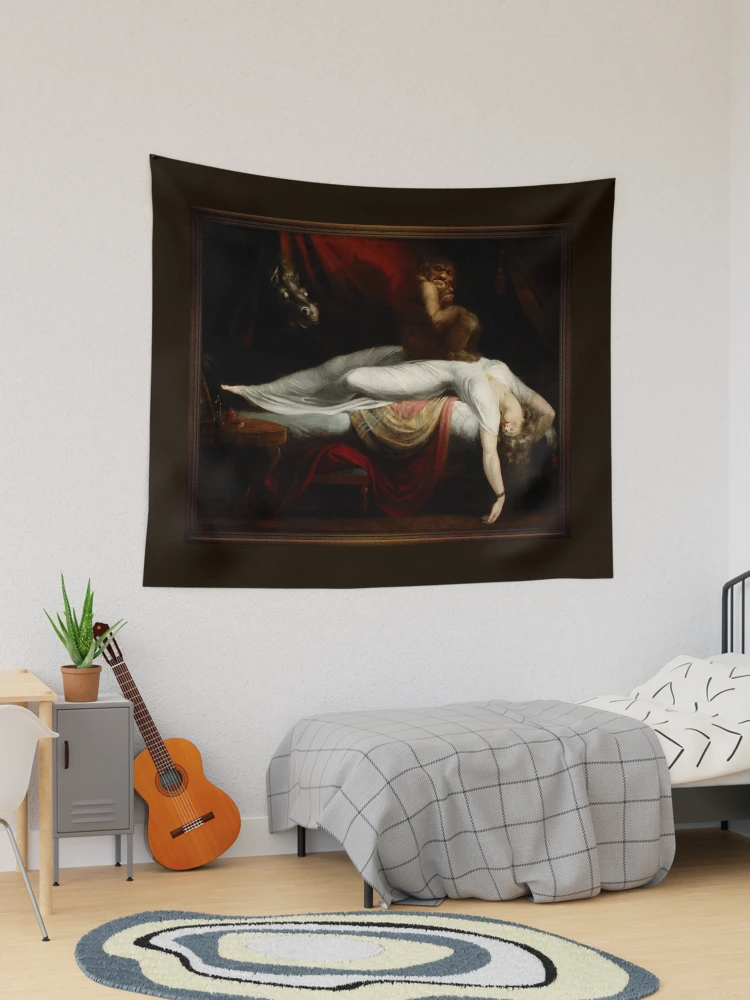
At the center of the mythological composition lies a woman, draped in a white gown, her head tilted back, her eyes shut, and her mouth slightly agape. She lies sprawled across a bed, her posture one of apparent vulnerability. The positioning of her body, her limp arms, and her slouched form suggest that she is not merely asleep, but entrapped in the grip of a terrible nightmare.
Her face is pale, accentuating the fear or distress she may be experiencing in her dream. The body language of the figure reveals both a sense of helplessness and submission, as though the woman is at the mercy of forces beyond her control. On top of her, partially crouched on her chest, is a grotesque, monstrous figure that resembles a demonic creature. This being, with its exaggerated features and intense expression, conveys a sense of malevolent power.
The creature’s posture, its crouched, almost primal stance, suggests a symbolic representation of a nightmare or night terror, which many during the period believed to be the work of supernatural forces. The sinister character appears to be pressing down on the woman, as if suffocating her, yet it exudes an aura of satisfaction and dominance, as if it derives pleasure from her torment.
In the background of the composition, a darkened, blurred silhouette of a horse’s head looms, eyes wide with a fearful expression. This spectral horse adds an additional layer of psychological intensity to the piece, as if the creature’s vision is skewed and tortured, suggesting the nightmare is shared between both the woman and the horse. Its presence only heightens the viewer’s sense of unease, as it represents the creeping nature of irrational fear, constantly lurking in the shadows of the dreamer’s mind.
Obiekty i szczegóły
The room surrounding the central figure is rich in dark tones, which evoke a sense of unease and confinement. To the left, a small table holds objects like a candle and an overturned vase, adding to the atmosphere of disarray and disturbance.
The faint illumination from the candle casts dark shadows on the walls, heightening the sense of isolation and the unknown. The dimness of the interior suggests that the nightmare takes place in the dead of night, further emphasizing the vulnerability and helplessness of the woman in her vulnerable state.
The bed itself, draped with a deep red velvet curtain, plays a significant role in amplifying the atmosphere. Otchłań, rich color of the bedding suggests both luxury and danger, implying that even in a space of comfort, horror can strike. This lavishness, often associated with the opulence of a safe and peaceful domestic life, is sharply contrasted by the horrific apparition that dominates the scene.
The interplay of light and shadow in this piece is significant. Fuseli’s use of chiaroscuro, the technique of using strong contrasts between light and dark, amplifies the drama of the composition. The light falling on the woman’s form illuminates her body in stark contrast to the surrounding darkness, focusing the viewer’s attention on her helpless state while casting her surroundings into an oppressive shadow. This creates a powerful sense of depth and dimensionality, evoking a tension between the reality of her physical form and the nightmare that haunts her.
Nastrój, Styl, and Theme
“Koszmar” evokes a mood of horror, anxiety, and suffocation. It is a powerful visual representation of the psychological terror associated with nightmares, the kind of fear that seems tangible yet is completely irrational. The artist blends elements of gothic horror with a romanticized exploration of the unknown. In the 18th century, people were particularly fascinated by the supernatural and the unknown realms of the mind, making the depiction of these elements a natural focus for Fuseli’s work.
Fuseli’s approach to painting often emphasized intense emotional experiences, and this piece is no exception. The tension in the scene is palpable, not just through the central figures but in the stark contrast between light and dark.
The theme of suppressed terror is explored through the supernatural, as both the woman and the viewer are drawn into a world that is both unsettling and bizarre. This dark exploration of the human psyche invites questions about the limits of consciousness, the fear of the unseen, and the potential for terror that resides within dreams.
The style of Fuseli’s work was influenced by his exposure to Neoclassicism, but he departed from its rationality and balance by incorporating exaggerated forms and dramatic, fantastical elements. The surreal nature of the creature that straddles the woman’s chest reflects his interest in psychological subjectivity and his rejection of realism in favor of emotional intensity.
Wniosek
Henry Fuseli’s “Koszmar” is a provocative, chilling exploration of human fear, zarówno rzeczywiste, jak i wyobrażone. The surreal quality of the painting, the disturbing imagery, and the unsettling use of light and shadow all contribute to the timeless power of this piece. Fuseli captured a universal experience, the sensation of being vulnerable and at the mercy of forces beyond understanding, in a way that continues to resonate with viewers today. The painting is a masterclass in both technique and emotional depth, exploring themes of vulnerability, terror, and the haunting nature of dreams.
The Nightmare to wyretuszowana reprodukcja obrazu należącego do domeny publicznej, wykonana przez starych mistrzów sztuki cyfrowej.
Bio artysty z Wikipedia.org
Fuseli urodził się w Zurychu, Szwajcaria, drugi z 18 dzieci. Jego ojcem był Johann Caspar Füssli, malarz portretów i pejzaży, i autor Żywotów malarzy helweckich. Przeznaczył Henryka do kościoła, i wysłał go do Caroline College w Zurychu, gdzie otrzymał doskonałe wykształcenie klasyczne. Jednym z jego szkolnych kolegów był Johann Kaspar Lavater, z którymi się zaprzyjaźnił.
Po przyjęciu zamówień 1761, Fuseli został zmuszony do opuszczenia kraju w wyniku pomocy Lavaterowi w zdemaskowaniu niesprawiedliwego sędziego, którego potężna rodzina szukała zemsty. Jechał przez Niemcy, i wtedy, w 1765, odwiedził Anglię, gdzie przez jakiś czas utrzymywał się z różnych pism.
Ostatecznie, zapoznał się Sir Joshuy Reynoldsa, któremu pokazał swoje rysunki. Podążając za Reynoldsem’ rada, postanowił całkowicie poświęcić się sztuce. W 1770 odbył artystyczną pielgrzymkę do Włoch, gdzie pozostał do 1778, zmieniając nazwisko z Füssli na bardziej włosko brzmiące Fuseli.
Wcześnie 1779 wrócił do Wielkiej Brytanii, po drodze zatrzymując się w Zurychu. W Londynie czekała na niego komisja od Aldermana Boydella, który wówczas zakładał swoją Galerię Szekspirowską.
Fuseli namalował kilka elementów dla Boydella, i opublikował angielską edycję pracy Lavatera na temat fizjonomii. Udzielił także Williamowi Cowperowi cennej pomocy w przygotowaniu tłumaczenia Homera.
W 1788 Fuseli poślubił Sophię Rawlins (pierwotnie jeden z jego modeli), i wkrótce potem został współpracownikiem Akademii Królewskiej. Wczesna feministka Mary Wollstonecraft, którego portret namalował, planował z nim wycieczkę do Paryża, i ścigał go z determinacją, ale po interwencji Zofii Fuselis’ drzwi były dla niej zamknięte na zawsze.
Fuseli powiedział później “Nienawidzę mądrych kobiet. Są tylko kłopotliwe”. W 1790 został pełnym akademikiem, przedstawiający Thora Battering the Midgard Serpent jako swoją pracę dyplomową. W 1799 Fuseli został mianowany profesorem malarstwa Akademii. Cztery lata później został wybrany na Strażnika, i złożył rezygnację z profesury, ale wznowił go w 1810, nadal pełni oba urzędy aż do śmierci.[4] Jako Strażnik, jego następcą został Henry Thomson.
W 1799 Fuseli wystawił serię obrazów z przedmiotów dostarczonych przez prace Johna Miltona, z myślą o utworzeniu galerii Miltona porównywalnej z galerią Szekspira Boydella.
Byli 47 obrazy Miltona, wiele z nich jest bardzo dużych, uzupełniane w odstępach ponad dziewięciu lat. Wystawa okazała się komercyjną porażką i została zamknięta 1800. W 1805 wyjął wydanie Żywotów malarzy Pilkingtona, co niewiele zrobiło dla jego reputacji.
Antonio Canova, podczas jego wizyty w Anglii, był bardzo zachwycony pracami Fuseli, i po powrocie do Rzymu w r 1817 spowodował, że został wybrany członkiem pierwszej klasy Akademii św. Łukasza.