

La visite de la reine de Saba au roi Salomon
La visite de la reine de Saba au roi Salomon c1890 par le peintre britannique Edward Jean Poynter (1836 – 1919); Portraitiste préraphaélite et éminent et écrivain de premier plan de son temps.
Il s'agit d'une œuvre d'art époustouflante et opulente qui représente la grande richesse et la puissance du roi Salomon. (990 – 931 BCE) pendant son règne estimé à environ 970 – 931 BCE.
La scène montre la cour du palais du roi Salomon avec des colonnes massives à double rangée ornées d'or à partir de la base à mi-hauteur., puis un rouge ardent et avec plus d'or sur la partie supérieure ornementale de la colonne.
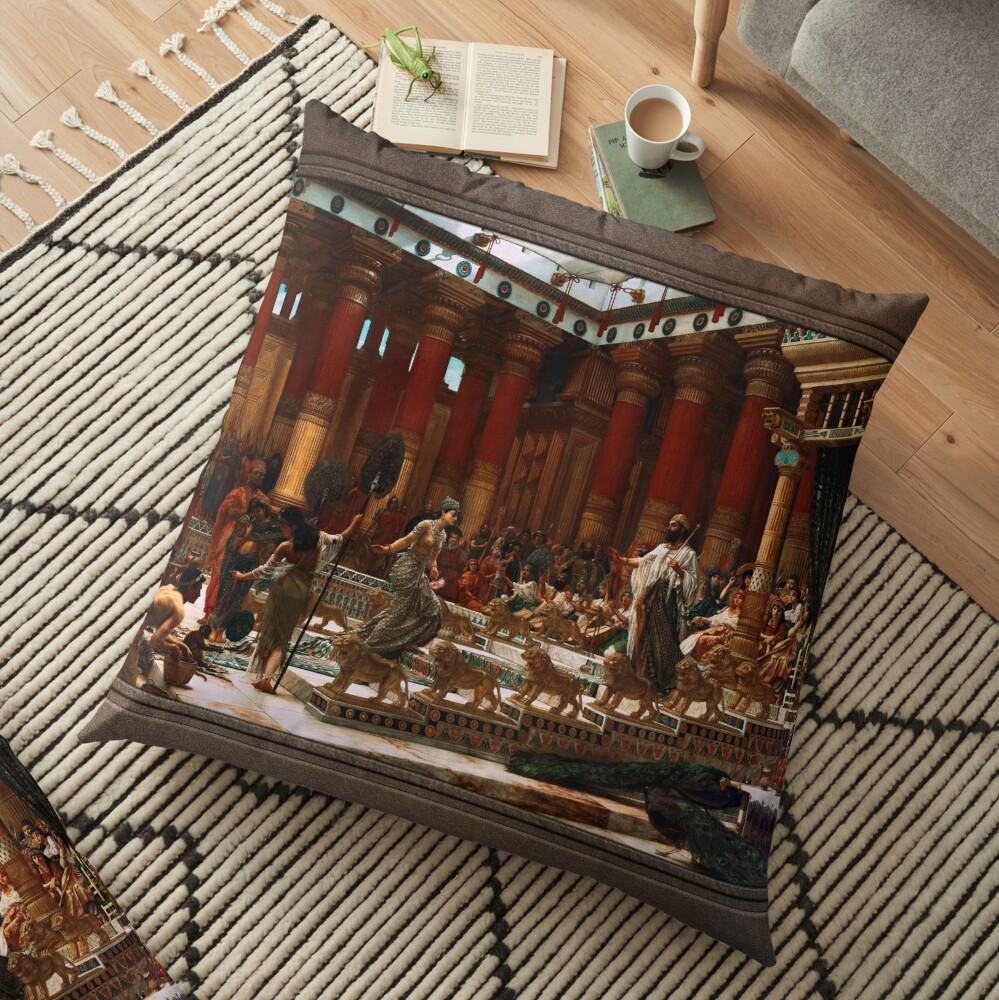
Le long du périmètre de la cour se trouvent un nombre massif de dignitaires ainsi que des soldats des terres qui bordent son royaume..
Son trône est orné d'or et comporte six marches en marbre avec des statues de lion dorées sur chaque palier de chaque côté.; les paliers étant également ornés d'or et de magnifiques objets d'art décoratifs.
À droite de son trône, nous pouvons voir certaines des épouses de Salomon et en dessous d'elles se trouvent des musiciens composés de quatre femmes et un homme jouant une sorte de harpe.; tandis qu'à gauche du trône, nous voyons de grands paons bleu-vert près d'une table avec des raisins et d'autres fruits entretenus par une femme..
Au cinquième palier se trouve le roi Salomon en robe blanche, chapeau d'or cultivé, un sceptre dans sa main gauche et un tissu décoratif suspendu à son côté gauche; avec sa main droite tendue vers l'avant, vers la reine de Saba qui est au deuxième palier.
Elle est ornée d'un bonnet de bijoux et porte des bijoux comme bijoux de corps sur sa poitrine et sa taille exposées., ainsi qu'un vêtement en soie verte qui fait office de jupe longue.
Derrière elle se trouvent deux servantes tenant de grands mâts d'éventail de paons avec un annonceur derrière l'une d'elles à droite et derrière elles devant les marches se trouvent des serviteurs ou des esclaves avec de la nourriture et des boissons.; ainsi qu'un singe qui tient un petit éventail paon dans sa main droite.
La visite de la reine de Saba au roi Salomon est une reproduction remasterisée de maîtres anciens d'art numérique d'une image du domaine public disponible sous forme de métal., acrylique, bois et impression sur toile.
Informations ci-dessous dérivées de Wikipedia.org
Edouard est né à Paris, France à British Architect et fondateur de l'Institute of British Architects (c1834) Ambroise Poynter (1796 – 1886) et Emma Forster (? – 1848); et peu après sa naissance, ses parents retournèrent en Grande-Bretagne.
Edward est allé au Brighton College et à l'école d'Ipswich, mais a été contraint de partir tôt en raison d'une mauvaise santé; ce qui l'a amené à passer ses hivers à Madère, Portugal et à Rome, Italie.
Quand il était 17 ans, à Rome, il rencontre le peintre britannique Frederick Leighton, et cette réunion a fait une forte impression sur; de sorte qu'à son retour à Londres, il s'inscrit à la Leigh's Academy, qui a été fondée par James Mathews Leigh (1808 – 1860) et deviendrait finalement la Heatherley School of Fine Art aujourd'hui; et il étudierait également à la Royal Academy Schools.
De là, il se rendit à Paris pour étudier à l'atelier du peintre classique suisse Marc Gabriel Charles Gleyre. (1806 – 1874).
Au cours de sa carrière, Edward a occupé un certain nombre de postes officiels, dont celui de professeur Slade à l'University College de Londres. (1871 – 1875), directeur de l'École nationale supérieure de formation artistique (1875 – 1881) et directeur de la National Gallery (1894 – 1904); supervisant l'ouverture de la Tate Gallery.
Edward a été noté comme un peintre de grandes peintures historiques tout au long de sa carrière, avec des œuvres comme Israël en Egypte c1867, suivi de St George pour l'Angleterre c1869, représentant St George et le Dragon et culminant peut-être avec la visite de la reine de Saba au roi Salomon c1884-90.