

Oso galanta
Oso galanta aurretik 1914 Cesare Detti margolari italiarrarena (1847 – 1914); mende amaierako eta XX. mende hasierako historiagatik ezaguna dena Genero eszenak mendeko XVII eta XVIII, Troubadour Arte Estiloan inspiratua.
Zalduntasuna eta galanta gizartearen arauak gizon zein emakumeengandik espero ziren garai bateko pieza ederra da..
Gazte aristokratiko bat erakusten du, goiko aldean luma gorri batekin txapel urdin batekin jantzita dagoena., bat datorren jaka urdina eta alkandora txuriduna jantzita, eta kapa horia bere eskuineko besoaren eta sorbaldaren gainean jantzita, belauneko galtza marroiekin, eta belauneko galtzerdiak alboan lazo batean zinta arrosaz lotuta, zapata baxu beltzekin.
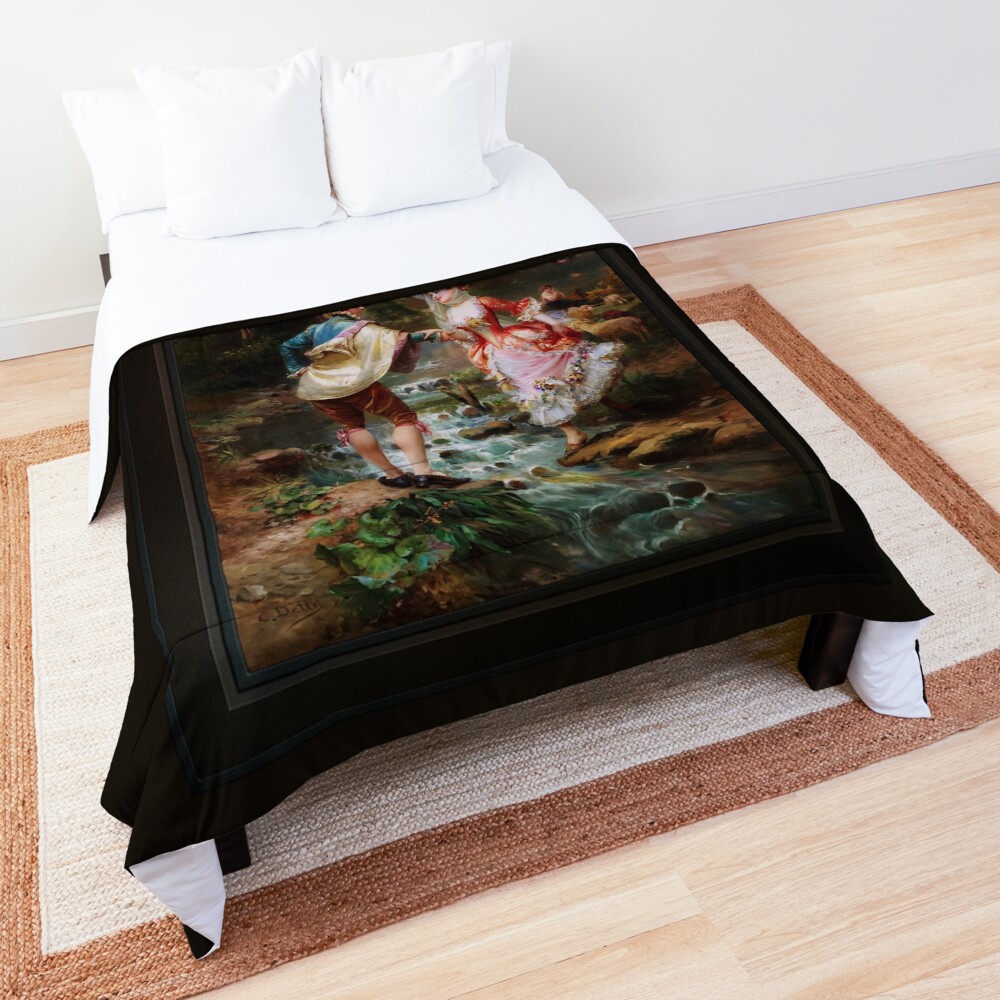
He is standing on one side of narrow stream that has small to medium sized boulders in its path; giving an aristocratic young lady a helping hand of support as she embarks on crossing the stream.
The young lady has red and pink roses in her read hair, that is covered by a yellow hat and a large flowing white scarf that wrapped around the top of the hat, under her chin and around her neck; covering part of her pearl choker necklace.
She is wearing a red deep-v and wide chest dress that is embroidered with floral designs and that has white ruffle accents along the chest and short sleeves that go down just below the elbow.
Her red dress is composed of several layers with the red top layer opening up to reveal a pink and white layer that has decorative floral accents along its edge, before giving way to the bottom white full ruffle layer.
Behind the young lady are three white and one brown grazing sheep that are being tended by a boy that is playing a simple flue by the edge of the river.
The rest of the scene is comprised ground filled with rocks that has very little grass, some green plants and large trees in the background, inter-mixed with a cloud filled blue sky.
Très Galant is a remastered digital art old masters reproduction of a public domain image that is available as a mihise inprimatu sarean.
Hemendik eratorritako informazioa Wikipedia.org
Cesare was borne to Davide Detti an engineer and amateur painter on November 28, 1848 in Spoleto Italy; and showed from an early age an interest in art, that was encouraged by his father.
zenean 13 years old he met the Italian Painter Francesco Coghetti (1801 – 1875), a painter from Rome, who was creating murals at the Teatro Nuovo Gian Carlo Menotti; Coghetti, seeing the young boys talent made the suggestion that Cesare should attend the Accademia di San Luca where he was a professor, for formal artistic training.
He studied at the academy until 1866, coming under the influence of Spanish Painter Marià Josep Maria Bernat Fortuny i Marsal (1838 – 1874); who was the leading Spanish painter of his day with an international reputation, who was more commonly known as Marià Fortuny or Mariano Fortuny.
Fortuny, introduces Cesare to the Macchiaioli; mendearen bigarren erdian Toskanan jardun zuten italiar margolari talde bat izan zena, margo gehienak aire librean egiten zituztenak, argi naturala harrapatzeko, itzala eta kolorea; garaiko Italiako arte akademietan irakasten ziren konbentzioetatik aldentzen zena.
Ikasketak amaitutakoan Cesare asko bidaiatzen hasi zen, Napolin urte batzuk emanez, Italian eta bertan erakusketa egiten 1872; barruan 1876 Parisera bidaiatu zuen, Frantzia eta Jean-Baptiste Adolphe Goupil margolari frantsesa ezagutu zuen (1806 – 1893); garaiko arte-merkatari nagusi bat zena eta bere artelanak erakustea onartu zuena, baita bere artelanak bere bezero burgesentzat grabatuak izateko moldaketak egitea ere.
Azkenean Parisen kokatu zen, urtean erakusketa egin zuen Salonean 1877; eta gero sartu 1880 Juliette-Emilie Filieuse ezkondu zen, with whom he had two daughter and a son.
When he and his family moved to the commune of Bourron-Marlotte, just outside of Paris in 1883, he became a member of the Groupe de Marlotte; an independent society of landscape painters.
Five years later he participated in the Italian Exhibition in London, and the following year in 1889 he had showings at the Exposition Universelle, where he was the Vice-President of the Italian Committee; he also exhibited at the Exposition Universelle in 1900 where he was awarded a Silver Medal.