

View fan’ arco di Benevento nel regno di Napoli
View fan’ arco di Benevento nel regno di Napoli c1748-74 by Italian Painter Giovanni Battista Piranesi (1720 – 1778); skilder, classical archaeologist and architect know for his etchings of Rome and fictitious atmospheric prisions.
View fan’ arco di Benevento is a capriccio of the ancient Roman triumphal Arch of Trajan in Benevento, of Southern Italy; which was erected in honor of the Emperor Trajan (53 AD – 117 AD) across the Via Appia (which was one of the earliest strategic and important roads of the ancient republic), at the point where it enters the city.
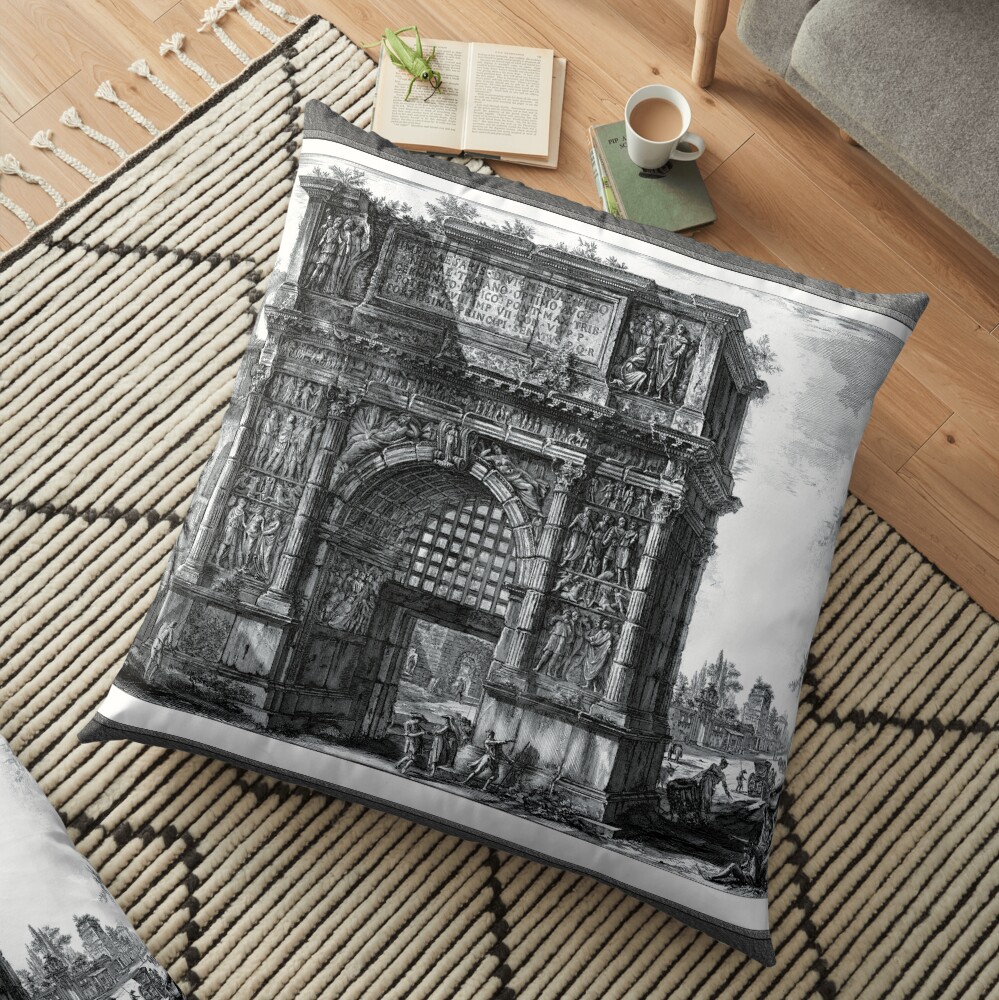
There are people gathered by the Arch and we can see people in the distance in horse and buggy, with backpack horses, and a town.
View fan’ arco di Benevento nel regno di Napoli is a remastered digital art old masters reproduction of a public domain image that is available online as a canvas rôle print.
Info hjirûnder ôflaat fan Wikipedia.org
Piranesi was the son of a stonemason and was born in Venice, in the parish of S. Moisè where he was baptized. His brother Andrea introduced him to Latin literature and ancient Greco-Roman civilization.
Later he was apprenticed under his uncle, Matteo Lucchesi, dy't in liedende arsjitekt wie yn Wetterskip, de steatsorganisaasje ferantwurdlik foar yngenieur en restauraasje fan histoaryske gebouwen.
Fan 1740, Giovanni hie in kâns om te wurkjen yn Rome as tekener foar Marco Foscarini, de Fenesiaanske ambassadeur fan de nije paus Benediktus XIV.
Hy wenne yn it Palazzo Venezia en studearre ûnder Giuseppe Vasi, dy't him yntrodusearre yn 'e keunst fan it etsen en gravearjen fan 'e stêd en har monuminten.
Giuseppe Vasi fûn dat Giovanni syn talint folle grutter wie as dat fan in gewoane graveur; neffens Legrand, Vasi fertelde Piranesi dat “do bist tefolle fan in skilder, myn freon, graveur te wêzen.”
Nei syn stúdzje mei Vasi konkludearre, hy wurke gear mei learlingen fan 'e Frânske Akademy yn Rome om in rige vedute te meitsjen (views) fan 'e stêd.
Yn 1743 Giovanni created his first work the Prima parte di Architettura e Prospettive, and followed that up in 1745 with Varie Vedute di Roma Antica e Moderna.
Fan 1743 nei 1747 Giovanni was mainly in Venice where, according to some sources, he often visited Giovanni Battista Tiepolo, a leading artist in Venice.
It was Tiepolo who expanded the restrictive conventions of reproductive, topographical and antiquarian engravings.
Giovanni then returned to Rome, where he opened a workshop in Via del Corso; en yn 1748 – 1774 he created an important series of vedute of the city which established his fame.
In the meantime Piranesi devoted himself to the measurement of many of the ancient buildings, which led to the publication of Le Antichità Romane de’ tempo della prima Repubblica e dei primi imperatori (“Roman Antiquities of the Time of the First Republic and the First Emperors”).
Yn 1761 he became a member of the Accademia di San Luca and opened a printing house of his own. Yn 1762 the Campo Marzio dell’antica Roma collection of engravings was printed.
The following year he was commissioned by Pope Clement XIII to restore the choir of San Giovanni in Laterano, but the work did not materialize.
Yn 1764, one of the Pope’s nephews, Cardinal Rezzonico, appointed him to start his only architectural work, the restoration of the church of Santa Maria del Priorato in the Villa of the Knights of Malta, on Rome’s Aventine Hill.
He combined Classical Architectural Elements, trophies and escutcheons with his own particular imaginative genius for the design of the facade of the church and the walls of the adjacent Piazza dei Cavalieri di Malta.
Yn 1767 he was made a knight of the Golden Spur, which enabled him to sign himself “Cav[aliere] Piranesi”. Yn 1769 his publication of a series of ingenious and sometimes bizarre designs for chimneypieces, as well as an original range of furniture pieces, established his place as a versatile and resourceful designer.
Yn 1776 he created his best known work as a ‘restorer’ of ancient sculpture, the Piranesi Vase, en yn 1777 – 78 he published Avanzi degli Edifici di Pesto (Remains of the Edifices of Paestum).