

When The Heart Is Young
When The Heart Is Young c1802 by English Artist John William Godward (1861 – 1922), who’s career spanned the end of the Neo-Classical era. He also painted in the Symbolism, Aestheticism and Academic Art Movement Styles
This painting by Godward depicts an attractive young lady lying down on a leopard skin covered marble bench with a garden, then a forest and the blue ocean in the background. She his wearing a pink blouse with a decorative white waste apron and sandals; and there is a gazebo behind the bench she is laying on.
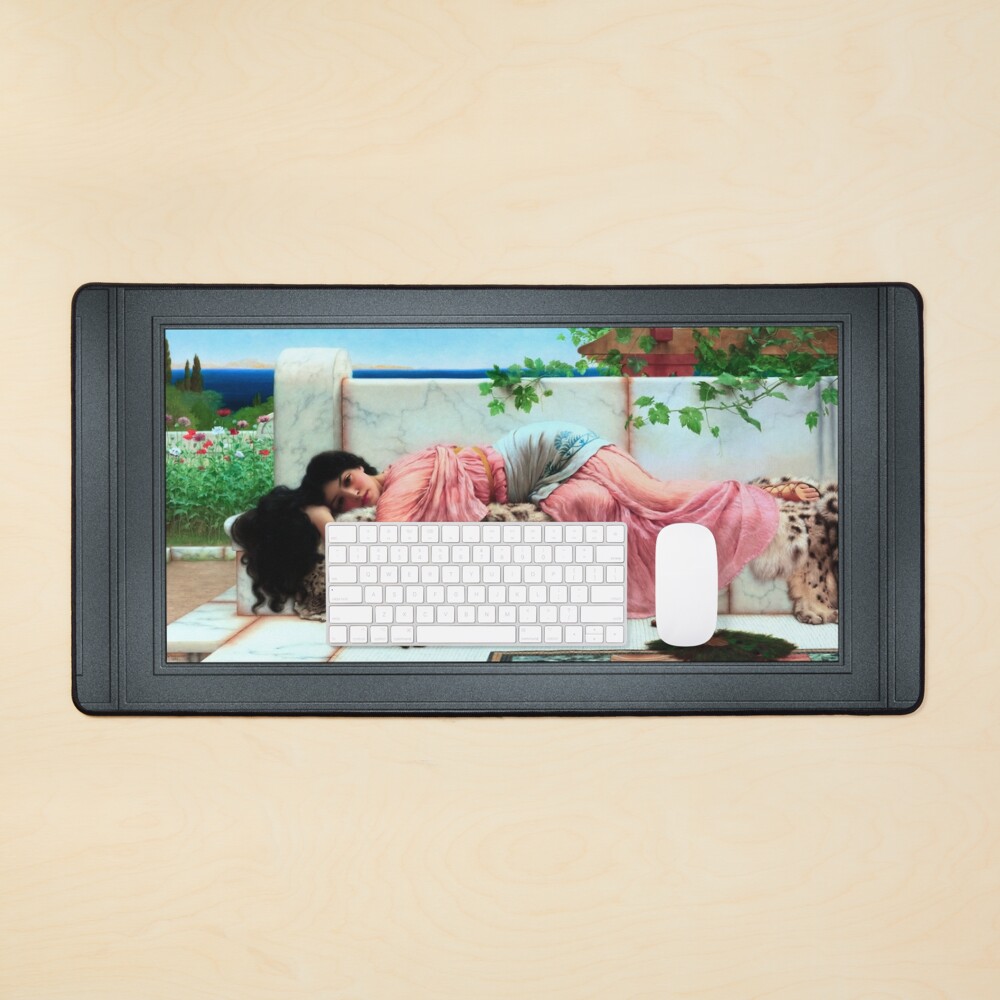
Dit is in retouchearre digitale keunstreproduksje fan in ôfbylding yn it iepenbier domein dat te keap is as in opgerold canvas print online.
Info hjirûnder Fan Wikipedia.org
John William Godward wie de âldste fan fiif bern, en waard neamd nei syn heit Jan en pake Willem.
Hy eksposearre oan de Royal Academy fan 1887. Doe't er ferhuze nei Itaalje mei ien fan syn modellen yn 1912, his family broke off all contact with him and even cut his image from family pictures. Godward returned to England in 1921, died in 1922, and is buried in Brompton Cemetery, West London.
One of his best-known paintings is Dolce far Niente (1904), which was purchased for the collection of Andrew Lloyd Webber in 1995. As in the case of several other paintings, Godward painted more than one version; in this case, an earlier (and less well-known) 1897 version with a further 1906 version.
He committed suicide at the age of 61 and is said to have written in his suicide note that “the world is not big enough for [both] myself and a Picasso”.
His estranged family, who had disapproved of his becoming an artist, were ashamed of his suicide and burned his papers. Only one photograph of Godward is known to survive.

Godward was a Victorian Neo-Classicist, and therefore, in theory, a follower of Frederic Leighton. lykwols, he is more closely allied stylistically to Sir Lawrence Alma-Tadema, with whom he shared a penchant for the rendering of Classical architecture – in particular, static landscape features constructed from marble.
The vast majority of Godward’s extant images feature women in classical dress posed against landscape features; although there are some semi-nude and fully nude figures included in his oeuvre, a notable example being “In The Tepidarium c1913”.
A title shared with a controversial Alma-Tadema painting of the same subject that resides in the “Lady Lever Art Gallery”. The titles reflect Godward’s source of inspiration; which was classical civilization, most notably that of Ancient Rome; a subject binding Godward closely to Alma-Tadema artistically.
Sjoen dat klassike beurzen mear wiidferspraat wie ûnder it potinsjele publyk foar syn skilderijen yn syn libben dan yn 'e hjoeddeiske dei, sekuer ûndersyk nei detail wie wichtich om in status as keunstner yn dit sjenre te krijen.
Alma-Tadema wie ek archeolooch en skilder, dy't histoaryske plakken besocht en artefakten sammele dy't hy letter yn syn skilderijen brûkte: Godward, te, studearre sokke details as arsjitektuer en klean, om derfoar te soargjen dat syn wurken it stempel fan echtheid droegen.

Derneist, Godward makke mei soarch en sekuer oare wichtige funksjes yn syn skilderijen, bistehûden wêrfan de skilderijen “Noon Day Rest c1910” en “In koele retreat c1910” befettet foarbylden fan sa'n werjefte likegoed as wylde blommen “Nerissa c1906” en “Simmerblommen c1903”.
The appearance of beautiful women in studied poses in so many of Godward’s canvases causes many newcomers to his works to categorize him mistakenly as being Pre-Raphaelite, particularly as his palette is often a vibrantly colorful one. The choice of subject matter (ancient civilization versus, bygelyks, Arthurian legend) is more properly that of the Victorian Neo-classicist.
In common with numerous painters contemporary with him, Godward was a ‘High Victorian Dreamer’, producing images of an idealized and romanticized world that, in the case of both Godward and Alma-Tadema, came to be criticized as a world-view of Victorians in togas.
Godward “fêstige gau in reputaasje foar syn skilderijen fan jonge froulju yn in klassike setting en syn fermogen om mei gefoelichheid en technyske behearsking it gefoel fan kontrastearjende tekstueren fan fleis oer te bringen, marmer, bont en stoffen.
Godward's foarkar foar it meitsjen fan keunstwurken dy't yn 'e klassike perioade sette, kaam wierskynlik út 'e tiidperioade wêryn't hy berne waard; sa't it wie de lêste folsleine klassike oplibbing yn westerske skilderijen, dat bloeide yn Ingelân fan 'e 1860's oant de 1890's.