

Will It Be Fine c1896
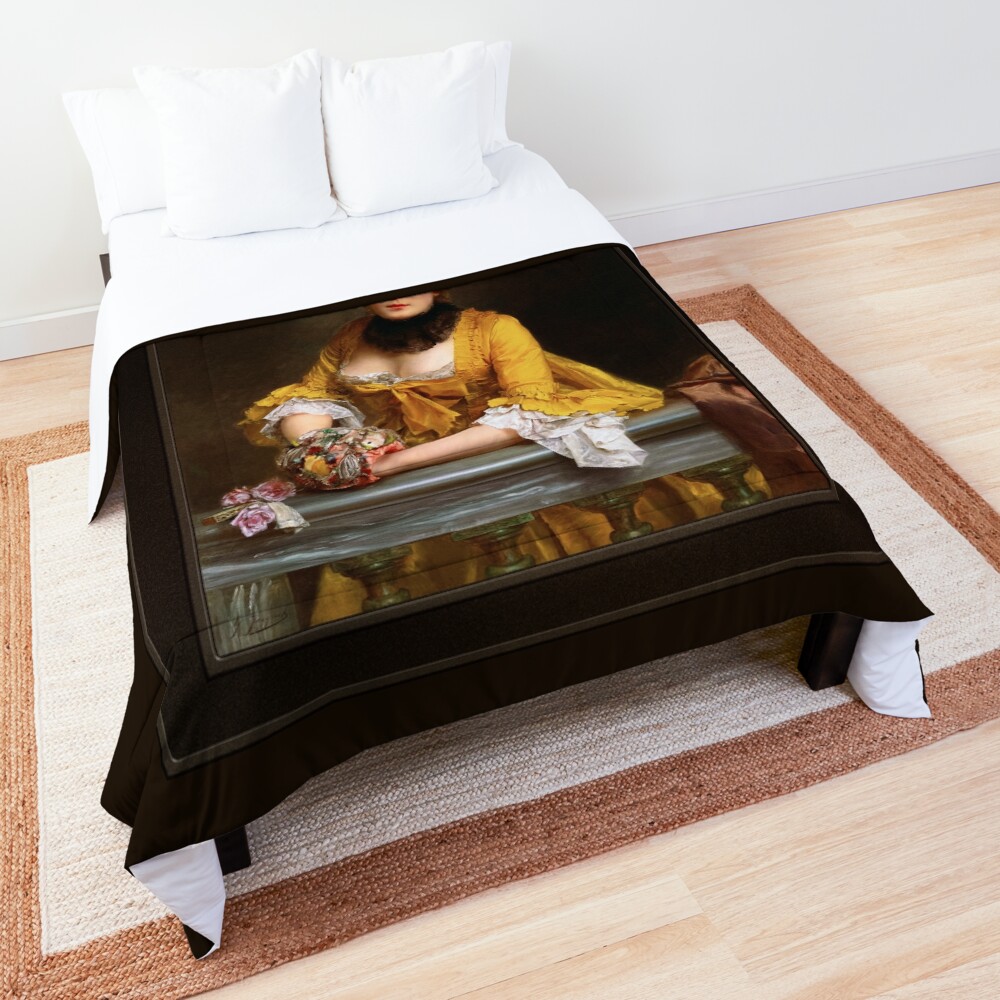
“Will It Be Fine,” created in 1896 by French painter Gustave Jean Jacquet (1846 – 1909), is a portrait that captures a moment of contemplation and grace, reflecting the aesthetic trends of the late 19th century. The painting features a young woman, dressed in an elegant yellow gown, leaning against a table as she holds a bouquet of flowers.
Her delicate pose and thoughtful expression invite the viewer into her world, perhaps pondering a future decision or the course of her life. The subject’s attire, hairstyle, and surroundings embody the refined atmosphere of the period, blending naturalism with a touch of Romanticism. The attention to detail and the soft, warm tones of the painting evoke a sense of timeless beauty and a tranquil moment of introspection.
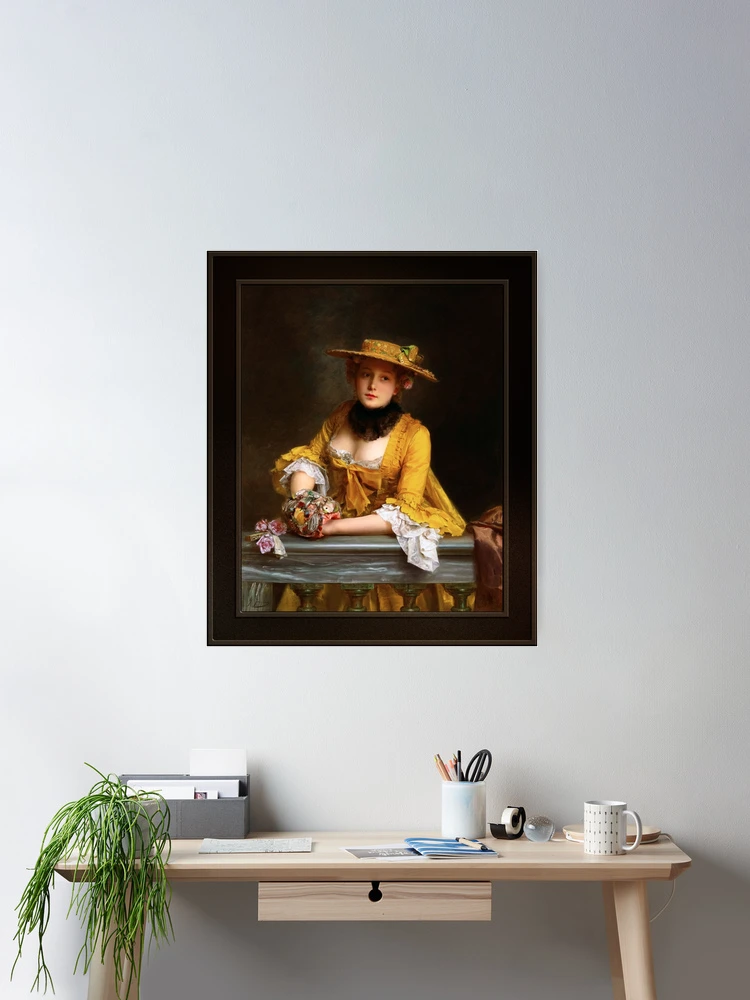
Table of Contents
The Subject: A Portrait of Elegance
At the heart of “Will It Be Fine” is the portrait of a young woman, likely a representation of femininity in its most delicate form. She is seated in a relaxed yet poised manner, with one arm resting on a table, and her gaze directed slightly off to the side, giving the impression that she is lost in thought. Her facial expression, serene and composed, speaks to the psychological depth that Jacquet was able to achieve through his meticulous brushwork.
The woman’s features are finely detailed, with soft, pale skin that contrasts subtly against the deeper tones of her clothing. The artist’s precision in capturing the texture and structure of her face is noteworthy, with every detail, from her soft cheeks to her slightly parted lips, contributing to a sense of realism that was characteristic of Jacquet’s work.
The woman’s attire, a yellow gown with intricate ruffles, is a statement of high fashion typical of the late 19th century. The dress, with its vibrant yellow color, is composed of fine fabrics that catch the light, enhancing the richness of the scene. The wide-brimmed hat atop her head, adorned with floral embellishments, completes her ensemble.
The rich textures of the fabric and the carefully painted details of her accessories, such as the ribbon tied at the neckline and the delicate bouquet she holds, all contribute to the luxurious feel of the portrait. The ensemble exudes elegance, signifying her high social status or noble birth. The bouquet of flowers, too, is a key detail, symbolizing beauty, youth, and perhaps the fleeting nature of time.
The Setting and Materials
The background of the portrait is subtle, providing a muted contrast to the vibrancy of the subject’s attire. The artist uses a dark, almost ethereal backdrop that adds a sense of depth and focus to the subject while enhancing the intimate mood of the piece. The table in front of her, upon which she rests her arm, is rendered with a sense of realism, though it remains in the background, serving as a support rather than a focal point. The use of light and shadow across her face and gown helps to create a three-dimensional effect, emphasizing the naturalistic approach Jacquet was known for.
The materials of the painting itself are oil on canvas, which allows for the soft transitions of color and light, contributing to the lifelike quality of the work. The application of light and shadow is particularly well-executed, with Jacquet employing delicate highlights to give the fabric of the gown a sense of texture. The light seems to caress the subject’s face and hands, drawing attention to the subtle beauty of her skin and the softness of her expression.
Style, Theme, and Mood
“Will It Be Fine” is an exemplary work of 19th-century French portraiture, with influences from both the academic tradition and the more intimate, psychological explorations that were emerging at the time. Jacquet’s style blends realism with a romanticized interpretation of his subject, capturing the physical likeness of the woman while also imbuing her with a sense of emotional depth. The painting’s realism is evident in the precise rendering of the fabrics, the textures, and the light, while the soft treatment of the woman’s face and the mood created by her distant gaze lend the piece an air of introspection and contemplation.
The theme of the painting seems to explore a moment of quiet anticipation, perhaps asking the question of whether the future will bring joy or sorrow—symbolized by the title “Will It Be Fine.” The title, in conjunction with the contemplative mood of the figure, suggests a sense of uncertainty or hopefulness, evoking a time in the subject’s life when decisions or events may alter her course.
The overall mood of the painting is one of calm introspection. The colors, especially the warm yellow of the gown and the softness of the background, contribute to a sense of peace. Yet, there is also an undercurrent of uncertainty, as the subject’s expression is not one of absolute confidence, but rather one of quiet contemplation.
Conclusion
In “Will It Be Fine,” Gustave Jean Jacquet succeeds in capturing a moment that is both timeless and evocative. The painting speaks to the viewer not just through its technical mastery but also through its emotional resonance. The young woman in her opulent attire, holding her bouquet and gazing into the distance, seems to embody a silent narrative of waiting, of pondering the future. Jacquet’s deft handling of light, his careful rendering of fabrics, and his ability to evoke a range of emotions through the subject’s expression all come together to create a portrait that is not just a depiction of a woman, but a meditation on beauty, youth, and the passage of time.
This is a retouched digital art old masters reproduction of a public domain image.
Artsit Bio Is Derived From 19thcenturypaintings.com
Gustave was born in Paris, France on 1846 and was a pupil of the French Painter William-Adolphe Bouguereau (1825 – 1905) of the Neoclassicism, Realism, Academic, Symbolism, Modern Art era; and never mentored with any other artist and being heavily influenced by him during the early part of his career.
Gustave debut artwork was La Rêverie, an allegory piece presented to the Salon in 1865; then in 1866 presented small dimension paintings that depicted the life of 16th, 17th and 18th century life, as well as painting portraits of subjects in period costumes of the 16th century.
In 1875 Gustave was awarded a medal of excellence and 4 years later was made a Chevalier de la Légion d’honneur (Legion of Honor, formerly the Royal Order of the Legion of Honour); is the highest French order of merit, both military and civil. Established in 1802 by Napoleon Bonaparte.