

Young Mother Nursing Her Baby
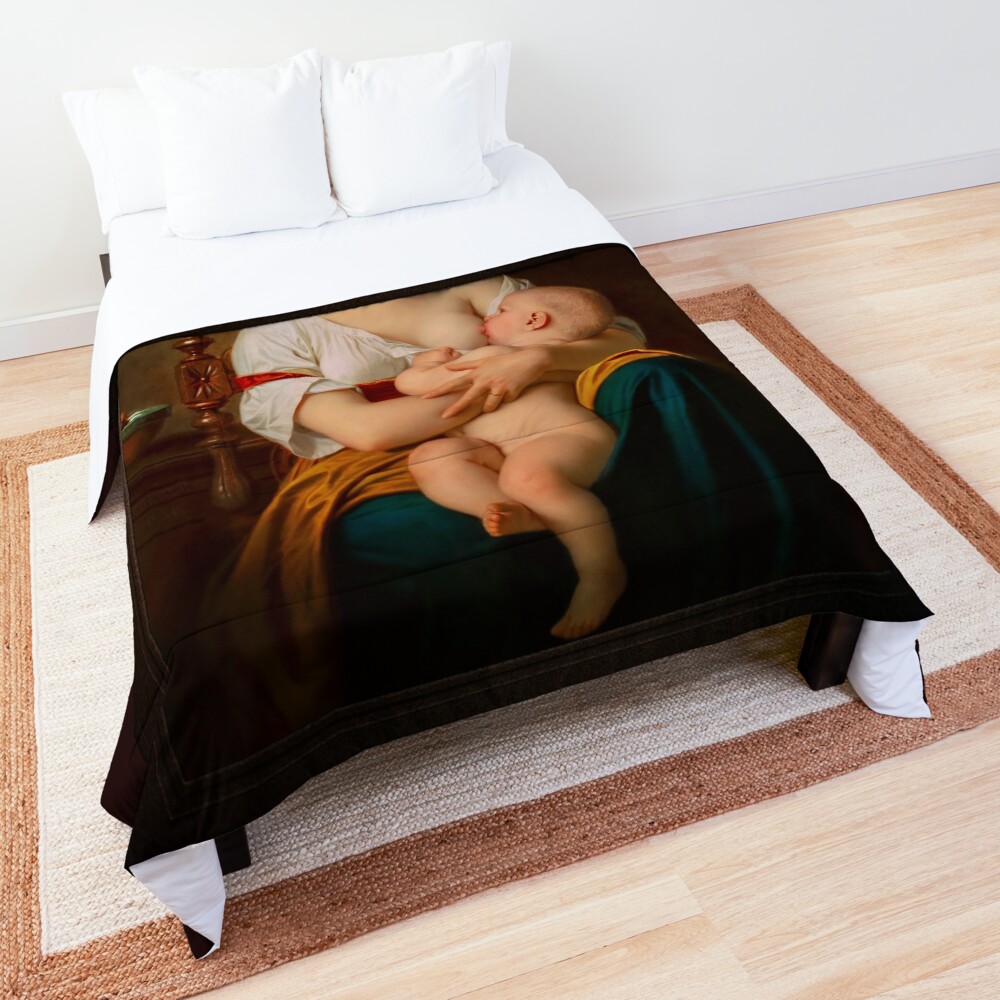
“Young Mother Nursing Her Baby,” eingemalt 1865 vom französischen Künstler Hugues Merle (1822 – 1881), is an exemplary work of genre painting that portrays a deeply intimate and tender moment between a mother and her child. Merle, who was well-regarded for his sensitive and realistic portrayals of human subjects, employs his characteristic naturalism in this painting, capturing both the physical and emotional intimacy of motherhood. Die Szene, focused entirely on the mother and child, exemplifies the artist’s ability to evoke a quiet, yet poignant narrative through a simple domestic moment.
Inhaltsverzeichnis
Hauptthema: The Mother and Child
At the heart of this composition is the mother, depicted as a youthful, serene woman, tenderly nursing her infant. Her expression is one of deep affection, marked by a gentle smile as she gazes lovingly at her child, whose eyes remain closed in the bliss of nourishment.
The bond between the two is palpable, captured in the delicate way her hands cradle the child and guide it to her breast. Her slightly bowed head and the softness in her facial expression emphasize the maternal devotion that defines this moment. Das Kind, in stark contrast, is a symbol of vulnerability and innocence, its plump form fully exposed in the close embrace of the mother. This contrast between the mother’s mature serenity and the baby’s trusting vulnerability highlights the theme of motherhood and its sacred, natural role in human life.
The composition exudes tenderness, and Merle’s careful attention to the details of their interaction serves to amplify the emotional resonance of the scene. The warm and harmonious connection between the figures is reinforced by their subtle poses and gestures. The mother’s soft, yet purposeful, embrace of her child suggests both strength and care, while the child, nestled in her arms, radiates a sense of peace and security. The quiet moment depicted here speaks volumes about the human condition—about the timeless and universal bond between mother and child.
Die Einstellung: Background and Surroundings
The background of the painting, though not as elaborate as the primary subjects, provides an atmospheric context to the intimate scene. A muted, soft-hued room creates a sense of domestic tranquility, with elements like the faint outlines of furniture and a distant, soft light that suggests the presence of a window, possibly offering a glimpse of natural light. The simplicity of the setting directs the viewer’s attention to the emotional weight of the moment between mother and child, highlighting the universal nature of the act of nursing in any time or place. The soft tones of the room contrast with the rich, more vibrant colors worn by the mother, particularly the luxurious red and green of her attire.
The scene is not bound by any grand historical or geographical reference but instead focuses on an intimate domestic world. The space is not filled with distractions; eher, it is subdued, allowing the figures of the mother and child to dominate the composition. The sparse but intimate nature of the environment enhances the warmth and the closeness between the subjects.
Materialien und Technik
Merle’s technique in this painting is indicative of the academic style prevalent in mid-19th-century French art, particularly within the tradition of French realism. His approach to the handling of light and shadow is one of his defining features. The soft but rich lighting in this painting creates a glow around the figures, emphasizing the contours of the mother’s face, die Weichheit ihrer Haut, and the fleshy innocence of the baby’s form. The artist’s use of light not only creates depth but also adds an ethereal quality to the scene, almost as if the figures are glowing with maternal love and warmth.
The textures in the painting are rendered with a remarkable attention to detail. The folds of the mother’s clothing, the softness of the infant’s skin, and the glint of light on her hair are all painted with a careful, realistic touch. Merle’s brushwork creates an almost tactile sense of the materials, from the smoothness of the mother’s breast to the soft, baby-like form of the child. The fine detailing in the faces of both figures adds to the lifelike realism of the painting, grounding it in the tangible world while also conveying the emotional depth of the moment.
Stil, Thema, und Stimmung
The style of the painting is rooted in the naturalistic tradition that dominated the academic art scene during Merle’s time. The artist employs a highly refined technique that reflects the precision and careful attention to anatomical accuracy that were hallmarks of academic training. The subjects are depicted realistically, with an emphasis on natural beauty and physical authenticity. The softness and warmth of the color palette, with its delicate flesh tones and rich fabrics, serve to emphasize the humanity and tenderness of the scene.
The theme of the painting centers around the intimate and sacred act of motherhood. Nursing, as depicted in the painting, is not just a physical act but also an emotional exchange between mother and child. The painting captures not only the physical nourishment being provided but also the emotional and psychological bond that is fostered during this moment. The scene embodies themes of care, Verwundbarkeit, nurturing, and the deep connection between a mother and her infant, which transcend time and cultural boundaries.
The mood evoked by “Young Mother Nursing Her Baby” is one of peace, tenderness, and devotion. The viewer is invited to share in the private moment of motherhood, and through this quiet, intimate act, the artist speaks to the universal experience of love and care that defines the human condition. The serene expressions of both mother and child, paired with the gentle composition, convey a sense of warmth and tranquility, making the viewer feel as though they are peering into a sacred, zeitloser Moment.
Abschluss
“Young Mother Nursing Her Baby” is a powerful portrayal of maternal love, captured through the refined brushstrokes and emotional depth characteristic of Hugues Merle’s work. The painting not only serves as an example of 19th-century academic realism but also offers a timeless reflection on the universal experience of motherhood. Through the depiction of this intimate moment, Merle invites the viewer to witness the profound connection between mother and child, emphasizing the beauty and purity of this human bond.
Behind the pair is a wooden table that has a green and brown ceramic bowl resting on top, with something in it.
Young Mother Nursing Her Baby is a retouched digital art old masters reproduction of a public domain image that is available as a Leinwanddruck online.
Diese digitale Kunstschöpfung, Wie alle Kunstwerke, die auf der Xzendor7-Website zu finden sind, können sie online in einer Vielzahl von Materialformaten einschließlich Leinwanddrucken erworben werden, Acryldrucke, Metalldrucke, Holzdrucke, gerahmte Drucke, Plakate, und als gerollte Leinwanddrucke in verschiedenen Größen von 12 Zoll zu 72 Zoll, abhängig von der Größe des tatsächlichen Kunstwerks und dem Print-on-Demand-Shop, in dem Sie das Kunstwerk kaufen möchten.
Das Kunstwerk ist auch auf einer breiten Palette von Herren- und Damenbekleidung erhältlich, Tassen, Tragetaschen, Schals, Notizbücher und Tagebücher sowie viele Heimdekorationsprodukte.
Biografie des Künstlers
Die folgenden Informationen stammen von Wikipedia.org und Rehs. com
Hugues Merle wurde geboren in 1822 in La Sône, Frankreich und ungefähr im Alter von 21 in Paris angekommen, Frankreich, wo er Malerei bei dem französischen Historien- und Porträtmaler Léon Cogniet studierte (1794 – 1880).
Obwohl wenig über Hugues frühes Leben bekannt ist, wird angenommen, dass er vor seiner Ankunft in Paris einen gewissen Grad an Kunstausbildung erhielt 1843; weil er begann, im Pariser Salon auszustellen 1847 mit seinem Stück Portrait de L’auteur und in 1848 er stellte das Stück Légende des Willis aus.
Im Laufe der Zeit wuchs Hugues Ruf als Porträtmaler in den 1850er Jahren erheblich; und als erfolgreicher und prominenter Maler konnte er ernsthafte Kunstliebhaber anziehen, die ihre Kunstsammlungen aufbauen wollten.
Einer dieser frühen Kunstsammler war der 4. Marquess of Hertford, Richard Seymour-Conway (1800-1870); der seine Salon-Einreichung Reading the Bible in gekauft hat 1859.
In den 1860er Jahren, Hugues client list of collectors included not only individuals from the European continent, aber auch amerikanische Sammler, wie William Walters aus Baltimore, der The Scarlet Letter in Auftrag gab.