

Damsel and Her Saluki
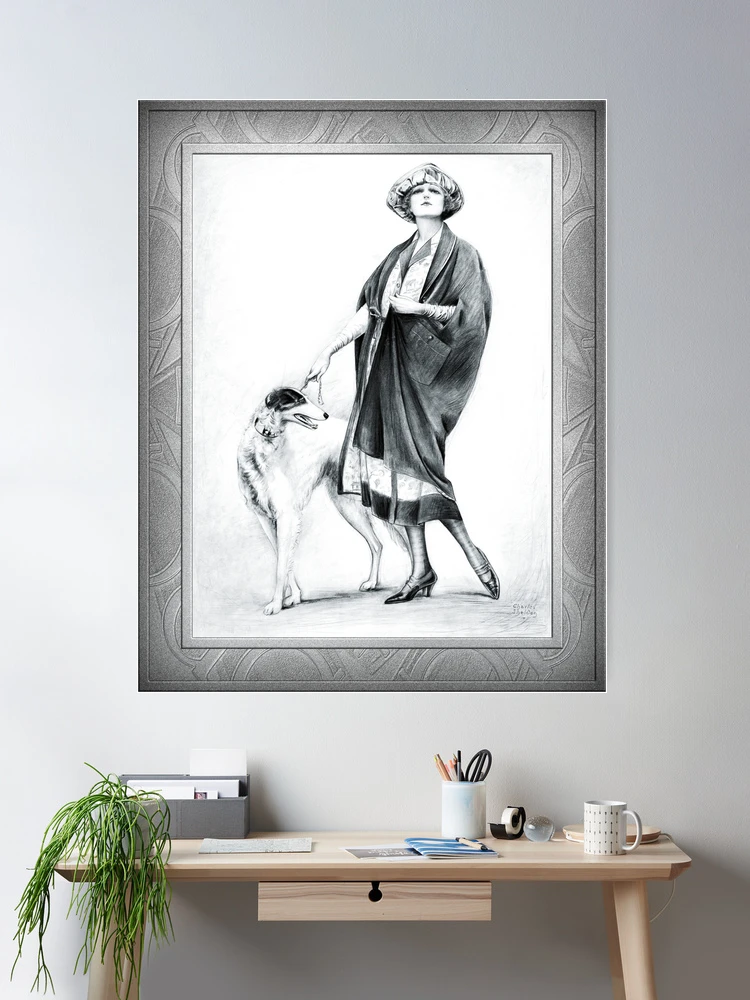
It keunstwurk mei de titel Damsel and Her Saluki was created by Charles Gates Sheldon (1889 – 1961) yn 1920, a renowned American painter celebrated for his portrayals of women and animals. BSheldon became recognized for his skill in capturing the elegance and beauty of the human figure, particularly through portraits.
Damsel and Her Saluki exemplifies his mastery of delicate lines and the refinement of both his subjects and surroundings. De art nouveau scene showcases a poised, aristocratic woman alongside her saluki, a breed known for its grace and agility. Sheldon imbues this piece with a sense of both tranquility and a subtle power, creating an image that communicates the elegance of the early 20th century.
Ynhâldsopjefte
It haadûnderwerp: The Damsel
Yn it sintrum fan de komposysje stiet de juffer, in frou klaaid yn ferfine klean dy't de hege maatskiplike moade fan 'e 1920's reflektearret. Se wurdt posearre mei in lucht fan selsfersekering, har postuer rjochtop en sierlik. De jurk fan de frou, mei syn streamende linen en lúkse stof, ropt in gefoel fan ferfining op. Se draacht in oanpaste jurk, mei in sêfte kraach dy't har elegant om 'e nekke leit. De jurk streamt soepel nei de flier, mei subtile plooien dy't beweging suggerearje. Om har taille is in brede riem te sjen, it tafoegjen fan struktuer oan 'e oars sêfte stof fan har jurk. Her clothing also seems to convey a sense of quiet dignity, with the dark tones of her attire emphasizing her calm presence.
Har gesicht, though delicately drawn, is the focal point of the portrait. With soft features and a serene expression, she gazes slightly to the side, conveying a sense of inward reflection. Har hier is styled yn in elegante updo, a fashionable choice for women of the period. The carefully placed curls and waves frame her face, adding to her sense of grace and refinement. The soft shading around her features enhances her ethereal presence, and her expression gives off a sense of quiet nobility. The positioning of her hands, gracefully placed along her side, contributes to the formal tone of the portrait.
De Saluki: In Nobele Begelieder
Standing beside the damsel is her saluki, a symbol of nobility and elegance in itself. The breed is often associated with royalty, benammen yn it Midden-Easten, en Sheldon syn werjefte fan it bist beklammet syn genede en poise. De hûn wurdt werjûn yn profyl, mei syn lichem langwerpich en posityf posysje. De bont is yn fyn ôfbylde, detaillearre strokes, it jaan fan de yndruk fan slankens en sêftens.
It gesicht fan 'e saluki is foarnaam, mei in hast minsklike útdrukking dy't yntelliginsje en bewustwêzen suggerearret. De sêfte eagen fan 'e hûn lykje dy fan 'e frou te spegeljen, suggerearret in djippe bân tusken de twa. Syn kraach, ienfâldich noch elegant, tsjinnet as in subtile yndikaasje fan syn status as begelieder foar ien fan hege sosjale rang.
It terrein: In yntym ynterieur
De setting fan it keunstwurk is yntym, mei in ûnbepaalde ynterieurromte dy't tsjinnet as in stille eftergrûn. De eftergrûn is relatyf lyts yn detail, wêrtroch de fokus bliuwt op 'e figueren fan' e famke en har saluki. It ûntbrekken fan útwurke dekor soarget foar in gefoel fan isolemint, as is de sjogger in privee ynfierd, serene romte.
De sêfte skaad op 'e eftergrûn kontrast mei de detaillearre werjefte fan' e ûnderwerpen, it ferbetterjen fan har oanwêzigens en it tekenjen fan oandacht foar har adel. Der binne gjin ôfliedingen yn it miljeu; ynstee, de minimalistyske omjouwing komplementearje de elegânsje fan 'e figueren sels.
Materiaal en technyk
It stik wurdt útfierd mei útsûnderlik omtinken foar detail, benammen yn it werjaan fan tekstueren lykas de stof fan 'e froulike jurk en de boete, seide bont fan 'e saluki. It medium liket grafyt of potlead te wêzen, in medium Sheldon wie bekend om te wurkjen mei, wêrtroch delikate gradaasjes fan ljocht en skaad mooglik binne. The use of fine lines and careful shading in the woman’s attire contrasts beautifully with the smoother, softer textures of the dog’s fur.
This contrast not only highlights the physical differences between the two subjects but also serves to enhance the overall composition. The monochromatic color palette, consisting solely of varying shades of gray, emphasizes the timeless quality of the image, further underscoring its sense of elegance and refinement.
Styl, Tema, en Mood
De styl fan Damsel and Her Saluki is rooted in the early 20th-century academic tradition, characterized by fine detailing and the use of classical techniques. The composition is orderly, with both the woman and her dog placed in balanced positions. This balance reflects a harmonious relationship between the two figures, reinforcing the theme of companionship and elegance.
The overall mood of the piece is one of quiet sophistication. The woman and her saluki are presented as a pair, symbolizing a shared sense of nobility and grace. The lack of overt emotion in their expressions gives the piece a contemplative tone, as though both the woman and her dog are lost in quiet thought. The subdued atmosphere, with its focus on the figures’ poise, exudes a feeling of timelessness, as if capturing a moment frozen in history.
Dit is in remastered digitale keunst âlde masters reproduksje fan in byld yn it iepenbier domein dat is beskikber as in canvas print online.
Artist Bio-ynformaasje ôflaat fan
Fineartphotographyvideoart.com
Charles was born in Worcester, Massachusetts USA, but spent most of his life in Springfield, Massachusetts.
He began his artistic studies at the Arts Students League located in New York City at 215 West 57th Street, dat waard oprjochte yn 1875 and originally housed in rented rooms at 16th street and 5th Avenue.
Charles created artwork in the Art Nouveau, Edwardian (which overlap, but with the Edwardian style being much simpler in design) as well as Art Deco styles and when he finished his studies at the Arts Students League, he traveled to Paris France to study under the Czech Painter Alphonse Mucha (Alfons Maria Mucha 1860 – 1939).
On his return to the United States, he began producing fashion illustrations for the Ladies Home Journal Publication; and would produce advertising art for clients such as the Fox Shoe Company, Gainsborough, Fiberloid Hair Brushes, Grown & Bigelow and La Vogue Lingerie in which he received his first commission in 1918 for a pinup illustration.
He would also go on to produces covers for Collier’s Magazine, The Saturday Evening Post, Woman’s Home Companion, Theater Magazine and Photoplay from 1925 – 1930; which launched his career as a portrait cover artist.
This recognition led to him receiving commissions from famous women from all over the world, who sat for him at his studio in Carnegie Hall; located in New York City, USA.
This resulted in many of the Hollywood starlets of the time posing for him such as Mae West, Greta Garbo, Mary Pickford, Jean Harlow, Clara Bow, Shirley Temple and many, many others of the Hollywood Golden Age Era.