

Het Jongste Broertje (The Youngest Brother)
“Het Jongste Broertje” (The Youngest Brother), painted in 1854 by the German artist Johann Georg Meyer (1813 – 1886), captures a tender and intimate moment in a domestic setting, exemplifying the genre of sentimental realism that was prevalent in mid-19th century Europe. The painting portrays three children, their expressions imbued with innocence and affection, set against a soft, atmospheric backdrop that enhances the emotional weight of the scene. This quiet and serene composition highlights Meyer’s attention to the subtleties of childhood emotions and familial love, rendered with a softness and warmth that invite the viewer to reflect on themes of family, care, and fragility.
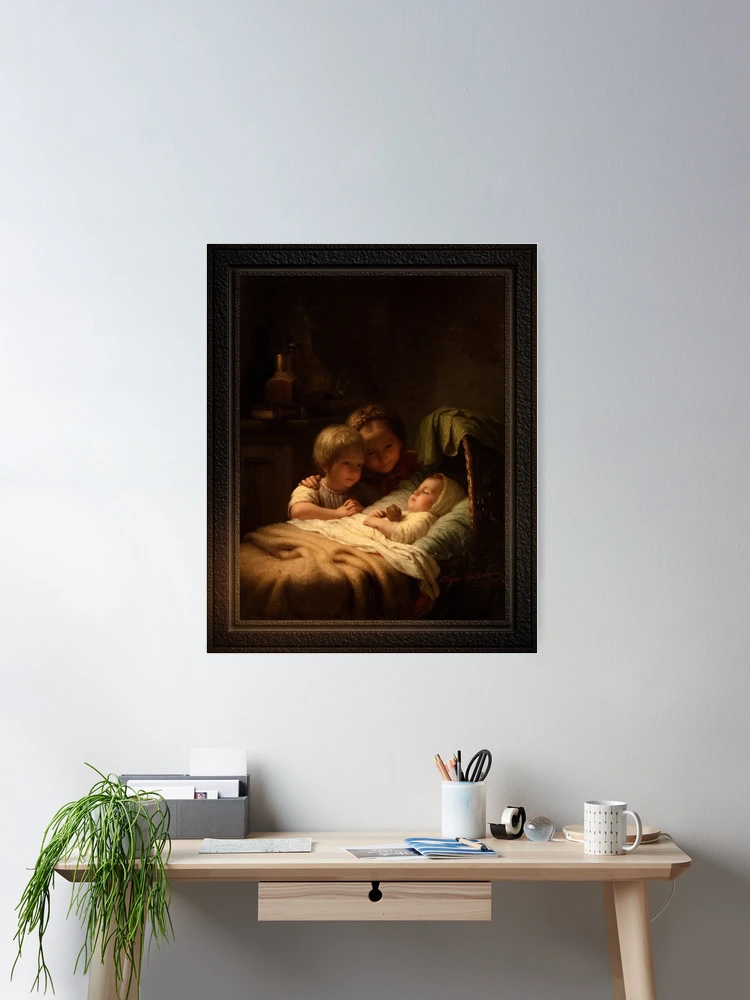
Table of Contents
Composition and Figures
In the center of the composition lies the youngest child, swaddled in a light white blanket, sleeping peacefully in a cradle. The soft, rounded features of the child, bathed in a gentle light, evoke a sense of tranquility and innocence. The sleeping infant, likely the subject of the painting’s title, is positioned as the focal point, symbolizing vulnerability and tenderness. Their eyes are closed, and their face is serene, creating a peaceful mood that contrasts with the more dynamic expressions of the surrounding children. The child’s tiny hand is curled around a small object, possibly a toy or comfort item, further enhancing the sense of peacefulness and contentment.
Flanking the cradle are two older siblings, their expressions filled with an affectionate interest and concern for the baby. The boy on the left, with his tousled blonde hair and wide eyes, gazes at the infant with a sense of deep love, while his hand rests on the edge of the cradle, gently touching the child. His posture is tender, suggestive of his role as a protective older sibling.
The girl on the right, with dark hair neatly styled in braids, leans forward with an expression of quiet joy, her lips slightly parted as though caught in a moment of reverence for the infant. The play of light and shadow on their faces suggests a shared emotional experience, one marked by familial devotion and a deep bond between the children.
Background and Atmosphere
The background of the painting is dark and indistinct, rendered with subtle brushstrokes that suggest a cozy, dimly lit room, likely part of a modest home. There are a few elements that offer hints about the interior, such as the faint outlines of a wooden cabinet or shelves, and an assortment of domestic objects, which create a sense of familiarity and comfort.
The background does not distract from the figures in the foreground, instead serving to amplify the emotional intimacy of the scene. The painter has skillfully used muted tones of brown, gold, and cream to craft an atmosphere that is both warm and quiet, invoking feelings of calm and security. The soft blending of light and shadow enhances the peacefulness of the moment, allowing the figures to emerge gently from the darkness.
Color Palette and Technique
Meyer’s use of color is restrained yet evocative. The palette of browns, soft greens, creams, and muted yellows imbues the scene with a warm, almost golden hue, reflecting the calm and comforting nature of the subject matter. The light source seems to come from the left, casting a soft glow on the children’s faces and bodies while leaving parts of the room in shadow. This play of light and shadow emphasizes the forms and textures of the figures, particularly the softness of the children’s clothing and the delicate texture of the blankets. The choice of colors suggests a deep emotional warmth, heightening the viewer’s emotional connection to the scene.
The painting’s technique is notable for its fine detail and subtle realism. Meyer uses a soft, almost velvety brushwork to depict the textures of the children’s faces, their clothing, and the folds of the bedding, creating a smooth and tender finish. The artist has a masterful command of light, using it not just to illuminate the figures but to enhance the emotional tone of the painting. The light seems to symbolically embrace the children, highlighting their faces and bodies in a manner that suggests care, protection, and love.
Mood and Theme
The mood of “Het Jongste Broertje” is one of quiet reverence and emotional tenderness. The closeness of the siblings to the sleeping infant evokes a sense of familial love and protection, as well as a deep connection to the simple joys of childhood. There is a timeless quality to the scene, as though the act of watching over a younger sibling is a universal experience, one that transcends time and culture. The peaceful expressions of the children, coupled with the calm environment, convey a mood of safety and harmony, inviting the viewer to reflect on the precious nature of childhood and the bonds that tie families together.
The theme of childhood innocence is central to the painting, with the depiction of the infant’s peaceful sleep standing as a metaphor for the purity and vulnerability of early life. The two older children’s attentive gazes and their protective postures reinforce the idea of familial responsibility and love. Meyer’s careful rendering of the figures and their emotional expressions underscores the theme of care, making this work not only a representation of childhood but also an exploration of the intimate emotional connections between siblings.
Conclusion
“Het Jongste Broertje” stands as an exemplary work of 19th-century sentimental realism, capturing a deeply emotional moment within a domestic setting. Johann Georg Meyer’s painting transcends mere depiction, offering a narrative that speaks to the universal experiences of childhood and family. Through his masterful use of light, color, and brushwork, Meyer evokes a sense of warmth and tenderness that resonates with viewers even today. The soft, peaceful scene reflects a bygone era when the bonds of family were cherished and protected, and childhood innocence was considered sacred.
The Youngest Brother is a retouched digital old masters reproduction of a public domain art masterpiece image.
This digital art creation, as with all the artwork that can be found on the Xzendor7 website is available for purchase online in a variety of material formats including canvas prints, acrylic prints, metal prints, wood prints, framed prints, posters, and as rolled canvas prints in a variety of sizes from 12 inches to 72 inches depending on the size of the actual artwork and the print on demand shop you choose to buy the art from.
The artwork is also available on a broad range of men’s and women’s apparel, mugs, totes, scarfs, notebooks and journals and many home decor products.
About The Artist
Information Below Derived From Wikipedia.org
Johann Meyer began his artistic studies in 1834 at the age of 21, when he went to Düsseldorf and entered the Academy of Art, which was run by German Romantic Painter Friedrich Wilhelm Schadow (1789 – 1862), who was the son of German-Prussian sculptor Johann Gottfried Schadow (1764 – 1850).
Seven years later in 1841 Meyer his own studio in Düsseldorf, but later moved to Berlin in 1853 as his popularity and famed increased.
Though Meyer’s early interest was in creating scenes from the Bible; later on in his career he turned his attention to creating genre scenes of every day life , with a focus on Hessian peasantry, and then on the portrayal of the pathetic aspect of family life.
Such pictures as ‘The Jubilee of a Hessian Pastor’ c1843, ‘Christmas Eve,’ ‘Blindman’s Buff,’ ‘The Soldier’s Return,’ ‘The Inundation’ c1846, ‘The Repentant Daughter’ c1852, are full of intense sympathy with the “simple annals of the poor.”
He also painted other scene that took inspiration from childhood life, which included ‘The Little Flower Girl c1853’, ‘The Fairy Tale,’ ‘Children Playing Blindman’s Buff,’ ‘Grandfather and Grandchild,’ and others.
While later in his career also did paintings of yougn women, either in single or group poses; and these included ‘The Tryst’, ‘The Love Letter’ and ‘The Letter’ c1873.