

Christ in the Storm on the Sea of Galilee
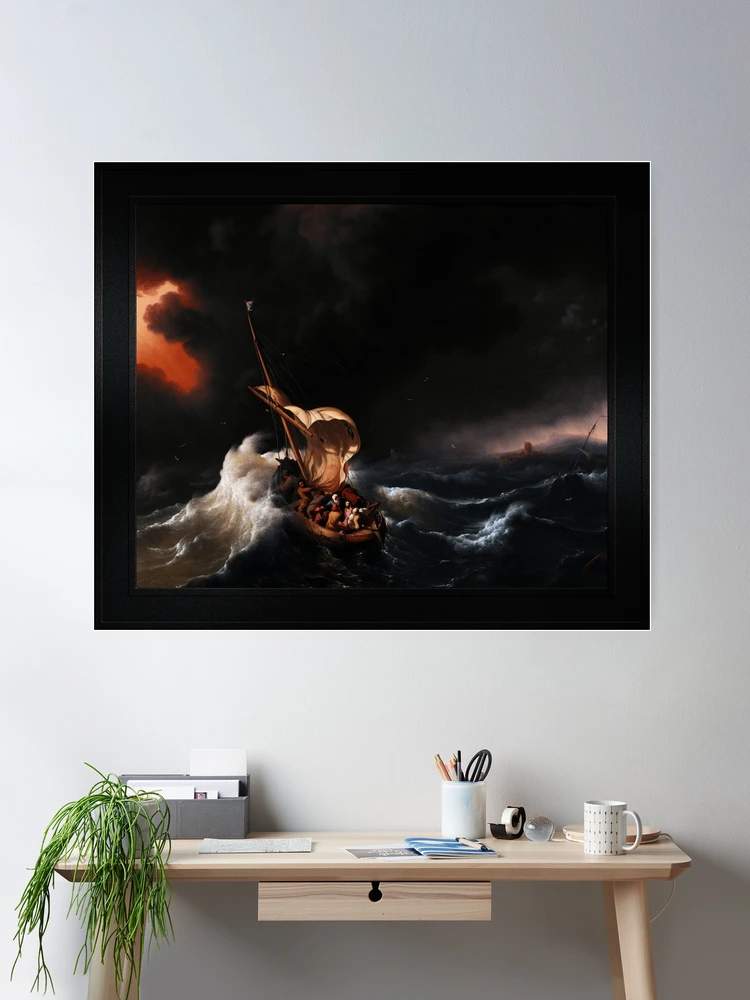
Das Kunstwerk mit dem Titel “Christ in the Storm on the Sea of Galilee”, erstellt in 1695 by the German-Dutch painter Ludolf Backhuysen (1630 – 1708), powerfully conveys a dramatic moment of biblical history. Backhuysen, known for his skillful mastery of maritime landscapes, utilizes his expertise to depict both the ferocity of nature and the calm authority of Christ amidst a violent storm. This painting is part of a broader tradition of maritime paintings during the Dutch Golden Age, with a specific focus on the themes of human struggle against nature, göttliches Eingreifen, and the Christian narrative.
Inhaltsverzeichnis
Hauptthema und Erzählung
The primary subject of the painting is the biblical story from the Gospel of Matthew, wo Jesus Christus den Sturm auf dem See Genezareth beruhigt. Backhuysen konzentriert sich auf den intensiven Moment des Chaos an Bord des Bootes, Er fängt die Panik der Jünger und das ruhige Verhalten Christi ein. Im Vordergrund, Der Betrachter sieht eine Gruppe von Männern, wahrscheinliche Schüler, Sie kämpfen gegen Wind und Wellen. Ihre Gesichtsausdrücke verraten Angst und Verzweiflung, während der Sturm um sie herum tobt. Das turbulente Meer, dunkle Wolken, und unerbittliche Wellen verstärken das Gefühl der Gefahr, das das Boot umgibt.
Inmitten des Aufruhrs, Christus bleibt ruhig und gelassen, die zentrale Figur der Komposition. Seine Anwesenheit ist sowohl beruhigend als auch gebieterisch, symbolisiert die göttliche Autorität über die Natur und den menschlichen Zustand. The artist uses the contrast between the violent sea and the peaceful figure of Christ to underscore the miraculous nature of the event. Christ’s stillness contrasts with the frenetic energy of the storm, making His divine role clear.
Objekte und Symbolik
The boat itself is a critical object in this piece, representing both the literal vessel in the biblical story and the symbolic “ship” of the Christian church navigating through the turbulent waters of the world. The ship is crafted with great detail, and the artist’s ability to render the movement of the water around it adds a sense of realism. The storm is not just a natural occurrence, but also a visual metaphor for the trials and tribulations of life, which are often beyond human control.
The figures in the boat are also symbolic. The disciples, dargestellt in verschiedenen Stadien der Panik und des Kampfes, spiegeln die menschliche Reaktion auf überwältigende Herausforderungen wider. Eine Figur beugt sich über den Bootsrand, möglicherweise kotzen, während ein anderer den Mast umklammert, sein Gesicht verzog sich vor Angst. Diesen Ausdrucksformen menschlicher Verletzlichkeit steht die Ruhe Christi gegenüber, suggeriert Glauben und den Glauben, dass göttliches Eingreifen Erlösung bringen wird.
zusätzlich, die Elemente des Sturms – tosende Wellen, dunkle Wolken, und Blitze – tragen zur Intensität der Szene bei. Der dunkle Himmel, mit seiner dramatischen Beleuchtung, repräsentiert die chaotischen Kräfte der Natur und, metaphorisch, die Prüfungen des Lebens. Doch das Licht, das durch die Wolken bricht, deutet auf Hoffnung und die göttliche Präsenz hin, die Frieden und Führung verspricht.
Gelände und Materialien
Die Szene spielt sich auf den turbulenten Gewässern des See Genezareth ab, welche, in Backhuysen’s portrayal, are dark, foamy, and churning. The waves are masterfully painted, showing a range of textures from the frothy white caps to the deep, threatening blue and green depths. The artist’s command of light is particularly notable in the way it reflects off the surface of the water and highlights the contours of the figures, lending a sense of realism to the otherwise supernatural scene.
Der Himmel, a striking backdrop to the action, is filled with ominous dark clouds, their heavy masses suggesting the sheer power and chaos of the storm. The dramatic interplay of light and dark contributes to the overall mood of the painting, amplifying the tension in the narrative. A small area of light appears through a break in the clouds, potentially indicating the divine presence, adding an aura of hope amidst the turmoil.
Stil, Thema, und Stimmung
Ludolf Backhuysen’s style is one of the defining characteristics of the Dutch Golden Age. Known for his ability to capture the mood and texture of the sea, Backhuysen demonstrates an extraordinary talent for conveying motion and emotion. The turbulence of the water, the billowing sails, and the energy of the storm all exhibit a mastery of the seascape genre.
The theme of the painting merges the natural with the divine, showing human struggle against the overpowering forces of nature, only to be saved through divine intervention. The mood is one of awe and reverence, evoking a sense of the sublime in the viewer. The dynamic clash between the forces of the storm and the calm figure of Christ is a powerful visual metaphor for faith, trust, and divine power.
Die Farbpalette, while dominated by darker hues of stormy skies and deep ocean blues, also contains areas of lighter tones that reflect the divine light shining through the chaos. The contrast between light and dark creates a dramatic tension in the composition, emphasizing the miracle at the heart of the scene.
In terms of technique, Backhuysen uses fine brushwork to create a vivid depiction of the storm, with each wave and cloud rendered in intricate detail. The fluidity of the water and the dramatic effects of the sky demonstrate Backhuysen’s technical prowess and his ability to transport the viewer into the heart of the storm.
Abschluss
“Christ in the Storm on the Sea of Galilee” by Ludolf Backhuysen stands as a testament to both the artistic skill of the artist and the theological depth of the subject matter. The painting is a dramatic visualization of the biblical narrative, combining natural and divine elements in a way that speaks to the viewer on both an emotional and spiritual level. The intensity of the storm, the vulnerability of the disciples, and the calm authority of Christ all combine to create a powerful visual experience, offering a meditation on faith, divine protection, and human endurance.
A Back Story Of The Artwork
This appears to be a work that was copied from Rembrandt van Rijn (1606 – 1669) piece, “Das Storm on the Sea of Galilee c1633″.
While the original version created by Rembrandt is up close with the entire focus being on the boat with Jesus and his 12 disciples in the boat with him; this version takes a much wider view.
This version shows Jesus in the sailboat with an additional 8 Männer, as it is slammed on its side by a large wave; and off to the right of the scene we see a part of a mast sticking out of the water and farther back another sailboat caught in the sea storm.
In the distance we can see two structures several miles apart on the shore, some mountains behind one of the structures as well as large dark storm clouds with a small clearing in the clouds that is orange in color due to the sun; while the boat is being illuminated by a bright white light.
Christ in the Storm on the Sea of Galilee is a remastered digital art old masters reproduction of a public domain image that is available as a Leinwanddruck online.
Diese digitale Kunstschöpfung, Wie alle Kunstwerke, die auf der Xzendor7-Website zu finden sind, können sie online in einer Vielzahl von Materialformaten einschließlich Leinwanddrucken erworben werden, Acryldrucke, Metalldrucke, Holzdrucke, gerahmte Drucke, Plakate, und als gerollte Leinwanddrucke in verschiedenen Größen von 12 Zoll zu 72 Zoll, abhängig von der Größe des tatsächlichen Kunstwerks und dem Print-on-Demand-Shop, in dem Sie das Kunstwerk kaufen möchten.
Das Kunstwerk ist auch auf einer breiten Palette von Herren- und Damenbekleidung erhältlich, Tassen, Tragetaschen, Schals, Notizbücher und Tagebücher sowie viele Heimdekorationsprodukte.
Biografie des Künstlers
Informationen unten abgeleitet von Wikipedia.org
Ludolf was born in Emden, Ostfriesland, a lower region in Lower Saxony Germany in 1630 und ungefähr im Alter von 20 went to Amsterdam, Netherlands and gained employment as a Calligrapher and Merchant’s Clerk.
In dieser Zeit entdeckte er sein großes Talent für die Malerei, und widmete so seine Zeit diesem Unterfangen, seinen derzeitigen Arbeitsplatz verlassen; Zunächst fertigte er Federzeichnungen an und studierte auch bei dem bedeutenden niederländischen Maler des Goldenen Zeitalters, Allaert van Everdingen (1621 – 1675), ein Maler, Grafiker und Radierer sowie Hendrick Dubbels (1621 – 1707), ein Meeres- und Winterlandschaftsmaler.
Als Naturforscher fuhr Ludolf oft in einem offenen Boot aufs Meer hinaus, um die Beschaffenheit der Wellen bei Sturmereignissen zu studieren; da sein Hauptaugenmerk auf der Meereskunst lag, mit einem Schwerpunkt auf Szenen mit stürmischen Meereswellen.